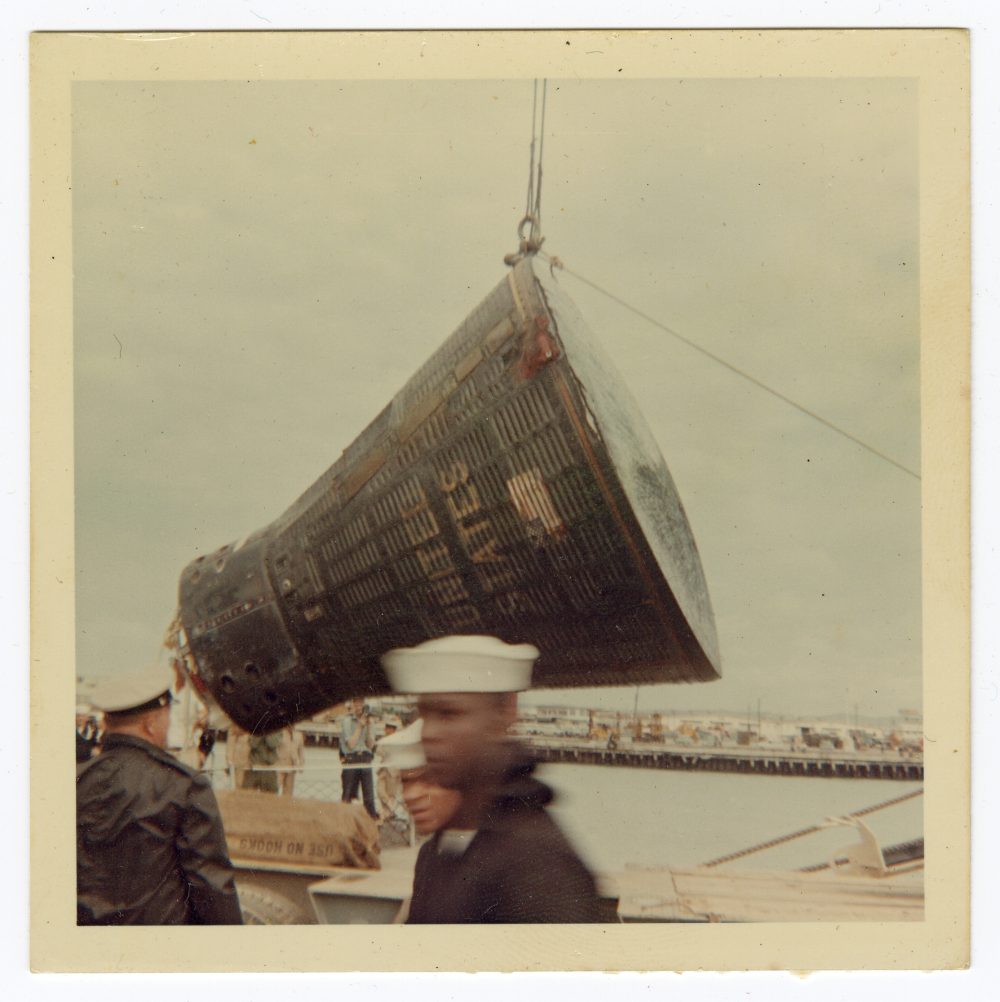

Six decades after Neil Armstrong’s brush with death during the Gemini 8 space mission, rare photographs documenting his dramatic return to Earth have surfaced at an Ohio museum dedicated to the legendary astronaut.
Armstrong and his crewmate David Scott were forced to cut their mission short following a life-threatening crisis that required an emergency landing in waters near Okinawa, Japan.
The remarkable images were captured by Ron McQueeney, a military veteran and skilled photographer who accompanied the astronauts during their recovery. His widow recently donated these historic photographs to the Armstrong Air and Space Museum.
Because the emergency landing was unexpected, very few reporters were present to document the event, though NASA and military photographers were on hand. Personnel like McQueeney, who were suddenly called in to assist with rescue efforts, became crucial witnesses to this dramatic chapter in space history.
“Sometimes, an incredible event can actually be documented by some of the most ordinary means,” said Dante Centuori, executive director of the Armstrong Air and Space Museum in Wapakoneta, Armstrong’s western Ohio hometown.
The donated photographs reveal Armstrong and Scott standing on a Navy ship’s deck and greeting military personnel on shore. Another striking image captures the Gemini 8 capsule being hoisted skyward for transportation.
The mission had aimed to achieve the first successful spacecraft docking in orbit. However, just moments after this historic accomplishment, both vehicles began spinning wildly out of control. The crew disconnected from the target spacecraft, but their dangerous rotation only intensified.
Armstrong took decisive action, firing the spacecraft’s control thrusters to halt the deadly spin. This maneuver consumed precious fuel reserves needed for their safe return, forcing mission controllers to abort the flight for safety reasons.
The astronauts touched down in the Pacific Ocean roughly 10 hours after their March 16, 1966 departure. A rescue vessel retrieved them and transported them to Naha Air Base in Japan.
Centuori noted that what stands out most in the photographs are the broad smiles on both astronauts’ faces, demonstrating their composure and professionalism even after surviving such a dangerous ordeal.
Space historian Robert Poole offered a different interpretation of their expressions.
“The obvious thing that sticks out to me is that they are very happy to be alive,” said Poole, of the University of Lancashire.
According to Poole, Armstrong’s calm response during this crisis became a deciding factor in his selection as commander for the historic Apollo 11 moon landing mission.
With NASA preparing for its upcoming Artemis lunar mission scheduled for April, these vintage images serve as a powerful reminder of space exploration’s inherent risks and challenges.
Current space travel frequency might make missions appear routine, but the reality remains far different.
“Seeing people launch to space frequently can suggest that it’s easy, but it’s very hard. And it requires a lot of resources and attention,” said Emily Margolis, a curator at the National Air and Space Museum.
The museum plans to use these newly acquired photographs to enhance their Gemini 8 exhibit, which already features the actual spacecraft capsule that carried Armstrong and Scott through their perilous journey.