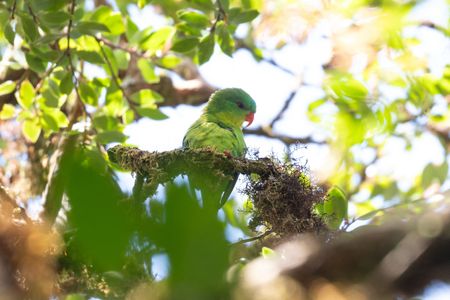

A rare parrot species that had virtually vanished for nearly 100 years has been found alive and thriving in the remote mountains of Indonesia, according to researchers who made the remarkable discovery in April.
The Blue-fronted Lorikeet, which exists only on the island of Buru, had been documented just once since the 1920s – through a single photograph taken in 2014. An expedition team organized by an Indonesian mountaineering group successfully located and photographed multiple birds after enduring days of treacherous climbing through razor-sharp limestone formations and challenging mountain conditions.
The discovery marks the first time scientists have recorded the bird’s distinctive high-pitched vocalizations, which the species uses for communication within the forest canopy. Researchers identified the small parrot by its vibrant green plumage, orange beak, blue rear crown, and sharp tail feathers.
“When you are looking for a bird that has only been documented once in the past century it feels like a long shot,” said John Mittermeier, director of the Search for Lost Birds at the American Bird Conservancy conservation group.
Scientists originally catalogued the Blue-fronted Lorikeet from seven specimens gathered during the 1920s. The species then disappeared from scientific records for nearly nine decades, despite extensive searches through lower elevation and mid-level forest areas, until the 2014 photographic evidence emerged.
Researchers had long theorized that the parrots might be surviving in higher mountain elevations that had been too dangerous to access. The highland region where the team finally located the birds had remained virtually unreachable until local climbers recently established a pathway into the mountainous area.
According to Mittermeier, the terrain presents extreme challenges including steep limestone cliffs, jagged rock formations, and complete absence of water sources, making exploration extremely difficult.
“There are no other birds on the island that look like the lorikeets, so when we saw them we knew immediately what they were,” Mittermeier said.
“We saw at least nine during the trip,” Mittermeier added.
James Eaton, a birder who participated in the expedition, described the harsh conditions including constant rainfall, sharp limestone surfaces, rushing river currents, and complete lack of established trails. He said reaching the mountain peak required “a strong – or crazy – reason to even attempt it.”
“This bird was our reason for doing so,” Eaton said.
Following an exhausting week of climbing, “to actually photograph our holy grail suddenly made all the hardships disappear – it’s a feeling adrenaline junkies would know well,” Eaton said.
The successful sighting represented the culmination of years of planning and preparation for Eaton.
“It makes all the researching, reading, plotting – some of which are years in the making, totally justified – it makes you feel alive, a justification for your dedication,” Eaton said.
The IUCN Red List had classified the Blue-fronted Lorikeet as Data Deficient, and the Search for Lost Birds partnership between American Bird Conservancy, Re:wild and BirdLife International officially designated it as a lost species in 2024.
Mittermeier emphasized that additional research is essential to determine the bird’s total population and identify potential dangers to its survival.
“A finding like this … is the first step to being able to protect it,” Mittermeier said.
For Eaton, rediscovering the species served as a powerful reminder of the natural wonders that remain hidden from human observation.
Despite constant negative headlines, Eaton said, “these moments of joy and discovery are a healthy reminder of what a beautiful world is there.”
“This small green parrot,” Eaton said, “it was here long before humans stepped foot on the island, just like birds living in your garden at home – they have more right to be there than you or I.”