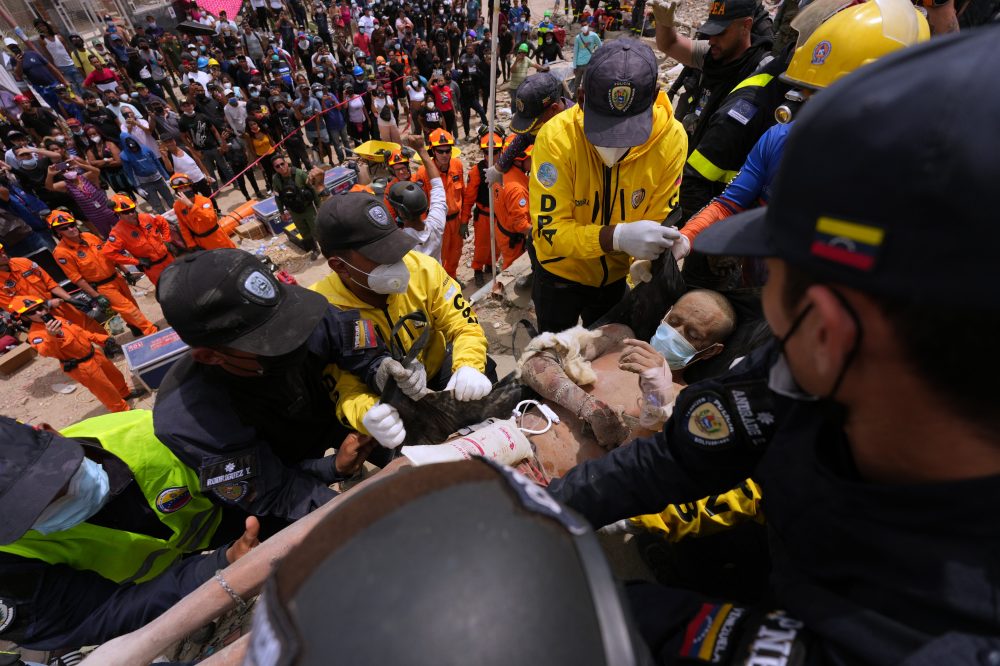

LA GUAIRA, Venezuela — Rescue workers from Venezuela and around the globe are growing increasingly desperate in their search for survivors four days after two powerful earthquakes devastated the northern state of La Guaira.
Venezuelan authorities reported a death toll exceeding 1,400 as of Saturday, even as the government faced mounting criticism that its response has been insufficient. Much of the search effort has been driven by ordinary citizens looking for missing loved ones beneath the ruins of collapsed buildings. Online databases set up for families to report and track missing persons indicate thousands of people are still unaccounted for.
Acting President Delcy Rodriguez announced Sunday that 33 people had been pulled from the wreckage the previous day, though she stopped short of releasing a new total death count.
A rescue team from Virginia in the United States successfully freed a man and his son from the debris Sunday morning. The two survivors, coated in dust, were carefully transported on a black tarp into a waiting ambulance, where they received fluids through an IV as a large crowd looked on.
Aid organizations generally regard the first 48 to 72 hours following a natural disaster as the most critical window for finding people alive — though that timeframe can stretch longer if survivors have had access to food and water. The United Nations reported that more than 2,200 rescue workers from countries around the world had arrived by Saturday, with additional teams still coming in.
As expressions of solidarity poured in from across the globe, Pope Leo offered prayers for “the eternal rest of the deceased.” He added, “Likewise, I express my gratitude and encouragement to all those who are generously working in the search and rescue efforts.”
Rodriguez stated on state television Saturday that more than 14,000 military and police personnel are now patrolling La Guaira state, which has been closed to the public — requiring special permits to enter. Despite this, many residents in the disaster zones reported seeing little presence from their government.
The catastrophe presents an enormous challenge for Rodriguez, the former vice president who assumed office in January following the capture and removal of then-President Nicolás Maduro by the United States. Venezuela has been mired in economic turmoil for over a decade, and significant portions of the population do not recognize the legitimacy of the political movement Rodriguez leads.
Scenes of anguish played out across the disaster zone. Some people climbed the ruins of buildings and called out names, hoping to hear a response. A thick layer of dust blanketed coastal communities, and as temperatures soared, more people began wearing masks as the smell of decomposition spread through the air. Elsewhere in La Guaira, workers loaded stacks of bodies — some in white bags, others without covering — onto white trucks from a dirt hospital parking lot, where they were being identified.
Lacking proper safety equipment, both civilian volunteers and rescue workers resorted to wearing motorcycle helmets while picking through debris.
Frustration with the government’s handling of the disaster boiled over in some areas. After state workers were seen taking selfies in front of flattened buildings before leaving without assisting, some angry residents physically blocked an excavator from departing a collapse site and removed the operator from the cab. Officials from the ruling party are known to frequently photograph themselves at government-related events.
The International Organization for Migration estimated that more than 6 million people could ultimately be affected by the disaster, including roughly 2 million in the capital, Caracas.
Experts noted that the damage was worsened by the rapid sequence of shallow quakes. Smaller aftershocks have continued to rattle Caracas and surrounding areas in the days since, including one registering 4.8 on Saturday.
Search and rescue teams and humanitarian aid have been arriving from Mexico, the United States, Brazil, El Salvador, France, and other nations.
On Saturday, Mexican rescue teams scaled collapsed structures and pressed into gaps in the crushed concrete, listening for any signs of life. “We’re rescuers from the Mexican military, if there’s anyone down there still alive, make noise or scream. Now!” one team member shouted into the rubble.
For survivors like Yonahí Regalado, the arrival of international teams offered a measure of hope. She had been calling out the names of her sister and 1-year-old nephew and godson since 1 a.m. the morning after the earthquakes — continuing until foreign aid workers began showing up. “It doesn’t matter who it is, whoever, whether it’s family or somebody else. If there is anyone alive, let’s get them out,” she said, as helicopters circled above.
Moments of compassion emerged amid the devastation. One video captured a Venezuelan rescuer reassuring a frightened elderly woman trapped under rubble who feared moving would cause the structure to collapse on her. “The roof won’t cave in. If it falls, I’ll be here with you,” he told her.
Simón Bolívar International Airport, which serves Caracas, sustained significant damage. Jeremy Lewin, a senior State Department official overseeing foreign assistance, told reporters that one runway is now operational as U.S. teams work to restore the airport’s full capacity. Lewin also said a U.S. Navy transport vessel is stationed off the coast and ready to receive airlifted survivors requiring medical care, calling the ongoing effort “a race against the clock.”