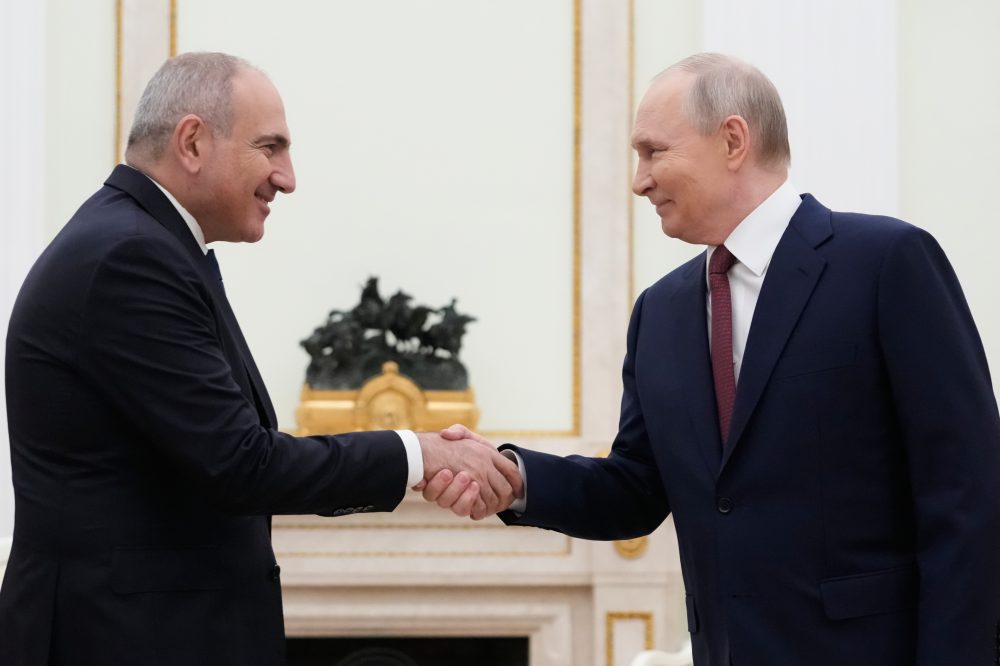

MOSCOW — During high-level discussions in the Russian capital Wednesday, President Vladimir Putin delivered a clear ultimatum to Armenia regarding its future economic partnerships, stating the nation cannot simultaneously participate in European Union membership and Moscow’s economic alliance.
Armenia has been actively pursuing stronger relationships with both the United States and European Union since signing a peace agreement with Azerbaijan last year that ended long-standing conflicts. Armenian leader Nikol Pashinyan has publicly announced his country’s intention to seek EU membership and has halted Armenia’s involvement in Russia’s military alliance known as the Collective Security Treaty Organization.
During the opening of discussions with Pashinyan in Moscow, Putin expressed that Russia remains “absolutely calm” regarding Armenia’s European outreach efforts, though he emphasized that “it’s impossible to be in a customs union with the EU and the Eurasian Economic Union.”
The Eurasian Economic Union, established in 2015 with Armenia, Belarus, Kazakhstan and Kyrgyzstan as members alongside Russia, operates as a unified marketplace enabling unrestricted movement of products, investment capital and workers.
Putin’s remarks seemed designed as a cautionary message, particularly given that Armenia’s path to EU membership remains uncertain with no concrete discussions about potential trade agreements currently underway.
The Russian president pointed out significant differences in market regulations between the two economic systems across various product categories, suggesting alignment between them appears unlikely in the near future. While acknowledging Armenia’s right to choose its direction, Putin highlighted that his country currently provides natural gas to Armenia at substantially reduced rates compared to European market prices.
Pashinyan acknowledged the impossibility of simultaneous membership in both organizations but indicated Armenia could maintain its current Eurasian Economic Union status while expanding European cooperation. “Ties with Russia are very deep and important for us,” he stated.
The relationship between Armenia and its historical patron Russia has deteriorated significantly since Azerbaijan regained complete control of the Karabakh territory in 2023, ending decades of ethnic Armenian separatist control in the region.
Armenian leadership criticized Russian peacekeeping forces stationed in the area for failing to prevent Azerbaijan’s military campaign. Moscow, focused on its Ukrainian conflict, dismissed these criticisms and argued its troops lacked authority to intervene in the situation.
Putin contended Wednesday that Pashinyan’s 2022 decision to acknowledge Karabakh as Azerbaijani territory prevented Moscow from taking action. He referenced the American-mediated peace agreement signed last year between the two nations and a potential transportation corridor supported by President Donald Trump as creating new opportunities for regional collaboration.
Putin also expressed expectations that pro-Russian political forces would have fair access to compete in Armenia’s upcoming June parliamentary elections, noting that some of their representatives have faced detention — likely referencing Russian-Armenian businessman Samvel Karapetyan, a Pashinyan opponent arrested last year after demanding government change.
Pashinyan, who has led Armenia since 2018, responded by explaining that Armenian law prohibits Russian passport holders from participating in electoral processes.