
Hundreds of demonstrators gathered in Taiwan’s capital Saturday, calling for lawmakers to approve the complete defense budget package after parliament only authorized a portion of the requested funds.
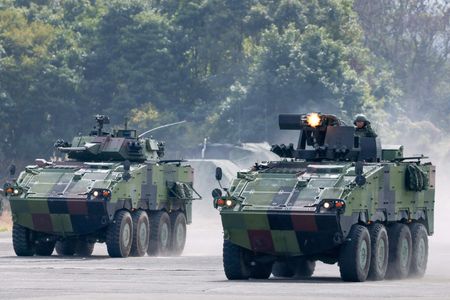
The opposition-controlled legislature approved just two-thirds of the $40 billion supplementary defense budget that President Lai Ching-te had sought. The president’s proposal included funding for American-made weapons systems as well as domestic military equipment like drones, aimed at strengthening defenses against China, which considers the island part of its territory.
Parliamentary opposition members, holding the majority of seats, passed their own modified version of the spending plan this month, authorizing funds only for American arms purchases. They argued the administration’s proposals lacked clarity and risked enabling corruption.
Multiple human rights organizations and pro-independence advocacy groups organized the demonstration in the capital, with participants displaying flags and chanting in favor of increased defense expenditures.
“True peace requires national defence. Only by strengthening our national defence can we ensure Taiwan’s freedom,” Wang Hsing-huan, chairman of the small Taiwan Statebuilding Party, which has no lawmakers in parliament, told the crowd.
Government officials are now working to secure approval for the remaining funds, including money for a new “T-Dome” integrated air defence system.
“We need to protect ourselves against China’s expansion,” said civil engineer Angela Yen, 34. “China and Taiwan are two different countries.”
Leaders from both major opposition parties maintain they support defense investments but refuse to approve “blank cheques” for military spending.
During remarks in southern Taiwan earlier Saturday, Cheng Li-wun, chairwoman of the largest opposition party the Kuomintang, stated that no one wished to see military conflict with China emerge.
Her party reported she emphasized that Taiwan possesses adequate resources but must avoid wasteful expenditures. Taiwan should invest in peace, not war, and not send the next generation to serve as soldiers and fight, added Cheng, who last month met Chinese President Xi Jinping in Beijing.
The island’s government continues to reject Beijing’s territorial claims, maintaining that only Taiwan’s citizens can determine their political future.