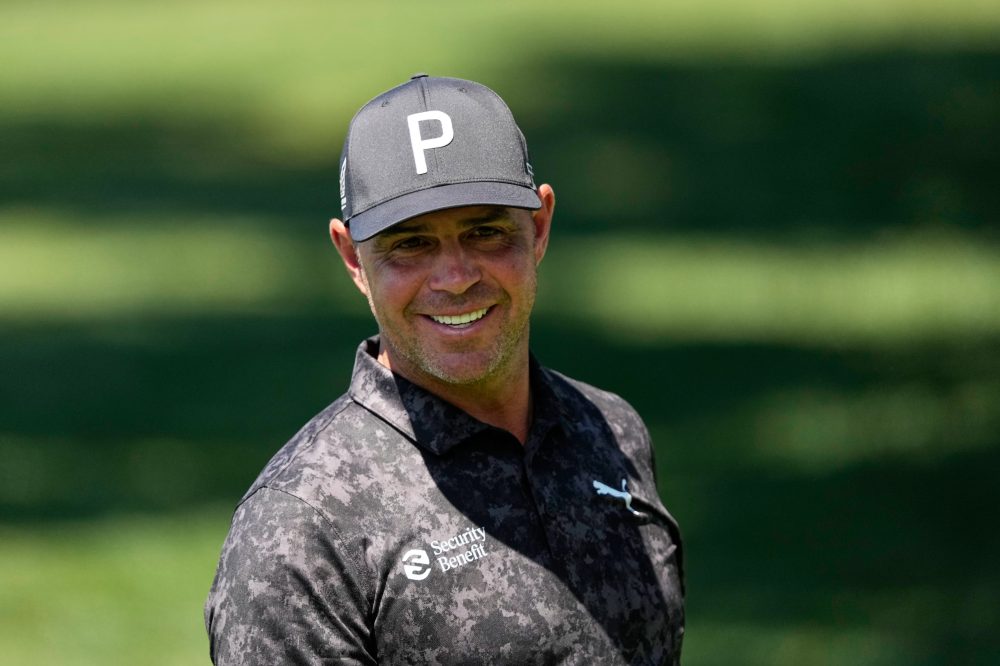

AUGUSTA, Ga. — Professional golfer Gary Woodland has courageously shared his ongoing battle with post-traumatic stress disorder, revealing how the condition affected him even during his recent tournament victory at the Houston Open.
The former U.S. Open champion disclosed Tuesday that during the final stretch of the Houston Open, which he ultimately won to earn his spot at the Masters, he experienced intense paranoia and hypervigilance.
“I battled the last 10 holes,” Woodland shared, “thinking people were trying to kill me.”
This stark revelation represents Woodland’s effort to shed light on mental health challenges, hoping his openness will encourage others facing similar struggles with trauma, anxiety, and PTSD.
Woodland’s mental health battles stem from a brain lesion discovered in 2023 that was causing irrational fears about dying. Before undergoing surgery in September 2023, he penned farewell letters to his family in case complications arose during the procedure.
Surgeons successfully removed much of the lesion through a procedure that required cutting a baseball-sized opening in his skull. Woodland returned to competitive golf in January 2024, gradually rebuilding his game and confidence.
Despite his Houston Open triumph, where he overcame Friday’s episode of hypervigilance to shoot a final-round 67 and defeat Nicolai Hojgaard by five strokes, few realized Woodland was still battling severe PTSD symptoms.
The condition had become so debilitating that he would retreat to restrooms to cry privately, constantly feeling threatened by his surroundings. PTSD creates heightened sensory awareness, keeping the nervous system in a perpetual state of alert.
“I talked to (PGA) Tour security that night,” Woodland explained about his Friday struggles in Houston. “I told them what I was going through, and every time I looked up on the weekend, my security team was behind me. Any time I got startled on the weekend, I turn around — last year I didn’t talk to Tour security. I fought this on my own. It was awful.”
“Turning around and knowing I’m safe, having somebody there with me? It’s the only reason I won two weeks ago.”
The victory showcased more than just Woodland’s mental resilience. His physical game had returned to championship form, with ball speeds reaching 196 mph off the tee, exceptional approach shots, and stellar short game performance that led to a 21-under finish — his first victory since capturing the 2019 U.S. Open.
“We live in a world, as men and especially as an athlete, that you put your head down and you fight through it. I’ve done it my whole life,” Woodland reflected. “This is honestly one battle that I’m not able to do on my own. I tried, and it wasn’t working.”
After seeking professional help, Woodland decided to share his story publicly through a Golf Channel interview, recognizing that his experience might benefit others facing similar challenges.
“The world we live in, speaking about something you would call a weakness is hard,” he acknowledged, “but speaking about it and how I feel afterwards made me a lot stronger. I didn’t know that releasing this battle was going to make me stronger, and it’s done that. I feel a lot stronger now than I did three weeks ago, I can tell you that. No matter how hard it is out here, I know I have someone I can talk to that I can have security. My team have been amazing in helping me, but I’ve turned a weakness into a strength.”
“I wouldn’t even say it as a weakness, but I think that’s the stigma out there. But I feel a lot stronger after I came out for sure.”
The Masters presents a new challenge for Woodland, with larger crowds and closer spectator proximity potentially triggering his symptoms. Fans often stand within feet of players, particularly around tee boxes.
Tournament organizers and the PGA Tour have coordinated to provide necessary security support for Woodland’s peace of mind.
“There’s probably not a safer golf tournament in the world, so I’m happy for that, but it’s still a battle in my head if I’m safe or not,” he explained. “I don’t have control when this thing hits me, and it’s tough. It can be a fan. It can be a walking score (board holder). It can be a camera guy running by me. Just any startlement from behind me can trigger this pretty quickly. Knowing where that security is is a constant reminder that I’m safe.”