
BARCELONA, Spain — Pope Leo XIV plans to connect a millennium of religious heritage this Wednesday through visits to two of Catalonia’s most significant spiritual sites: an ancient mountaintop monastery and Barcelona’s world-famous Sagrada Familia Basilica.
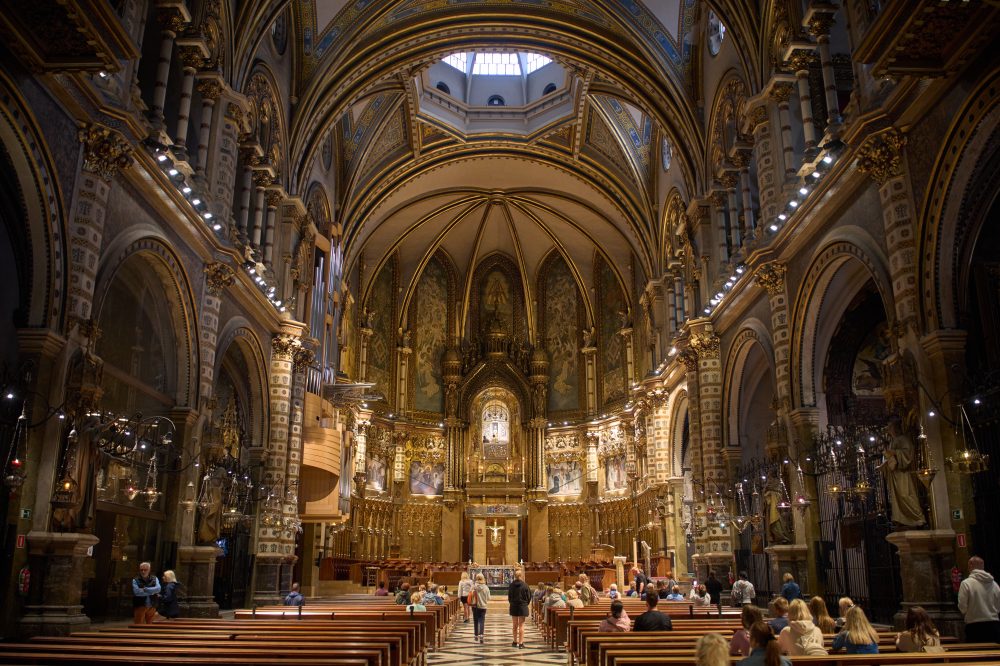
The sacred mountain of Montserrat, requiring a lengthy drive from Barcelona followed by a challenging climb, holds special meaning for Catalans in northeastern Spain. Each year, 2 million visitors journey to this complex featuring an 11th-century Benedictine abbey and a 16th-century basilica. The site’s renowned Black Madonna statue, originally white but darkened by centuries of candle smoke and incense before being deliberately painted black, draws widespread devotion.
However, for many Catholics worldwide — particularly non-Catholics — the centerpiece of the Chicago-born pontiff’s week-long Spanish visit will be his evening Mass at the Sagrada Familia, officially known as the Basilica of the Holy Family. This service honors the 100th anniversary of architect Antoni Gaudí’s death. The pope will deliver his remarks primarily in Spanish, with some portions in Catalan.
This dual visit demonstrates his careful approach to maintaining age-old religious customs in a nation experiencing declining faith while connecting with a worldwide audience from a basilica that attracts more sightseers than worshippers. Despite their differences, these two locations share a bond that even many residents don’t recognize.
The Sagrada Familia incorporates nature’s universal elements — trees, birds, reptiles, abundant fruit displays — alongside depictions of Christ’s earthly journey. Beyond its distinctive appearance, the structure fascinates visitors by allowing them to observe a magnificent church still under construction.
This building process started 144 years ago when the initial cornerstone was placed in 1882 during the papacy of Leo XIII, the current pope’s namesake.
Gaudí’s creation stands apart from Europe’s other great cathedrals precisely because of its claim to innovation, which explains its appeal to millions. Leo’s Mass provides a chance to connect him with this remarkable worship space.
“Its stones and stained glass speak of the possibility of conjuring up 2,000 years of Christian history from a modern and even postmodern view,” Ferran Sáez, professor of humanities at Barcelona’s University of Ramón Llull, told The Associated Press. “It is a building that expresses very complex ideas while coming across as comprehensible for anyone who is receptive, whether they are Christian or not.”
The Sagrada Familia has achieved international acclaim, appearing on nearly every serious traveler’s must-see list. International visitors comprise 90% of its guests, whose admission payments support ongoing construction, with more Americans touring the site than Spaniards, basilica records show.
Though visitor age demographics aren’t tracked, the basilica proves extremely popular with teenagers and young adults. This contrasts sharply with the aging congregations found in most Spanish churches as the Catholic Church works to connect with and stay meaningful to younger generations.
The basilica’s newest distinction — becoming the world’s tallest church with its recently completed Tower of Jesus Christ — has enhanced its status as a global landmark.
The Sagrada Familia serves as a worldwide platform, yet it sits in a nation where Christian faith is retreating. Spain experienced a religious transformation during its late 20th-century return to democratic governance. Slightly more than half of Spaniards surveyed by the state polling organization in 2024 identified as Catholics, but only about one in five described themselves as practicing believers.
Catalonia ranks among Spain’s most secular regions, Sáez noted.
Catalan Catholics practice their faith quietly, without the elaborate Easter Week ceremonies seen in Seville and other Spanish cities.
Their spiritual strength comes from sacred locations: the Sagrada Familia, the Poblet monastery, and the Romanesque churches scattered throughout the Pyrenees foothills. Most importantly, it comes from Montserrat, where pilgrims travel by bus, cable car, mountain railway, and demanding hiking paths.
“It is home to our most beloved representation of Mary, the Black Madonna,” Catalan theologian Francesc Torralba told AP. “Many Catalans pray to her and feel close to her in times of need. Montserrat is a key to our culture, as well as our efforts to maintain our language and our traditions.”
While Montserrat serves as the region’s spiritual center, local faith finds expression “culturally expressed in its artistic creations” like the Sagrada Familia, he explained.
This extraordinary and distinctive artistry draws countless visitors. Many Barcelona locals believe the Sagrada Familia’s popularity has contributed to overtourism’s most serious problems. Tour buses overwhelm the neighborhood with cruise ship day visitors, and nearby streets feature numerous fast food establishments and gift shops. Demonstrators who sprayed tourists with water guns last year intended to reach the Sagrada Familia before police intervention.
“Where there are two people (tourists and locals), there can be friction, and that happens in the best marriages,” the Sagrada Familia’s rector, the Rev. Josep Turull, told AP. “So we try, just like with a marriage, for these small crises to be growing pains, and that’s why we try to not just welcome pilgrims and tourists but also make sure that our parishioners feel that this is their basilica.”
Leo’s visit could generate additional tourism. Pope Benedict XVI’s 2010 consecration ceremony that established it as an active basilica increased annual visits from approximately 3 million to nearly 5 million in 2025, according to Xavier Martínez, the CEO of the Sagrada Familia’s construction project.
“I believe that on June 10 we will experience something similar to what we saw in 2010,” Martínez said. “At that time, the world discovered the interior of the Sagrada Familia. Now the world will discover the towers of the Sagrada Familia.”
Tour guide and historian Mònica Santín has witnessed the Sagrada Familia’s remarkable impact on believers and skeptics alike; some visitors even cry when entering the church. While she finds it personally rewarding to help tourists experience these transformative moments, she worries Leo’s Mass might push tourism beyond what the community can handle.
Santín has secured her place to see Leo personally, but not at the basilica. She will instead travel to the Montserrat monastery.
Santín’s grandmother completed the same pilgrimage, walking without shoes to a mountainside cave where legend claims shepherds found the Black Madonna statue and prayed for her husband’s safety during the Spanish Civil War. Today, Santín wears the ring her grandmother passed down to her.
“I don’t know how it doesn’t fall apart,” Santín said, carefully touching her ring, with its profile of the Virgin of Montserrat, the patron saint of Catalonia, barely visible after so many years.
She points out that Montserrat and the Sagrada Familia share a connection that few people know about.
The young Gaudí worked as an apprentice with an architect constructing the mountaintop chapel for the Virgin of Montserrat, according to Santín, who is writing her doctoral dissertation on the architect at Barcelona’s ISCREB theology school. This same architect initially received the commission to build the Sagrada Familia, but material expenses made his neo-Gothic design financially impossible, leading to Gaudí’s selection. In his revolutionary design, he incorporated mountain elements.
The basilica’s castle-like towers even mirror the pointed rock formations that every Catalan recognizes as rising from Montserrat.
“Montserrat is our holy mountain,” Santín said. “The Sagrada Familia is like a Montserrat in the middle of the city.”