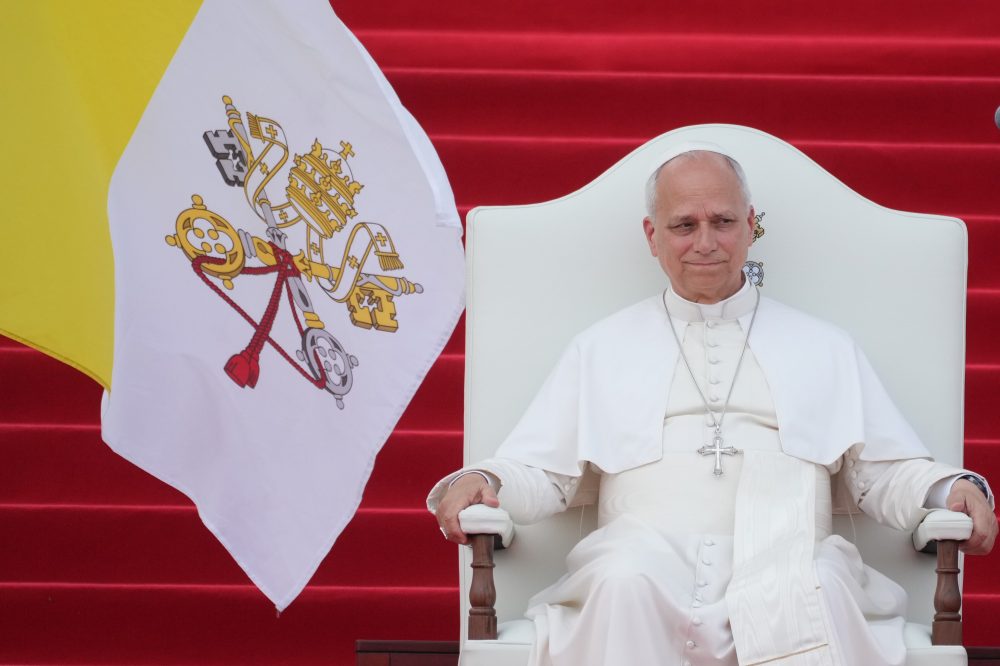

VATICAN CITY — As Pope Leo XIV completes his first year in office, his leadership style stands in stark contrast to Pope Francis, who immediately launched sweeping changes through rapid reforms and new appointments. Instead, Leo XIV has adopted a more measured approach, taking time to establish his bearings while developing a long-term vision for his papacy.
While Leo has implemented some notable changes during his initial year, he confronts several major challenges on the horizon.
Multiple upcoming appointments both in the United States and within Vatican leadership will provide Leo with opportunities to reshape the church’s power structure according to his vision and priorities.
Cardinal Blase Cupich of Chicago reached age 77 this past March, placing him two years beyond the standard retirement age for bishops. This means Leo may soon select a new archbishop for his home city.
Come December, Los Angeles Archbishop José Gomez will turn 75, opening the door for Leo to appoint new leadership for America’s largest archdiocese.
Leo has already selected Archbishop Ronald Hicks to succeed retiring Cardinal Timothy Dolan in New York. However, according to Michael Moreland, a professor of law and religion at Villanova University (Leo’s former school), this appointment “didn’t ideologically code dramatically one way or the other … in keeping with Leo’s overall kind of approach to a lot of these decisions.”
Within Vatican walls, British Cardinal Arthur Roche recently turned 76. He currently oversees the liturgy office, which implemented Francis’ disputed restrictions on the traditional Latin Mass. Close attention will be paid to Roche’s eventual replacement as an indicator of how Leo might handle this contentious matter.
American Cardinal Kevin Farrell represents another significant Vatican figure. At 78, he has exceeded retirement age but continues leading the family and laity office. Additionally, he serves as camerlengo (the official who supervised the conclave that elected Leo) and sits on the most crucial Holy See committees overseeing financial investments and the city state’s supreme appeals court.
Canadian Cardinal Michael Czerny will celebrate his 80th birthday in July, making him not only the oldest Vatican prefect — he leads the office handling migrants, environment and development — but also removing him from eligibility to vote in future conclaves.
This change will drop the number of voting-eligible cardinals to 117, falling short of the typical 120-member limit for cardinals under 80 who retain voting rights. This situation suggests Leo might announce his first group of new cardinals within the coming year to help select his eventual successor.
When Francis began his papacy, he encouraged young people to create upheaval in their dioceses and “make a mess.” Leo has already begun addressing some of these disruptions.
This past April, the Vatican terminated a Francis initiative called the World Day of Children, which had generated confusion about its goals and purpose. The cancellation followed Leo’s official elimination of the temporary pontifical commission Francis had established for this event in 2024.
In December, Leo disbanded a Holy See fundraising commission established under questionable conditions in 2025 while Francis was hospitalized during his final weeks. The commission consisted exclusively of Italians lacking professional fundraising backgrounds. Its leader was the assessor of the Secretariat of State, the same Vatican department Francis had previously prohibited from managing assets after losing tens of millions of euros in a controversial London real estate transaction.
Leo subsequently announced the formation of a new committee to create fundraising proposals and frameworks.
“The Holy Father was clearly paying attention,” stated Ward Fitzgerald, president of The Papal Foundation, an organization of affluent U.S. donors funding papal charitable projects in developing nations. “He realized that it was not going to be highly functional.”
Leo also reversed a 2022 regulation issued by Francis that centralized financial authority within the Vatican bank. Leo created his own legislation permitting the Holy See’s investment committee to utilize banks beyond the Vatican when financially advantageous.
Leo has also conducted meetings with activist survivors of clergy sexual abuse, who report he pledged to engage in ongoing dialogue as they urge the Vatican to establish a global zero-tolerance policy for abuse. While Francis regularly met with individual abuse survivors, he maintained distance from advocacy and activist organizations.
Leo’s private meetings have offered insights into his areas of focus and concern, indicating his willingness to hear diverse perspectives while revealing little about his personal views.
This pattern was evident when he met on March 16 with Gareth Gore, author of “Opus: The Cult of Dark Money, Human Trafficking and Right-Wing Conspiracy Inside the Catholic Church,” discussing alleged misconduct within the influential Opus Dei movement.
On February 6, Leo held a private meeting with representatives from Courage International, a church-affiliated organization claiming to help individuals with same-sex attraction live celibately. Critics have labeled Courage as anti-gay and accused it of promoting conversion therapy, allegations the organization disputes.
On March 5, Leo met with Stephen Bullivant and Stephen Cranney, authors of “Trads. Latin Mass Catholics in the United States.” They had conducted research surveying Catholics who participate in traditional Latin Mass services.
Leo recognizes the controversy surrounding Francis’ restrictions on the Latin Mass and has shown interest in consulting with traditionalists to comprehend their perspectives as he considers how to bridge divisions over the ancient liturgy.
The Latin Mass controversy may reach a critical point on July 1 when four new traditionalist Catholic bishops are scheduled for consecration in a ceremony without Leo’s approval. These bishops belong to the breakaway traditionalist Society of St. Pius X, and their consecration will present the most significant challenge to Leo’s authority thus far. If conducted, it would constitute a schismatic action virtually guaranteeing their automatic excommunication.
While the SSPX represents a fringe element within the broader traditionalist Catholic community, traditionalist Catholics maintaining full communion with the Holy See are monitoring Leo’s response.
On the other end of the theological spectrum, the Vatican confronts potential major conflict with the German Catholic Church regarding its extended reform initiative called the Synodal Path. This has resulted in proposals for creating a permanent joint body of German bishops and lay Catholics making shared decisions, representing a significant departure from Catholic ecclesiology that places governing authority exclusively with bishops.
The Vatican has already expressed opposition to such joint governance and has disagreed with German proposals to formalize blessings for same-sex couples, which Francis permitted only on an informal, spontaneous basis.
A confrontation may occur when German proposals are submitted to Rome for final authorization.
While some might argue Leo’s primary challenge involves his relationship with President Donald Trump and a potential U.S. visit — none is currently planned this year — Leo would likely emphasize his eagerly anticipated first encyclical. Expected within the coming weeks, it addresses artificial intelligence and other peace and justice concerns.
Leo has already stated he views the AI revolution as having existential significance comparable to worker rights concerns at the turn of the century that confronted the previous Pope Leo XIII in his groundbreaking encyclical “Rerum Novarum” (“Of New Things”).
“Like his namesake Leo XIII with the Industrial Revolution, Leo clearly sees the church as having something important to offer in an era of what may turn out to be epochal technological change,” explained Dan Rober, associate professor of Catholic studies at Sacred Heart University.