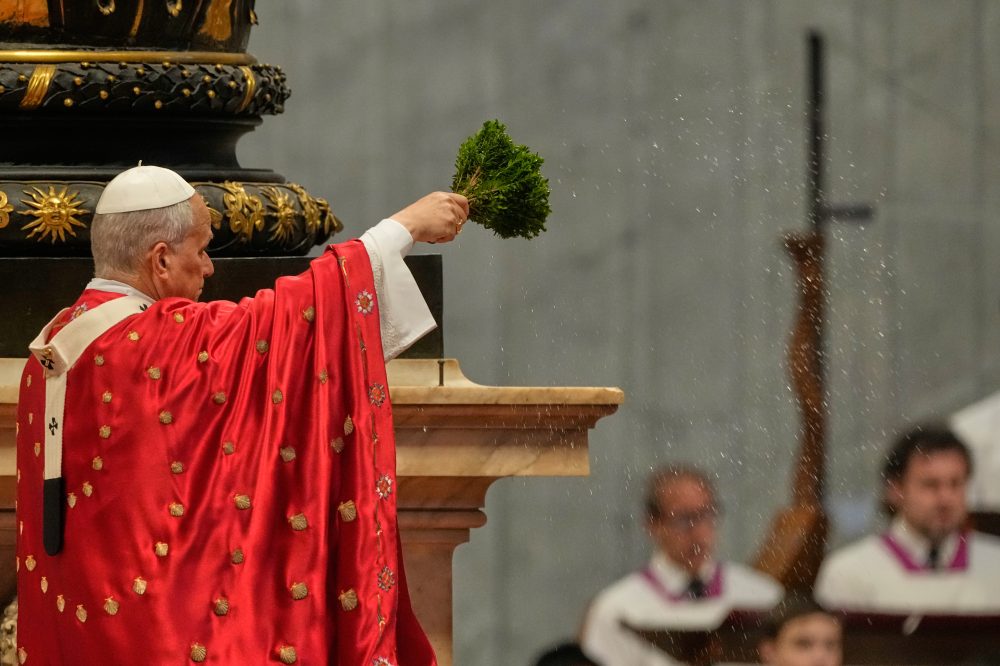

VATICAN CITY — The pontiff has released a comprehensive 83-page document addressing how artificial intelligence is transforming human society across multiple sectors.
The manifesto, titled “Magnifica Humanitas” (Magnificent Humanity), was made public on Monday and covers wide-ranging concerns about technology’s role in modern life.
Regarding false information, Pope Leo XIV stated that AI has become “a powerful amplifier” for disinformation by enabling the “manipulation of content, images and videos,” creating exposure to “biased or misleading perspectives.” The pope warned that democracy suffers when practicality — “what appears useful effective” — replaces truth. “Indifference to the truth leads, slowly but surely, to a descent to totalitarianism,” Pope Leo XIV stated.
The document emphasizes that digital platform controllers, including social media companies, wield influence that “should be constantly guided by the pursuit of truth or respect for human dignity.” The pope described the internet as needing to function as “a setting in which inner freedom and critical thought can mature,” rather than “an instrument of excessive distraction, homogenization or dominance.” He noted that communication shapes culture beyond merely sharing information.
On employment matters, Pope Leo XIV stressed that workplaces must prioritize “the protection of employment opportunities and the irreplaceable role of the individual.” He cautioned that “the pursuit of greater profits cannot justify choices that systematically sacrifice jobs, because the human person is an end, not a means, and the economic order must remain subordinate to human dignity and the common good.” The pope also emphasized that governments should create employment-friendly conditions “since it is a primary good for families and for societies.”
Concerning military applications, Pope Leo XIV warned that AI “can only bring conflict about more quickly and render it more impersonal.” He outlined specific standards for strike decisions, including clear responsibility chains that encompass “those who design, train, authorize and employ technology,” plus safeguards ensuring target selection distinguishes between fighters and civilians while considering effects on vulnerable populations. Essential requirements include accountability guarantees and preventing automated lethal force deployment. Pope Leo XIV advocated for international cooperation “to curb the technological arms race and ensure robust protection for civilians.”
The pope observed that global wealth “is increasingly concentrated in fewer hands, widening inequalities.” In today’s AI and robotics environment, relying only on market forces’ “invisible hand” is insufficient, Pope Leo XIV wrote, encouraging leaders to focus policies on “the common good” while promoting “dignified work, social inclusion and an equitable distribution of the benefits of innovation.”
Pope Leo XIV highlighted how digital networks — encompassing online platforms, messaging applications, and anonymous payment systems — facilitate human trafficking, which he characterized as “a contemporary form of slavery.” He cautioned that ignoring or accepting such practices risks involvement in “today’s sins, which are akin to those of the past when slavery was being concealed and justified.”
The environmental impact of AI infrastructure also drew attention, with Pope Leo XIV noting that data centers powering AI systems consume “enormous amounts of energy and water, significantly influencing carbon dioxide emissions.” As requirements grow, particularly for advanced language models, he urged development of environmentally responsible technological alternatives.
For youth protection, Pope Leo XIV proposed cooperation between policymakers, schools, and families to address the “culture of immediacy and hyperstimulation” from digital media. He stressed AI’s role in increasing risks to young people and cautioned against early access to personal mobile devices. “Online phenomena such as grooming, blackmail and the sexual exploitation of minors are not uncommon, and are made more insidious by the use of fake profiles, algorithms that facilitate dangerous contact, and AI tools capable of manipulating images and videos,” the pope stated.