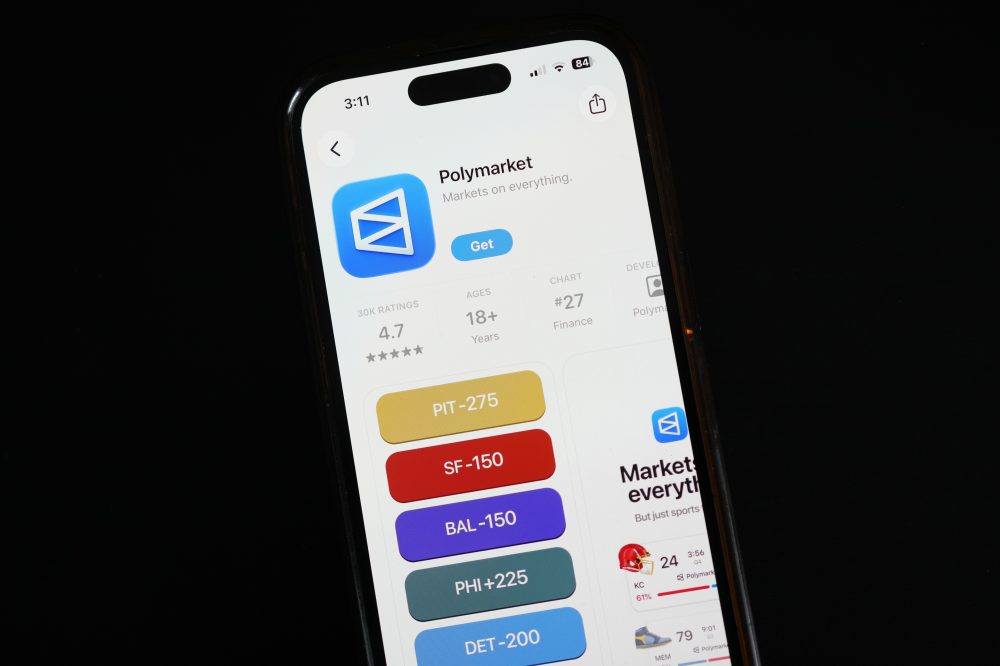

NEW YORK (AP) — After spending four years locked out of the American market, the prediction market platform Polymarket has launched a well-funded effort to reintroduce itself to U.S. customers — and to convince them it’s a fundamentally different company than the one they may have heard about before.
The company is working on multiple fronts to win over policymakers, regulators, and everyday Americans. It has brought on social media influencers to generate viral content on TikTok and other platforms. Its account on X, formerly known as Twitter, now boasts millions of followers and posts regularly about current events. The company has also struck partnership deals with major sports teams, Major League Baseball, and news outlets including CNBC and CNN — all in support of its argument that its real-time markets offer a more accurate glimpse into the future than traditional polls or political commentary.
The campaign is essentially designed to reposition Polymarket as something different from what most people currently associate with the brand.
What Americans know as Polymarket has, technically speaking, been off-limits to them. In 2022, the company was forced to move its operations offshore after settling federal charges that it had run an unregistered derivatives market. Despite the prohibition, many Americans found workarounds to continue using the platform. That offshore operation drew criticism over allegations of insider trading and allowing bets connected to war and other acts of violence.
Polymarket re-entered the U.S. market at the end of 2025 by purchasing the derivatives exchange QCEX, which gave it the regulatory license needed to operate domestically. Company executives say the U.S. exchange is kept entirely separate from the international platform, and they have brought on a number of compliance, surveillance, and regulatory specialists in recent weeks to maintain that separation.
“Trust is the product we are building here,” said Dan Lee, head of U.S. operations at Polymarket, in an interview. Lee joined Polymarket in February, coming from Coinbase.
Among the new additions, the company brought on Megan McGrath from Robinhood to serve as its chief compliance officer. Lee and another executive, Natalie Oblazny, were both recruited from Coinbase. The company has also hired former officials from the Department of Justice and FBI to lead its enforcement and surveillance efforts. Lee said Polymarket’s ability to successfully reestablish itself in the U.S. depends almost entirely on whether it can persuade people that its American platform can be a trustworthy prediction market, and the new hires are central to making that case.
Both Polymarket International and Polymarket U.S. offer the same basic service — letting users trade on the probability of future events, from weather and sports to politics and breaking news. However, the two operate very differently under the hood. The international platform runs on blockchain technology and requires users to trade using cryptocurrency, while the U.S. version uses a more traditional, centralized structure regulated by the CFTC and funded with U.S. dollars.
For most users, the experience on either platform will feel similar, with the main difference being how they fund their accounts. Polymarket U.S. will also offer a much smaller selection of contracts and operate under stricter rules than the international version.
“Polymarket U.S. is supposed to comply with U.S. law and regulations. Polymarket international is where anything goes,” said Todd Phillips, who has written extensively on prediction markets at the Roosevelt Institute.
The stakes are enormous for Polymarket. In the years since it left the U.S. market and its return six months ago, the prediction market industry has expanded significantly in both size and popularity. Combined trading volume across Polymarket and its main competitor Kalshi now stands at $26.6 billion, according to blockchain analytics firm Dune — up from $9.75 billion in October of last year. Kalshi accounts for roughly two-thirds of that activity, driven largely by sports wagering, and was valued at $22 billion in its most recent funding round.
Both companies are also operating in a more favorable regulatory environment in Washington. The Trump Administration has generally been supportive of prediction markets, and the CFTC has gone to court against states to argue that federal law should override state-level regulations on the industry. Additionally, Donald Trump Jr., the president’s son, has invested in Polymarket through his venture capital firm, 1789 Capital.
Despite the momentum, Polymarket’s comeback has not been without stumbles. The Wall Street Journal uncovered evidence suggesting the company’s marketing campaigns used deceptive tactics, including hired influencers who appeared to be making real money on the platform when the trades shown were actually fake. Politico reported in June that a Polymarket executive paid at least 20 political content creators, many of whom never disclosed those financial relationships to their audiences. Both campaigns were part of Polymarket’s broader reintroduction effort in the U.S. The company says it is now investigating those marketing and promotional activities.
Questions also remain about whether Polymarket U.S. can truly distance itself from the controversies surrounding its international counterpart. Earlier this year, a U.S. Army sergeant was indicted in connection with bets placed on the capture of Venezuelan President Nicolás Maduro — bets made on Polymarket’s international platform. The Associated Press also reported in April that 50 brand-new accounts on the international platform placed significant bets on a U.S.-Iran ceasefire in the hours and even minutes before President Donald Trump announced the ceasefire on social media, raising serious concerns about insider trading.
Lee acknowledged those issues but expressed confidence that the steps being taken on the U.S. side will help establish its credibility over time.
“I think having the international business being the bulk of the volume, it often sorts of masks the progress we are making here in the U.S. to broaden Polymarket’s acceptance,” Lee said.