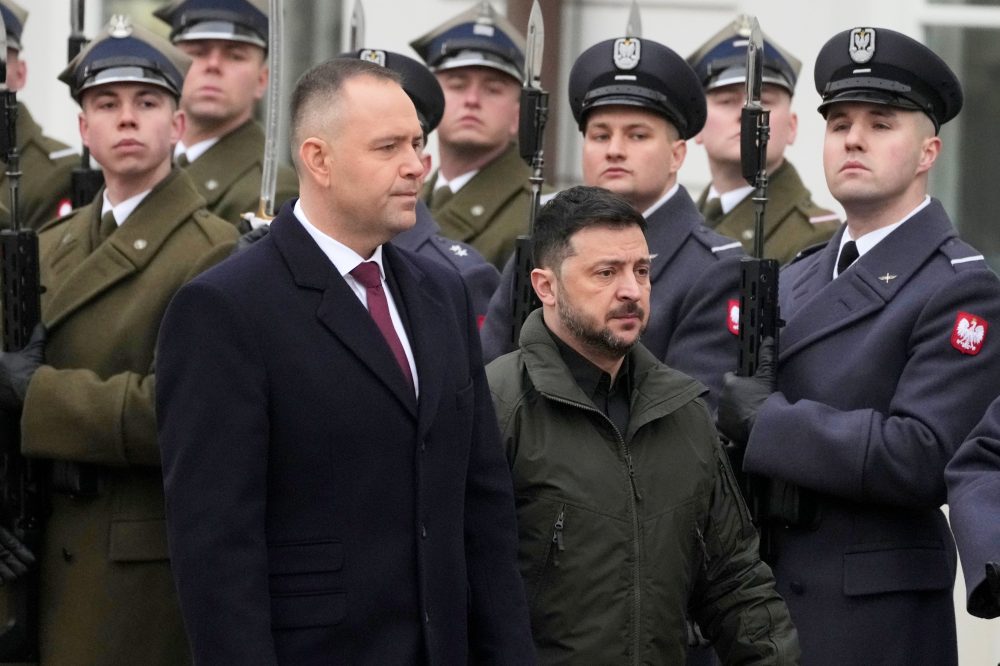

WARSAW, Poland — Polish President Karol Nawrocki announced Friday that he intends to revoke Ukrainian President Volodymyr Zelenskyy’s Order of the White Eagle — Poland’s most prestigious state honor — following a controversial decision by the Ukrainian leader to name a military unit after a group accused of killing Poles during World War II.
Zelenskyy had received the Order of the White Eagle back in 2023, awarded by Poland’s then-President Andrzej Duda in recognition of Zelenskyy’s contributions to security, resilience, and the defense of human rights.
The honor will now be taken away after Zelenskyy signed a decree on May 26 designating a unit within Ukraine’s Special Operations Forces after the UPA — known as the Ukrainian Insurgent Army — a paramilitary organization that was active during the 1940s and 1950s and is accused by Poland of carrying out mass killings of Polish civilians.
In a 13-minute video address posted to social media, Nawrocki explained his reasoning: “For the majority of Polish society, the Ukrainian Insurgent Army remains above all a formation responsible for cruel crimes against the citizens of the Polish Republic during World War II.”
Despite revoking the honor, Nawrocki made clear that Poland’s backing of Ukraine in its defense against Russian aggression would not waver as a result of this decision.
The timing is notable — Poland is set to host a major international conference next week focused on Ukraine’s postwar reconstruction, and Zelenskyy is expected to be in attendance.
According to Zelenskyy’s decree, naming the military unit after the UPA was intended to honor the unit’s battlefield performance in defending Ukraine’s territorial integrity and independence, while also restoring historical military traditions.
The UPA was a military organization that fought for Ukrainian independence, battling both Nazi German and Soviet forces during the war. However, Poland holds the group responsible for the wartime slaughter of tens of thousands of Polish civilians, primarily in the Nazi-occupied regions of Volhynia and Eastern Galicia. In 2016, the Polish parliament formally recognized those killings as genocide.
Ukraine’s position is that armed groups on multiple sides — including both the Ukrainian Insurgent Army and Polish underground forces — carried out attacks and reprisals that resulted in large numbers of civilian deaths among both Poles and Ukrainians.
Poland’s liberal Prime Minister Donald Tusk also voiced criticism of Zelenskyy’s decree, though he cautioned that Russian President Vladimir Putin could stand to gain from any deepening rift between Poland and Ukraine over historical grievances.
Ukraine’s Foreign Minister Andrii Sybiha issued a statement on June 3 calling on both nations to dial back the tension, saying the escalation was not in the interest of either Ukrainians or Poles. He urged both sides to let professional historians handle the more sensitive chapters of their shared past.
The dispute comes despite recent signs of progress between the two countries. A presidential meeting held in December in Warsaw had suggested momentum toward historical reconciliation, including advances on the question of exhuming Polish victims.