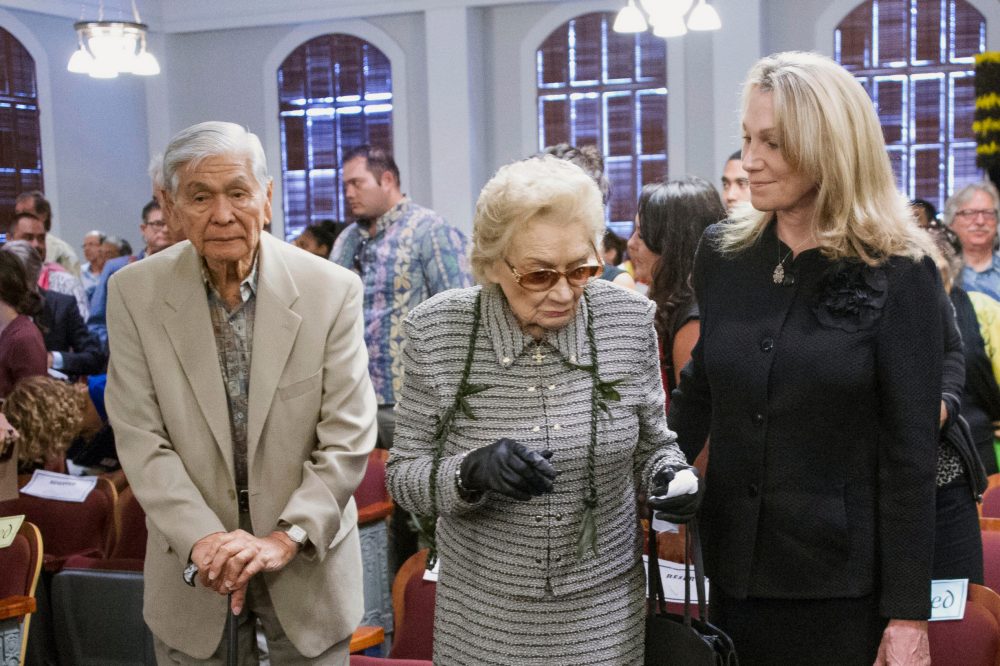

George R. Ariyoshi, who broke racial barriers by becoming America’s first Asian American state governor, passed away Sunday evening at the age of 100.
The longtime Hawaii leader died peacefully with his family by his side, current Hawaii Governor Josh Green announced Monday. Ariyoshi served as the island state’s chief executive for 13 years, from 1973 through 1986.
“Governor Ariyoshi devoted his life to Hawaiʻi with humility, discipline and an unwavering sense of responsibility to the people he served,” Green said. “He led our state during a pivotal moment with quiet strength and integrity, and his legacy as a trailblazer and public servant will endure for generations.”
The Democratic politician initially assumed the governor’s office in October 1973 when Governor John Burns became seriously ill with cancer. Ariyoshi had been serving as lieutenant governor after winning that position three years earlier.
He secured the governorship in his own right during the 1974 election and successfully defended it twice more, in 1978 and 1982. Current Hawaii law limits governors to two terms, but no such restriction existed during Ariyoshi’s tenure.
His political ascent paralleled the Democratic Party’s emergence as the dominant force in Hawaiian politics. The Democrats seized legislative control from Republicans in 1954, the same year Ariyoshi claimed his first victory for the Territorial House of Representatives, serving two terms there.
In 1958, he captured a territorial Senate seat and transitioned to state senator when Hawaii achieved statehood the following year. Ariyoshi continued his state Senate service through three additional election cycles in 1964, 1966, and 1968 before ascending to lieutenant governor.
Born George Ryoichi Ariyoshi on March 12, 1926, he entered the world in modest circumstances in a small two-room apartment near Honolulu Harbor. His parents had emigrated from Japan, settling in the working-class Kalihi district close to downtown Honolulu.
His father Ryozo had been a sumo wrestler in Fukuoka Prefecture before becoming a dock worker and dry cleaning business owner in Hawaii. His mother Mitsue originated from Kumamoto, Japan.
In his 1997 memoir titled “With Obligation to All,” Ariyoshi reflected on childhood challenges including a speech impediment.
“The fact that we had no money did not seem to be a barrier, but I had a barrier of a different kind,” he wrote, explaining his determination to become an attorney if he could overcome his speaking difficulties.
After completing his studies at McKinley High School in 1944, Ariyoshi enlisted with the U.S. Army’s Military Intelligence Service, working as an interpreter in Japan during the final phase of World War II.
Post-war, he initially enrolled at the University of Hawaii before transferring to Michigan State University, where he completed his bachelor’s degree in history and political science in 1949. He subsequently obtained his law degree from the University of Michigan Law School in 1952.
During his mainland education, Ariyoshi found acceptance rather than discrimination. “On the contrary, I enjoyed the fact that Hawaii had a reputation even then for people of different backgrounds coming together and living harmoniously,” he noted in his autobiography.
He established his legal practice in Hawaii in 1953, the year following his law school graduation. When elected lieutenant governor, Ariyoshi stepped away from private law practice and resigned from various corporate board positions.
His motivation for seeking higher office stemmed partly from a commitment to advancing minority representation.
“The new state of Hawaii had produced United States representatives and senators of Caucasian, Chinese and Japanese ancestry, reflecting our diversity,” he explained. “But only Caucasians had been governor.”
During Ariyoshi’s gubernatorial years, Hawaii experienced explosive tourism growth and rapid population expansion. “I was convinced that neither our infrastructure nor our environment would support this rate of growth,” he recalled.
A memorable moment occurred in 1975 when Ariyoshi and his wife Jean Hayashi Ariyoshi attended their inaugural National Governor’s Conference in Washington, D.C. President Gerald Ford invited them to a formal White House dinner.
As described in Jean Ariyoshi’s book “Washington Place: A First Lady’s Story,” while the couple danced together, she whispered to him: “Look at the little girl from Wahiawa dancing at the White House.”
His response was: “And she’s dancing with the kid from Kalihi.”
John Waiheʻe, who served as Ariyoshi’s lieutenant governor starting in 1982, succeeded him as governor in 1986 with Ariyoshi’s endorsement, becoming the first person of Native Hawaiian heritage to hold the office.
Ariyoshi leaves behind his wife Jean, daughter Lynn, and sons Donn and Ryozo.