
LIMA, Peru — Thursday’s election results from Peru revealed an extremely close contest for second and third positions, potentially requiring several weeks to determine which two candidates will advance to the mandatory June runoff election.
A nationalist representative with ties to a jailed former president and an ultraconservative political figure advocating for capital punishment restoration are the leading contenders to challenge Keiko Fujimori, who appears certain to claim first place among the 35 presidential hopefuls from Sunday’s voting.
Official tallies covering 93% of cast ballots showed Fujimori, the conservative offspring of discredited ex-President Alberto Fujimori, commanding 17.06% of votes — well short of the 50% threshold required to prevent a runoff.
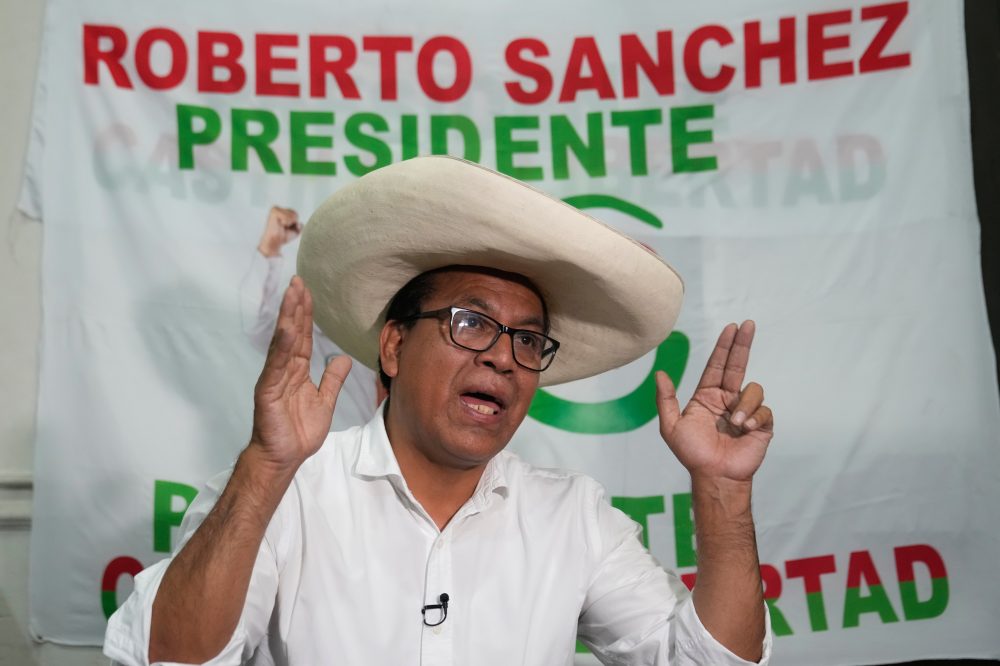
In second position, Roberto Sánchez, a nationalist representative and former cabinet member under jailed ex-President Pedro Castillo, captured 11.97% of votes. Following closely in third was Rafael López Aliaga, the ultraconservative ex-mayor of Peru’s capital city, Lima, with 11.91%.
Uncertainty grew regarding which candidate would proceed to the June 7 runoff, as fewer than 8,000 votes separated Sánchez and López Aliaga according to the latest tallies.
The two politicians represent completely opposite political philosophies.
Sánchez, regularly appearing in his signature wide-brimmed peasant hat, has pledged significant economic reforms, including substantial increases in government expenditures, comprehensive tax system overhauls, and partial state control of Peru’s natural resources.
López Aliaga, the ultraconservative former Lima mayor, emphasizes strict security measures, proposing Amazon region prison construction, allowing judicial anonymity, and deporting undocumented foreign residents.
The slim vote difference is complicated by roughly 1,600 outstanding ballot counts from isolated communities and overseas locations. Furthermore, another 5,000 ballot sheets face disputes, creating an appeals procedure that may require weeks to complete.
“In Peru, a percentage of tally sheets are always ‘challenged’ due to potential mathematical errors,” explained Álvaro Henzler, president of Transparencia, a democracy-watchdog group that deployed 4,000 observers. “When this occurs, they are sent to 60 special electoral boards for review.”
During 2021, Peru’s electoral tribunal announced first-round outcomes 37 days following the April 11 election. However, the gap between second-place competitors exceeded 238,000 votes initially, eliminating uncertainty.
“In this case, since the race is so tight, the contested tally sheets could end up altering the standings; that is why it is taking longer,” Henzler noted.
Presidential candidates require over 50% of votes for immediate victory. The two highest vote-getters in the initial round proceed to the June 7 runoff.
The victor will become Peru’s ninth president within a decade and will succeed José María Balcázar, who gained the interim presidency in February. He followed another temporary leader who was removed due to corruption charges just four months after taking office.
In her fourth presidential campaign, Fujimori has pledged to combat crime while supporting legislation that analysts claim hinders criminal prosecutions. These laws, endorsed by her political party recently, eliminated pretrial detention in specific situations and increased requirements for confiscating criminal proceeds.