
Financial markets in Peru experienced significant volatility this week as leftist congressional representative Roberto Sanchez advanced toward a potential runoff position in the country’s presidential election, sparking investor anxiety reminiscent of Peru’s previous experience with anti-establishment leadership.
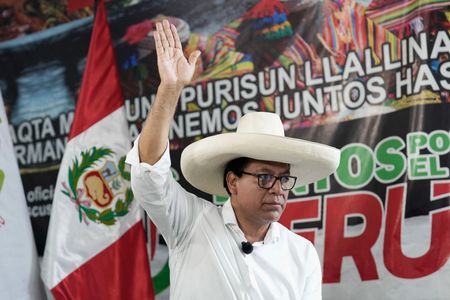
Sanchez, who previously served as a cabinet minister during the administration of removed leftist former President Pedro Castillo, may find himself competing against conservative leader Keiko Fujimori in a runoff election set for June 7, pending completion of official ballot tallying.
During a Reuters interview conducted before Sunday’s election, Sanchez expressed his belief that Peru requires a “new beginning” following what he characterized as decades of marginalization of Peru’s underrepresented communities within the existing economic framework.
“We want a new social contract, a plurinational state that recognizes the true face of Peru,” Sanchez stated during the interview at the Together for Peru party headquarters in Lima, where he displayed a wide-brimmed straw hat that he claimed had belonged to Castillo — an emblem strongly connected to the former president’s support among rural voters.
With approximately 92% of votes tallied by Wednesday evening, Sanchez has captured roughly 12% of ballots cast, placing him in second position behind Fujimori’s 17% in an election characterized by processing delays and disputed claims of voting irregularities. The top two vote-getters will proceed to the runoff election.
International election monitors have recognized issues with the voting process but have found no evidence supporting allegations of fraud.
The tight competition for the second runoff position has captured investor attention. Sanchez’s late momentum in vote tallies, combined with his policy agenda including constitutional reform and mining contract renegotiation, could strengthen further as ballots from rural areas, which typically favor leftist candidates, are completely processed.
Sanchez contends that Peru’s economic system has marginalized significant portions of the population, particularly remote and Indigenous communities.
“The rural vote, the Andean vote, the Quechua, Aymara and Amazonian vote was never respected,” he stated.
“We sell stones. Thirty years of mining and the mining towns are still the poorest in our country.”
A cornerstone of his political agenda involves establishing a constituent assembly to create a new constitution, replacing the existing document established during the 1990s under Alberto Fujimori, who is the father of the current frontrunner.
Regarding economic matters, he supports increased government oversight of natural resources and has suggested reviewing mining and gas agreements, implementing windfall profit taxes, and establishing a wealth tax.
“We are not talking about expropriating anyone’s property,” he explained. “We are demanding justice for a people that remain poor despite living atop enormous wealth.”
Coming from an Indigenous background with family ties to Peru’s Andean south, Sanchez has also indicated opposition to the current central bank leadership, creating unease among investors who consider the institution crucial for maintaining economic stability.
Financial markets responded quickly to Sanchez’s electoral progress. Wednesday saw the sol currency decline 1.46% against the dollar to reach its lowest point since late September, while Lima’s primary stock index dropped nearly 5%.
Sanchez’s electoral gains led investors to “recalibrate their positions,” according to Cesar Huiman, an analyst with Renta4 SAB, who described the candidate as “less business-friendly.”
These market concerns are intensified by Sanchez’s strong ties to Castillo, who has provided his endorsement from behind bars.
Castillo currently faces imprisonment on rebellion and conspiracy charges following a brief presidency that concluded with an unsuccessful attempt to dissolve Congress in 2022.
Throughout the interview, Sanchez consistently referenced Castillo as “president,” strengthening beliefs that his campaign represents a continuation of the former leader’s agenda.
While Sanchez stated he would not transfer power back to the former leader if victorious, he acknowledged their close alignment and regular communication. He indicated he would work toward Castillo’s release and pursue accountability for those killed during demonstrations that followed Castillo’s removal from office.
Some political observers suggest Peru’s fractured political environment may constrain the scope of change regardless of electoral results.
Based on preliminary results and pre-election polling projections, Peru’s legislative chambers for the 2026 to 2031 period would likely see increased representation from right-wing parties, although they would remain divided.
“The only certainty in Peru’s chaotic 2026 election is that Keiko Fujimori has a place in the June runoff, and that Congress and the new Senate will lean strongly conservative,” stated Eileen Gavin, principal Americas analyst at Verisk Maplecroft.
This conservative control of the legislature, she noted, indicates that economic policy will likely remain stable, helping markets move beyond immediate political uncertainty.