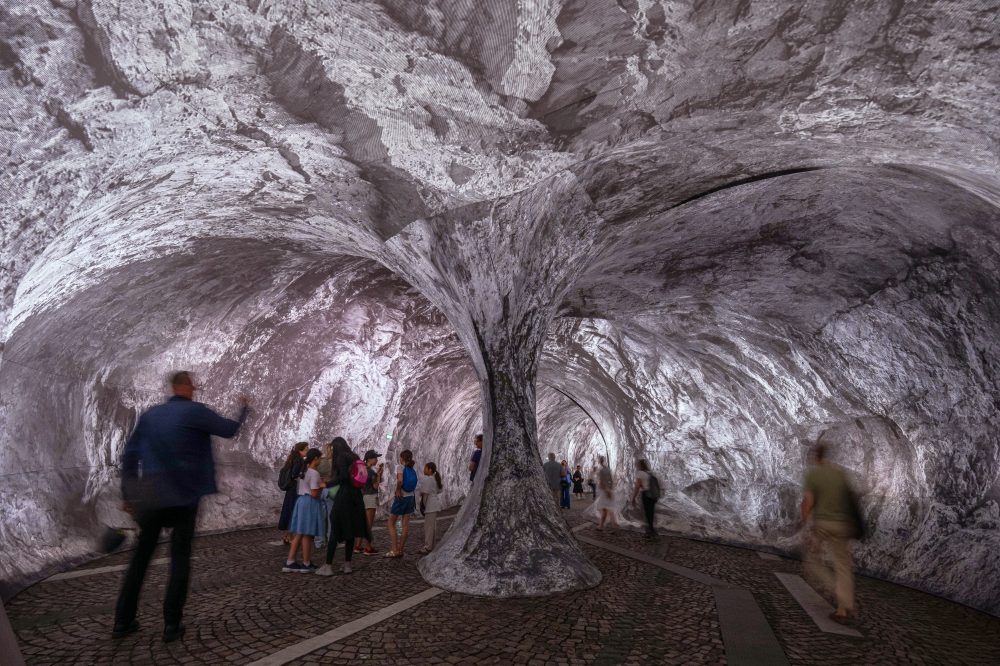

PARIS (AP) — For weeks, a dark mountain-like structure towered over the Seine River where Paris’ oldest bridge normally stands. On Monday evening, the doors to that structure swung open to the public.
Stepping inside, visitors immediately notice that Paris smells different. The air carries the scent of wet earth, aged stone, damp cellar walls, and a faint hint of smoke.
From the bright riverfront, guests enter a dim corridor lined with illuminated photographs of caves, while a low electronic rhythm seems to pulse through the surrounding walls.
Underfoot, the original cobblestones of the Pont Neuf still rise and fall with every step.
The installation, called the Pont Neuf Cavern, is the work of French street artist JR — sometimes referred to as the French Banksy. It is free to enter at any hour of the day and will remain open through June 28.
Constructed primarily from printed fabric and air, the structure converts the 17th-century bridge into a simulated cavern that reaches 18 meters — roughly 59 feet — above the Seine.
“It feels like the city has disappeared,” said Léa Martin, a 22-year-old art student from Lyon who visited on Tuesday. “You know the river is right outside, but for a moment you’re somewhere ancient.”
The scent experience is a deliberate and central part of the illusion. Olfactory expert Sarah Bouasse designed two evolving fragrances drawing on geosmin and isoborneol — chemical compounds linked to the smell produced when rain falls on dry ground.
The scent shifts as visitors cross the bridge: beginning with wet soil and mineral dampness, it gradually transitions into something warmer, smokier, and faintly animal in nature.
“Usually I cross here without looking up once,” said Michel Dupré, a 67-year-old retiree, as he blinked stepping back into daylight. “Today I felt the stones under my feet. And smelled them too. It makes you walk like a child again.”
Adding to the atmosphere is a sound installation by Thomas Bangalter, formerly one half of the French electronic music duo Daft Punk. His composition fills the cavern with deep rumbles, echoes, and rhythmic pulses.
The Pont Neuf was completed in 1607 and, despite its name translating to “New Bridge,” remains the oldest bridge still standing in Paris.
JR’s creation invites people to experience this familiar crossing in a completely new way — through their sense of smell, hearing, and touch.
The installation also serves as a tribute to artists Christo and Jeanne-Claude, who in 1985 wrapped the Pont Neuf in pale golden fabric, drawing an estimated 3 million visitors. That project bathed the bridge in light. JR’s version takes visitors into darkness.
“You enter into the darkness,” JR has said, “and emerge into the light on the other side.”
Those who wish can hold up their phones to unlock an augmented-reality layer developed with tech company Snap. Through the screen, digital bats streak light across the cave, passing visitors leave ghostly impressions, and a dancer appears to materialize out of thin air.
JR has connected the work to Plato’s allegory of the cave — the ancient philosophical idea that prisoners mistake shadows for reality. In his view, today’s cave walls are the screens and algorithms that filter what people perceive. Even so, the most powerful moments in the installation require no phone at all.
“It’s completely strange,” said Nadia Benali, 34, smiling near the artificial cliff walls. “Paris needs things that make people stop.”
Once the installation closes, its fabric materials will be reused or recycled. The mountain-like structure will disappear, traffic will resume, and the Pont Neuf — a bridge older than the French Revolution itself — will once again stand open to the sky.