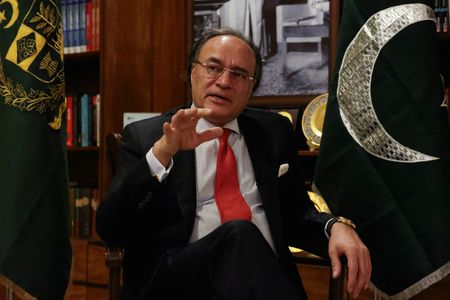

Pakistan is attempting to turn its diplomatic standing with the Trump administration into concrete financial support, but economists are raising serious doubts about whether new funding would do anything to fix the deep-rooted economic problems the country has repeatedly failed to address.
During a visit to Washington this week, Pakistan’s Finance Minister Muhammad Aurangzeb asked the U.S. for a $10 billion exchange stabilization fund, according to sources familiar with the matter who were not authorized to speak publicly. In a development not previously reported, Pakistan also separately pitched a trade-finance arrangement through the U.S. EXIM Bank, a source said. Both proposals are aimed at strengthening the rupee and reducing Pakistan’s reliance on the International Monetary Fund, China, and Saudi Arabia.
Pakistan played a key role in brokering a ceasefire between the U.S. and Iran earlier this year. However, the country’s underlying economic situation has changed little since before that conflict began. In April, Pakistan paid back $3.5 billion to Abu Dhabi — roughly one-fifth of its foreign reserves — amid tensions with the United Arab Emirates, and then leaned on a $3 billion Saudi backstop to cover the shortfall.
It remains unclear whether Washington will agree to either proposal. Uzair Younus, a partner at The Asia Group, noted that the Trump administration has been pursuing a larger foothold in Pakistan’s critical minerals sector, and suggested the financing could help lock in the U.S. role in potential mining agreements.
Others are more skeptical. Adeel Malik, an associate professor at Oxford University, described the proposed reserve facility as “geopolitical rent” — a reward tied to Pakistan’s mediation role in the U.S.-Israeli war on Iran and the broader instability now unfolding across the Middle East.
On the reform front, there have been some recent signs of progress. S&P Global Ratings upgraded Pakistan to ‘B’ from ‘B-‘ on Wednesday — its first upgrade in nine years — pointing to improved fiscal and institutional conditions. But the $7 billion IMF program behind those improvements comes with painful tradeoffs: unpopular tax increases and spending cuts, all while Pakistan’s government keeps one eye on elections expected by 2029.
Gareth Leather of Capital Economics said a U.S. fund would give Pakistan a “vital cash cushion” for its reserves — one that wouldn’t come with the IMF’s strict conditions or the need for constant renewal like Chinese and Saudi deposits require.
The EXIM Bank arrangement, meanwhile, would allow Pakistani buyers to delay payments to American exporters by one to three years, which would help narrow the U.S. trade deficit with Pakistan.
But Pakistani economist Vaqar Ahmed said the real question isn’t whether new money arrives — it’s whether Pakistan finally follows through on reforms to its tax system, energy sector, and state-owned enterprises. Without those changes, he said, Pakistan will keep going back to the IMF for help.
“Fresh liquidity can buy time, but it cannot buy growth,” Ahmed said.
A statement attributed to the U.S. Treasury secretary this week praised Pakistan’s reform efforts but emphasized the need for greater economic self-sufficiency and a return to international capital markets. The statement made no mention of the requested $10 billion facility. EXIM Bank confirmed Wednesday that talks are ongoing only around a “strategic framework” intended to be signed at the United Nations General Assembly in September.
The situation draws some comparisons to Hungary’s Viktor Orban, another Trump ally, who sought an Argentina-style “financial shield” in November 2025. Trump did not provide one, and Orban’s party went on to lose Hungary’s election five months later.
Brad Setser, a senior fellow at the Council on Foreign Relations and a former Treasury and U.S. Trade Representative official, said any facility for Pakistan would likely be structured as a maximum draw limit rather than an immediate dollar transfer. He noted that Treasury’s Exchange Stabilization Fund could support it, since Argentina is not currently drawing on its own separate $20 billion line — though Argentina did draw $2.5 billion in October and repaid it in December, according to Treasury.
Not everyone in Washington is on board. Mark Sobel, a former senior Treasury official now serving as U.S. chair of the OMFIF think tank, argued that Treasury should turn down any swap line for Pakistan, even given the two countries’ security relationship. He described Pakistan as a “permanent ward” of the IMF, saying it has failed to enact meaningful reforms despite years of strict lending requirements.
Martin Muehleisen, a fellow at the Atlantic Council and former IMF strategy chief, questioned whether the size of the request makes any sense given Pakistan’s roughly $138 billion debt load.
“For a country the size of Pakistan, you would talk about a few hundred million dollars; $10 billion is just a different order of magnitude,” he said, adding that without a solid debt-sustainability framework, it “would probably be a big risk for the U.S. to spend so much money.”
China, for its part, would likely not object to U.S. involvement. Yun Sun, director of the China Program at the Stimson Center, said Beijing wants Pakistan to remain stable but does not want to be its only financial backer — and would welcome the U.S. sharing that responsibility.
Still, few analysts expect a U.S. exchange stabilization fund to allow Pakistan to break free from the IMF and its reform requirements. Malik said IMF programs have become closely tied to U.S. geopolitical goals in Pakistan and serve as a key tool of American influence — one Washington is unlikely to surrender. Setser added that the U.S. would probably require Pakistan to stay enrolled in an active IMF program as a condition of any funding.
Even then, deeper reforms are far from guaranteed. Setser warned that the most cautious use of any borrowed reserves would simply be to hold them on Pakistan’s books — inflating the country’s reported gross reserves without fixing any of the underlying problems that created the crisis in the first place.