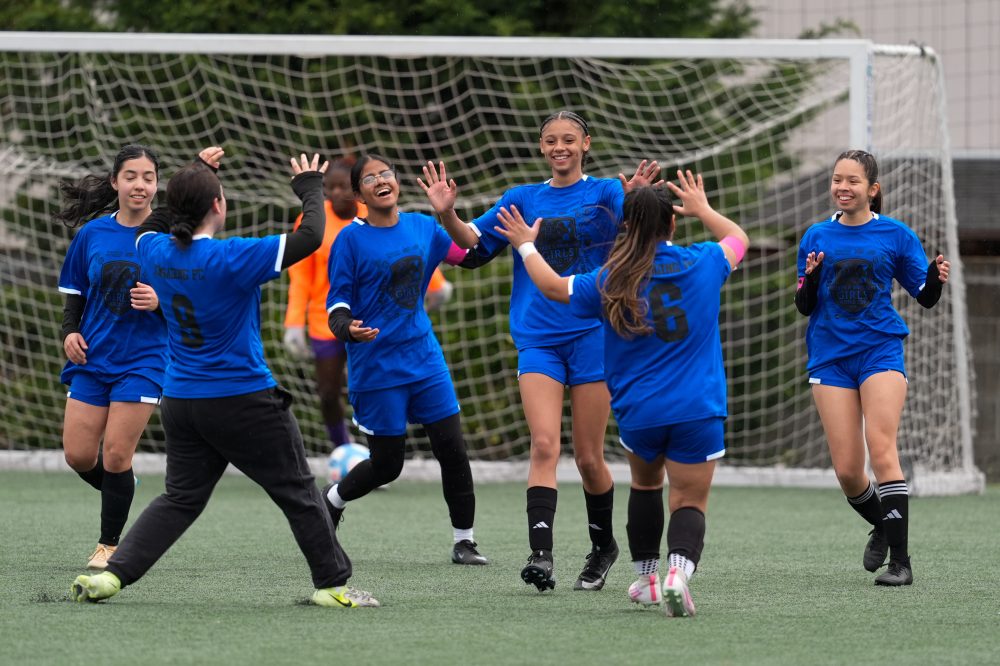

Enthusiastic coaches called out encouragement as young players maneuvered the ball down the field, with cheers erupting from spectators when a goal found its mark during a special soccer tournament in Portland, Oregon.
The weekend event was organized as what its creator called a World Cup specifically for immigrant and refugee girls. Som Subedi, a community advocate who immigrated from Bhutan, developed the tournament to bring happiness and solidarity during a time when federal immigration enforcement has created anxiety for participating families.
During opening ceremonies, Subedi declared that “ICE and federal enforcement must be out of our parking lots, out of our soccer fields, and most importantly, out of the fear in our hearts and minds,” referring to U.S. Immigration and Customs Enforcement.
Subedi’s background includes being part of the Lhotshampa, a Nepali-speaking community that faced persecution from Bhutanese officials in the early 1990s. After spending years in a Nepalese refugee camp, he relocated to Portland in 2008 and later gained American citizenship.
“This is more than a competition. It is more than soccer,” Subedi explained to The Associated Press. “We are making this a community event so that they feel valued and welcomed.”
Concerns about federal immigration enforcement have created widespread anxiety in youth athletics nationwide.
During the previous fall season, Oregon’s Youth Soccer Association had to cancel or postpone multiple Portland-area games due to reports of immigration agents near recreational facilities, according to The Oregonian/OregonLive. Similar incidents occurred elsewhere, including a New York City baseball coach protecting his team from ICE agents during practice, and a Massachusetts high school athlete being detained by immigration officials while heading to volleyball practice before his release.
Federal enforcement activity intensified significantly in the Pacific Northwest during fall months under President Donald Trump’s policies, reaching levels comparable to peak enforcement during the early Obama years, based on University of Washington Center for Human Rights statistics. Oregon experienced a dramatic increase with approximately 1,200 arrests between October and December.
Portland’s ICE facility has become a focal point for ongoing demonstrations protesting immigration policies since June, featuring nightly gatherings for months. The federal agents’ deployment of chemical dispersants like tear gas against protesters has sparked two legal challenges from area residents and demonstrators that are currently under review by federal appellate courts.
Several tournament participants, ranging from ages 10 to 18 and representing families from Mexico, Somalia, Myanmar and other nations, have experienced direct impacts from immigration enforcement. Fifteen-year-old Valeria Hernandez shared that her brother faced deportation to Mexico in recent months.
“I broke down at that moment. I was really sad,” she revealed to the AP, becoming emotional. “He was my best friend.”
Transportation to soccer practice became more challenging after losing her brother’s assistance with rides. She described him as her primary motivation for playing the sport and mentioned sending him a tournament photo before her opening match.
“He was just very passionate about it,” she explained, “so I wanted to be just like him.”
During the ceremony, Valeria, her mother and younger sister received colorful scarves as gestures of community support while dealing with their family separation, with Subedi noting they “deserve to be united” with their deported relative.
Subedi recounted his own family’s experience when his 11-year-old daughter became afraid to attend soccer practice after immigration agents were reported near her school during winter months. Despite showing her his REAL ID and passport for reassurance, anxiety persisted.
“I had to calm her down, and she went into the practice, but also not without the fear,” he recalled.
To establish a secure environment at the tournament, representatives from two police departments and a local immigrant advocacy organization maintained a visible presence. Officers could be seen engaging in casual conversations with attendees around the park perimeter or stationed in vehicles nearby. Oregon’s sanctuary legislation prevents local law enforcement from participating in federal immigration operations.
The police departments agreed to participate in a supportive capacity, according to Subedi, “and their presence helped families feel protected, not policed.”
The gathering of supporters and families also enhanced the welcoming atmosphere, he noted.
“When there’s a feeling of having a community’s back for these girls, I think that creates that sense of belonging, sense of safeness,” he said.
Esraa Alnabelsi, who relocated from Syria to the United States in 2012, expressed enthusiasm about watching her 13-year-old daughter compete while witnessing people from various cultural and religious backgrounds unite.
“We really have to be in one hand to face all that’s happening now in Oregon and other states,” she observed.
The tournament also fostered connections between players. Several girls from non-immigrant families requested participation and were welcomed, as Subedi emphasized the event’s inclusive nature.
Community donations made the tournament completely free for participants, including uniforms and footwear, with girls divided into six squads. Some teams represented specific ethnic communities and organizations, including the Karen people from Myanmar and the African Refugee Immigrant Organization. Winning teams received trophy recognition.
Numerous community members volunteered for various roles, including officiating and coaching positions.
Sergio Medel served as a volunteer coach for his 16-year-old daughter’s team, bringing experience from his professional playing career in Mexico and coaching background in the United States since his 1997 arrival.
“I hope that when they walk away from here, they feel like, ‘Hey, we’re not alone,’” he stated.
Soccer’s status as the world’s most widely played sport creates natural opportunities for diverse communities to connect, with similar immigrant-focused tournaments occurring across the United States in recent years.
Subedi, who has enjoyed playing soccer since childhood, characterized it as a sport where “there is no language needed.”
“You just come together and play,” he concluded.