
During scorching summer heat waves, countless air conditioning units kick on simultaneously across the country, creating enormous strain on electrical systems and increasing the likelihood of power outages while driving up energy costs for consumers. Traditional solutions have involved asking residents to raise their thermostat settings during peak hours — a request many homeowners are reluctant to follow.
A new pilot initiative in New York City is exploring an innovative alternative: compact battery units that can operate air conditioners independently from the grid during high-demand periods, reducing pressure on the electrical system while maintaining comfortable indoor temperatures for residents.
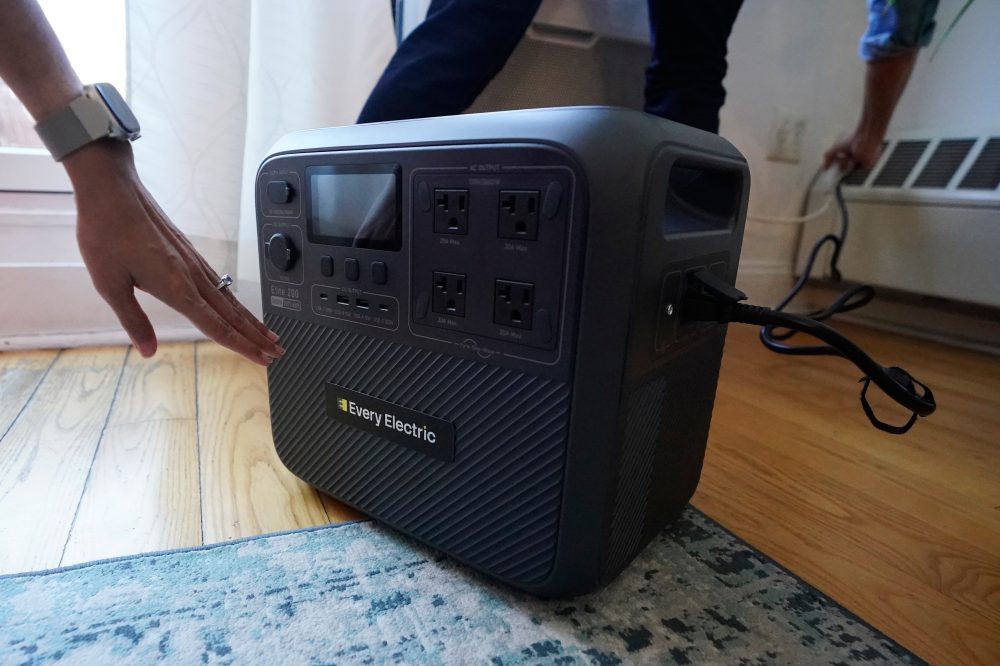
“It’s basically a souped up version of the power bank that you would use to charge your phone when you go out,” explained Andrew Wang, chief executive officer of Every Electric, the company spearheading this pilot project in partnership with Con Edison, the city’s utility provider.
These microwave-sized units store electricity when demand is minimal, then supply power to window air conditioning units for several hours during consumption peaks. The program represents one component of Con Edison’s broader demand response initiatives, which compensate customers for reducing or shifting their electricity usage to support grid stability.
This summer, the pilot project is expanding to include more than 1,000 households, with participants eligible to receive monetary rebates for their involvement.
Energy specialists note this program exemplifies the growing trend toward virtual power plants, where numerous small, distributed energy sources work together to alleviate stress during peak demand periods. When implemented on a larger scale, such solutions could substantially improve power system reliability and cost-effectiveness.
During electricity demand surges, utility companies frequently activate backup generating facilities that operate infrequently and tend to be less efficient and more environmentally harmful, according to Kevin Brehm, a manager at RMI, a nonprofit organization focused on energy system research and clean power transitions.
Eventually, these demand spikes can force utilities to construct additional power facilities, often relying on fossil fuels, with associated costs ultimately transferred to consumers.
“There’s a question of emissions, and then there’s also a really important question around affordability,” Brehm stated.
This explains why utility companies frequently request energy conservation during the year’s hottest days and implement higher pricing during peak periods to incentivize power reduction. However, these approaches “can be hard to rely on because they don’t know exactly how consumers are going to behave,” Brehm noted.
Solutions like Every Electric’s technology can address this uncertainty.
Utility companies and government agencies are increasingly seeking methods to handle growing electricity demand as heat waves become more common and severe.
Every Electric’s demand response program represents one approach, compensating customers for reducing or shifting electricity consumption during high-demand periods.
Virtual power plant initiatives offer another expanding solution, implemented state by state. These programs link thousands of small energy devices, including home batteries and smart appliances, coordinating them to return power to the grid during demand spikes, reducing strain without requiring new plant construction. California is developing one of the world’s largest such programs, compensating hundreds of thousands of participants for returning stored energy to the grid during extreme weather events. Most existing programs are restricted to homeowners with solar panel installations.
Con Edison indicated that battery systems can help decrease peak demand, support renewable energy adoption, and reduce infrastructure expansion needs.
Every Electric’s program specifically targets users of window air conditioning units, typically renters, though it doesn’t send power back to the grid. Instead, it decreases demand by utilizing stored battery energy.
Nevertheless, Brehm said programs like this contribute to the broader effort to incorporate consumer energy devices into the grid while rewarding the services they provide.
“I can’t put solar panels on my roof,” said Bianca Pasternack, a New York City renter participating in the program. “This is at least something that’s accessible and easy. It was very set-it-and-forget-it.”
The battery connects to the air conditioning unit, then plugs into a standard wall outlet. A smartphone application detects low-demand periods, charging the battery during off-peak hours and powering the AC during peak times, typically between 1-4 p.m. or 4-8 p.m. during the warmest months.
Program participants also receive financial compensation, roughly equivalent to a July electricity bill’s cost, according to the company. Pasternack reported receiving a $100 gift card at season’s end.
The company reports its pilot is expanding from approximately 200 kilowatts of flexible capacity last year to roughly 2 megawatts this summer, with potential for much greater expansion. For comparison, California’s program exceeds 200 megawatts. Wang said the company is exploring expansion to additional cities.
While Every Electric’s program currently operates on a limited scale, Brehm believes systems like this could significantly reduce grid strain if they reach sufficient households.
“It’s a matter of how we’re able to get to that scale,” he explained, emphasizing that widespread adoption depends on how easily the technology can be deployed and integrated into existing systems. He praised Every Electric’s accessible installation process as “plug-and-play and you don’t need a ton of permissions.”