
Federal transportation safety officials revealed Wednesday that a fatal UPS aircraft accident claiming 15 lives last year could potentially have been avoided if stricter maintenance inspection requirements had remained in place, rather than being reduced at Boeing’s request.
During testimony before the National Transportation Safety Board, investigators learned that Boeing used outdated information when requesting extended inspection intervals in 2015, failing to properly consider seven documented cases of engine mount component failures on similar aircraft models. The Federal Aviation Administration approved Boeing’s proposal after just one month of review without requesting additional data.
“Safety is a shared responsibility between the airline, the manufacturer, and the regulator. And the NTSB is attempting to parse out the roles and responsibilities of each of those three entities,” aviation safety expert Jeff Guzzetti said.
The expert, who previously worked as a crash investigator, noted that the two-day proceedings revealed critical safety data wasn’t being properly communicated between all parties involved, and suggested federal regulators should have been more questioning of Boeing’s proposal.
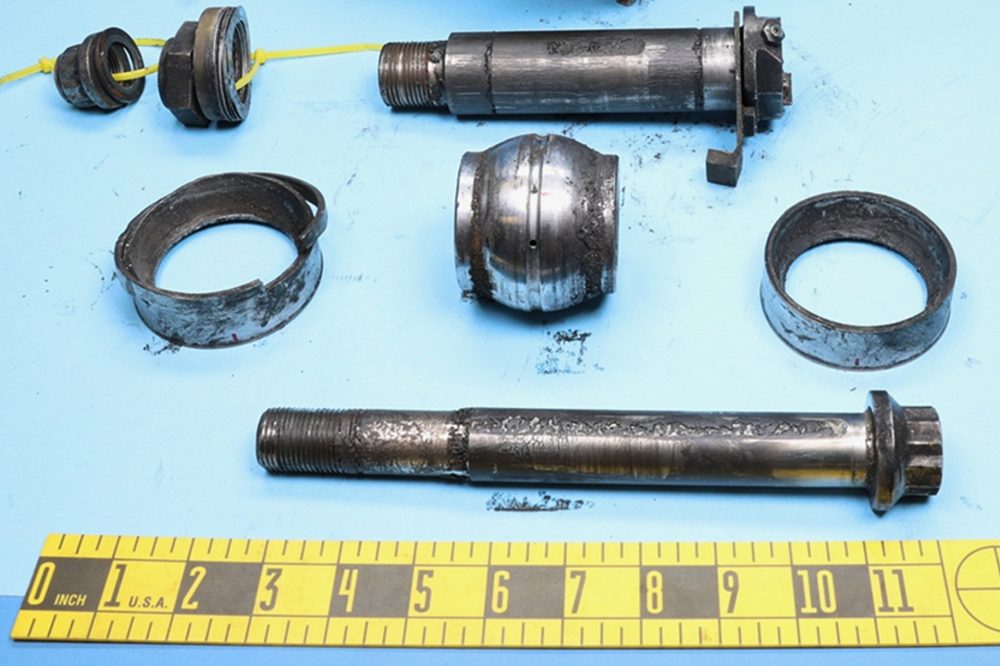
Representatives from both Boeing and the FAA admitted they failed to fully comprehend the dangers associated with potential failures of steel bearings and metal sheaths within engine mounting systems prior to the accident. They didn’t realize these components could cause the attachment points securing engines to MD-11 aircraft wings to break. These bearings are located deep within the engine pylon area, making defects difficult to detect without complete engine removal for thorough examination.
Boeing successfully obtained approval to extend mandatory inspection requirements from every 19,900 flight cycles to every 29,260 cycles, allowing airlines to coordinate major maintenance work more efficiently with reduced aircraft downtime. The manufacturer pursued this modification despite having received reports about seven bearing defects that occurred well before aircraft reached their original inspection thresholds. Following the relaxed schedule implementation, three additional instances were identified before the crash occurred.
The aircraft that crashed after losing its engine during takeoff acceleration at Louisville’s Muhammad Ali International Airport had completed 21,043 flight cycles, meaning it would have undergone comprehensive inspection under the previous requirements. The accident resulted in the deaths of all three crew members and 12 individuals on the ground, with 23 others sustaining injuries. Only one other crash involving a similar aircraft model losing an engine has occurred in decades, but that incident was attributed to maintenance errors rather than the same structural defect.
Aircraft operators typically don’t deviate from federally approved maintenance protocols, according to Greg Raiff, who owns multiple aviation maintenance businesses and operates aircraft through Elevate Aviation Group.
“I would not expect UPS or any other operator to do it unless it’s specifically on the manufacturer’s design maintenance programs,” Raiff said. “Surely everyone at UPS feels awful about this tragic accident, but it’s not up to individual airlines to reinvent the inspection program for the airplane.”
NTSB Chairwoman Jennifer Homendy criticized the FAA for not adequately challenging Boeing’s 2015 request, noting that even if regulators weren’t aware of all component failures, they knew the manufacturer had issued service notifications about them and had previously documented two instances.
“I’m confused on why you wouldn’t ask for more information, more testing, and why you would just accept information that Boeing provided in the late 80s during certification, 30 years earlier basically,” Homendy said.
Boeing’s Director of Airframe Service Engineering Justin Konopaske couldn’t always explain his company’s decision-making process because documentation wasn’t available. The MD-11 and its predecessor the DC-10 were originally developed by McDonnell Douglas before that corporation merged with Boeing in 1997. However, he acknowledged Boeing should have provided complete details about known issues to the FAA when requesting the extended inspection schedule.
“I believe transparency is critical in that process. I don’t know what the engineers were considering or how they were considering, or if they considered those bearing failures in that discussion, I can’t say,” Konopaske said.
The NTSB will continue examining all potential contributing factors to this accident before releasing its final report, expected either late this year or next year.
Meanwhile, FedEx has returned its MD-11 fleet to service this month after the FAA approved Boeing’s safety assurance plan. Engine mounts received detailed inspections following the November crash, and new procedures require spherical bearing replacement every 4,000 flight cycles. Homendy noted that documented problems from 2002 to 2009 all occurred between 6,058 and 13,650 cycles.