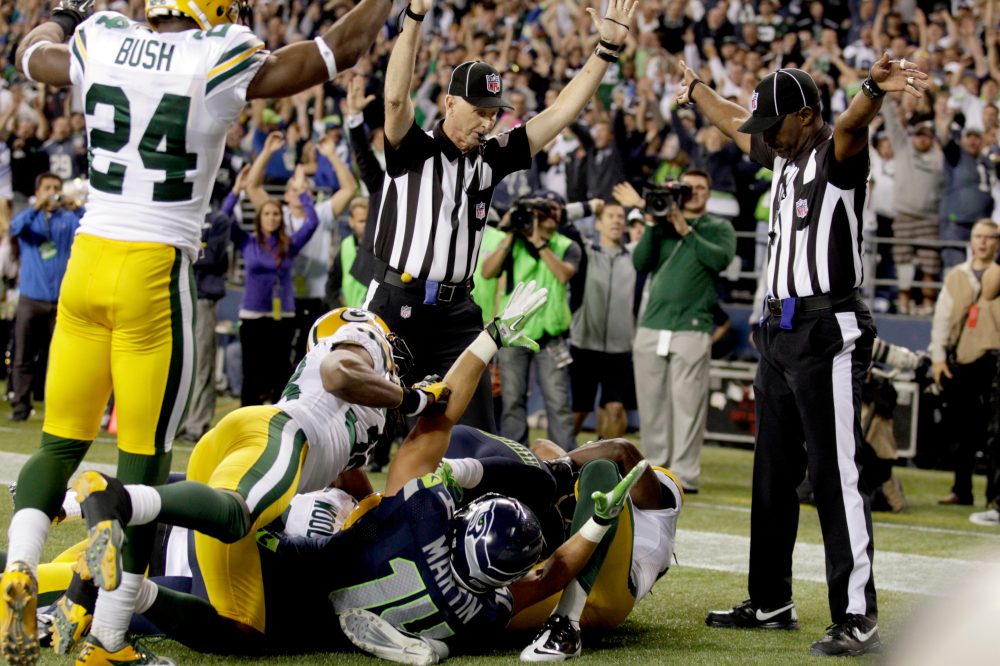

The National Football League is once again facing the prospect of starting a season with substitute officials after contract talks with the referees’ union have stalled, bringing back memories of the chaotic 2012 season that concluded with one of the most controversial calls in football history.
League officials are moving ahead with plans to recruit and train replacement referees in the coming weeks, according to two sources familiar with the negotiations who spoke anonymously to The Associated Press on Sunday.
The last time the NFL relied on substitute officials during the opening weeks of 2012, the experiment culminated in disaster during a Monday Night Football matchup between Seattle and Green Bay that featured the notorious ‘Fail Mary’ play.
In that game’s final moments, with Seattle trailing 12-7, quarterback Russell Wilson threw a desperation pass to the end zone where receiver Golden Tate pushed cornerback Sam Shields aside before battling Green Bay’s M.D. Jennings for the ball. While Jennings appeared to make the initial catch, the substitute officials delivered conflicting signals – one indicating a touchback, the other a touchdown.
The play was ultimately ruled a simultaneous catch, awarding Seattle the victory in a decision that sparked nationwide outrage.
“It was awful,” Packers quarterback Aaron Rodgers commented afterward. “Just look at the replay. And then the fact that it was reviewed, it was awful.”
The NFL later acknowledged that Tate should have been penalized for offensive pass interference, which would have secured Green Bay’s victory, though they maintained insufficient evidence existed to reverse the catch ruling.
Las Vegas bookmakers estimated that controversial decision affected at least $300 million in worldwide betting action – a figure that would be substantially larger today given the expansion of legal sports gambling.
Dallas safety Gerald Sensabaugh captured the frustration felt across the league at the time, saying: “Would you let a Toyota dealership work on your brand new Rolls-Royce? That doesn’t work right, does it. Our brand is so big, it’s so important to a lot of people. There’s no way you can have guys that don’t have experience at that level.”
The controversy extended beyond that single play. The previous evening, another prime-time contest ended in dispute when Baltimore kicker Justin Tucker’s 27-yard field goal was ruled successful despite appearing to miss wide right, giving the Ravens a 31-30 victory over New England. Patriots coach Bill Belichick was subsequently fined $50,000 for grabbing an official’s arm while seeking a review.
Player safety concerns also emerged during the 2012 replacement period. In one incident, Pittsburgh safety Ryan Mundy delivered an uncalled helmet-to-helmet blow to Oakland receiver Darrius Heyward-Bey, who required hospitalization for a concussion and neck injury. Mundy later received a $21,000 fine.
Procedural errors plagued games throughout those three weeks. Seattle received an undeserved timeout during their opener against Arizona when officials incorrectly failed to charge them for one following an injury in the final two minutes. San Francisco was granted two additional challenges in their loss to Minnesota despite coach Jim Harbaugh having no timeouts remaining.
“I granted him the challenge and we went and looked at it,” replacement referee Ken Roan admitted afterward. “That was wrong. I should not have.”
During overtime of a Tennessee-Detroit matchup, officials incorrectly enforced a penalty, giving the Titans an extra 12 yards on a drive that concluded with the game-winning field goal.
“Obviously, there was a miscommunication, or I don’t know what you call it, from an enforcement standpoint,” Lions coach Jim Schwartz observed.
Questions about impartiality also surfaced when side judge Brian Stropolo was removed from a Carolina-New Orleans game just hours before kickoff after the league discovered his Facebook page contained photos of him wearing Saints gear while tailgating.
The NFL previously used replacement officials during the 2001 season’s opening week, though that experience generated fewer memorable controversies. The labor dispute was resolved shortly after September 11th, allowing regular officials to return when games resumed following a one-week suspension.
However, complaints still emerged from that earlier period. Oakland quarterback Rich Gannon noted multiple missed calls following a Raiders victory, while Washington defensive end Bruce Smith wrote a formal complaint to Commissioner Paul Tagliabue about poor officiating.
“The officiating crew that we had today was horrible,” Smith stated after Washington’s loss to San Diego. “There were a number of plays out there, at least six, and we’re going to send into the league and I would hope that the league would take action and fine these guys. They were a mess and they definitely put players’ careers in jeopardy. This is unacceptable.”
Not everyone shared those concerns, with Seattle coach Mike Holmgren saying at the time: “I thought they did a pretty good job. They didn’t throw a lot of flags and they kept the game under control.”
Statistics showed 1.6 fewer penalties called per game during that week with replacement officials compared to the remainder of the 2001 season.
As the league prepares for another potential labor dispute, officials are considering rule modifications that would allow the replay center to correct obvious mistakes, including certain penalties not typically subject to review, if replacement referees are used.