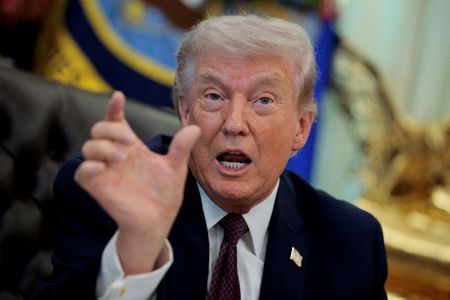

WASHINGTON, June 12 – A recent Reuters/Ipsos survey reveals that roughly half of evangelical Christians – a key segment of President Donald Trump’s political coalition – question whether his administration’s Iran military campaign and immigration policies align with their Christian beliefs.
The evangelical community played a crucial role in the Republican’s 2024 electoral success, and Trump along with senior officials like Defense Secretary Pete Hegseth frequently incorporate religious rhetoric when discussing their policy objectives. The party will rely heavily on this demographic during November’s midterm contests, where they face the challenge of maintaining narrow control in both chambers of Congress.
The survey, conducted June 3-8, found that 54% of evangelicals viewed Trump’s military operations in Iran as inconsistent with their Christian understanding, while 41% considered it aligned. Similarly, 51% of evangelical respondents felt the administration’s immigration approach conflicted with Christian principles, compared to 44% who saw it as compatible.
Trump’s support among evangelicals registered at 52% in the most recent polling, representing a decline from 61% recorded in August, though still significantly higher than his 35% approval among the broader American population.
His overall approval numbers have declined in recent months as the controversial Iran conflict has driven fuel costs substantially higher.
During his initial presidency, Trump fulfilled a long-sought evangelical objective by establishing a 6-3 conservative Supreme Court majority, which subsequently reversed the decision that had guaranteed nationwide abortion access.
In his current term, he has frequently welcomed religious leaders to the Oval Office and modified policies to permit federal workers to express their faith-based views in the workplace.
Evangelical voters lean Republican by more than a 2-to-1 margin, and Trump captured the white evangelical vote 81%-16% in 2024, based on exit polling analysis from the Pew Research Center.
White House spokeswoman Taylor Rogers stated that Trump has fulfilled promises to faith communities by protecting religious freedoms and pardoning anti-abortion activists with criminal convictions. “There has never been a greater president for Christian Americans than President Trump,” Taylor said.
Potential fractures within this critical voter group could create additional challenges for the Republican Party heading into the midterm elections.
Evangelical Christian Sandy Miller, 63, indicated she would not support him again given the chance. The Worthington, Indiana resident, from a community of approximately 1,400 people, cares for a 24-year-old daughter whose home-healthcare Medicaid benefits were eliminated under Trump.
Beyond her economic circumstances, Miller emphasized that her faith guides her voting decisions. She believes Trump may be a Christian but doesn’t demonstrate it publicly.
“I just don’t think waging war is the answer to everything all the time,” Miller said. “I understand sometimes you have to, but I don’t know in this instance that it needed to be done.”
Miller shared that she prays nightly for the nation’s leaders to follow God’s guidance. “I wish our politicians would pray more than they talk,” she said.
The Reuters/Ipsos survey included 4,531 American adults nationwide with a margin of error of 2 percentage points in either direction.
Evangelicals also rate Trump poorly on cost-of-living management.
The United States and Israel launched the Iran war on February 28 to prevent the Iranian government from completing nuclear weapon development. Despite the conflict’s effect on family budgets, Trump has pledged to prevent Iran from acquiring nuclear capabilities regardless of cost.
The Iran war has resulted in thousands of casualties, including over 3,000 in Iran according to official counts, though rights organizations estimate closer to 3,600, plus more than 1,800 deaths in Lebanon and over 100 in Iraq, based on official and NGO data.
Many evangelicals view the United States as morally bound to defend Israel, a crucial American ally in the Middle East region.
Connie Reese, 77, an evangelical voter from Iowa, explained in a subsequent Reuters interview that his backing for Trump’s Iran war has biblical foundation, and that nations possess the right to defend themselves preemptively. While acknowledging disagreements with Israel’s government at times, he believes the Jewish people have “historical grounds for their homeland.”
“The re-establishment of Israel, the country, is a prophetic answer or an answer to a prophecy that is clearly spelled out in the word of God,” he said. “So in that regard, I support Israel as a free and sovereign nation.”