
Following the Pearl Harbor attack, thousands of second-generation Japanese Americans enlisted to serve the United States during World War II, despite the fact that their own families had been imprisoned in government detention facilities and labeled as “enemy aliens.”
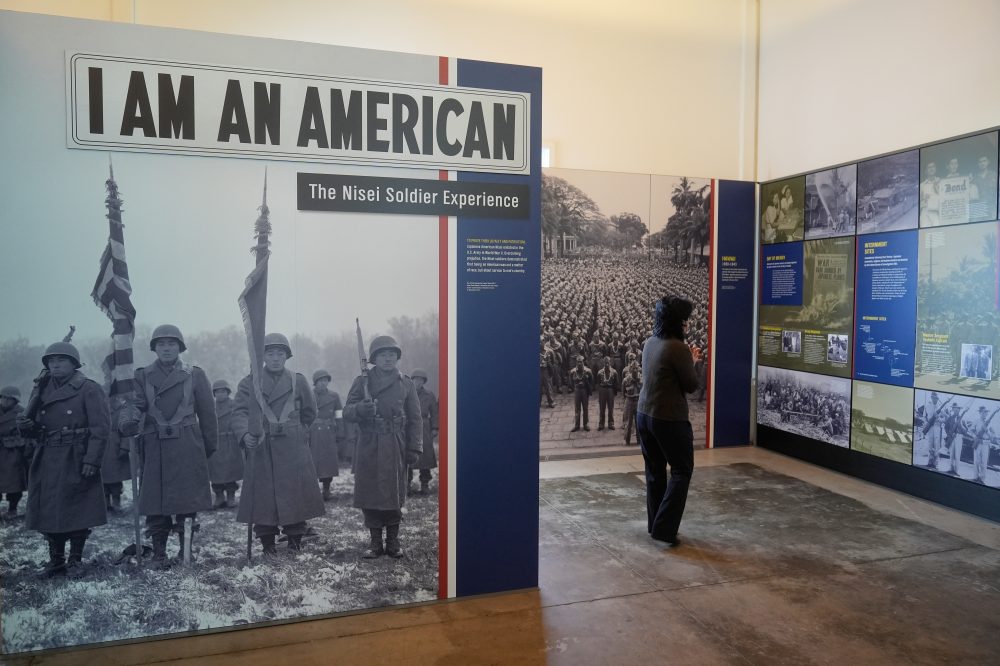
Now, many years after these veterans returned home to continued prejudice and bias, their service is being celebrated through a new traveling display that launched in San Francisco. The exhibition, titled “I am an American: The Nisei Soldier Experience,” takes its name from a prominent banner displayed at a Japanese American business in Oakland, California, on the day following Pearl Harbor.
This 1,500-square-foot display showcases family photographs, personal keepsakes, and brief biographical accounts of these Nisei servicemen, contributed by their descendants to preserve these tales of courage for future generations, particularly as issues surrounding national identity remain relevant today.
Among the featured items is a travel case belonging to Sgt. Gary Uchida, decorated with his own sketches of his Hawaiian homeland and locations he visited during his military service.
Visitors can view a military identification document where Oregon native George S. Hara clearly wrote “American” under the nationality section.
One particularly moving piece is a note holder crafted by Rihachi Mayewaki using wood scraps during his detention at Jerome camp in Arkansas. The handmade item displays an American bald eagle alongside a blue star banner containing three stars, representing each of his sons: Ben, who worked in enemy intelligence analysis; Charles, who trained with the renowned 442nd Regimental Combat Team; and Hachiro, who served as a military translator.
The word “nintai,” meaning endurance in Japanese, appears at the base of this holder.
“The father was incredibly proud he had three sons serving in the American army,” Christine Sato-Yamazaki, executive director of the National Veterans Network and co-curator of the exhibit, said last month at a ribbon-cutting ceremony for the exhibit.
Approximately 33,000 Japanese Americans served in World War II, even as the U.S. government forcibly relocated an estimated 120,000 people of Japanese heritage to remote detention centers. Many detainees were elderly individuals or young children who had no understanding of betrayal. Two-thirds held American citizenship. Their properties and businesses were confiscated during their imprisonment, frequently housing them in crowded, wooden barracks in desolate areas with difficult living conditions.
The United States did not issue an official apology until 1988.
“These soldiers wanted to prove they were loyal patriotic Americans, part of the greatest generation at that time and they were American — just like anybody else,” said Sato-Yamazaki, whose grandparents did not talk about their time in camp or at war. The garrison cap worn by her grandfather, Tech. Sgt. Dave Kawagoye, is featured in the exhibit. It contains the words “Go for Broke,” the motto of the famed 442nd.
Japanese Americans enlisted in the 442nd Regimental Combat Team and 100th Infantry Battalion, both decorated but racially separated military units. They additionally worked as interpreters within the Military Intelligence Service. Approximately 800 Nisei soldiers died in combat.
This five-year touring exhibition will remain at San Francisco’s Presidio until August before traveling to 10 additional cities, including Honolulu, Los Angeles, and Portland, Oregon. The National Veterans Network, National Museum of the United States Army, and Army Historical Foundation sponsor the display.
Staff Sgt. Robert Kuroda is among the soldiers highlighted in the exhibition. As a second-generation Japanese American in Hawaii, he faced employment discrimination based solely on his ethnic background. He decided to enlist in World War II, believing that military service would eliminate employers’ ability to refuse him work.
On October 20, 1944, Kuroda pushed forward through intense enemy fire to eliminate two enemy machine gun positions after participating in the liberation of the French town of Bruyères from Nazi control. He maintained his attack until enemy sniper fire ended his life. He was 21 years old.
Kuroda received the Distinguished Service Cross posthumously, which was subsequently elevated to the Medal of Honor. The medal citation recognized that his “courageous actions and indomitable fighting spirit ensured the destruction of enemy resistance.”
The exhibition displays Kuroda’s Medal of Honor alongside his high school class ring, which held special significance in his family as the first of nine children to complete graduation.
The ring remained lost until 2021 when metal detecting enthusiast Sébastien Roure discovered it buried in woodland near Bruyères. Roure dedicated significant effort to returning the Farrington High School class ring to the Kuroda family, and now both families maintain contact, communicating through translation apps and basic French and English.
Prior to the exhibition, both the ring and medal were kept in a display case at a relative’s automotive repair shop near Honolulu.
“The family just felt if we could, in our own ways, help others, the country, know the sacrifices of the previous generation and what they did for our lives, then, even better,” said Kevin Kuroda, a nephew who traveled from Hawaii for the exhibit’s opening.