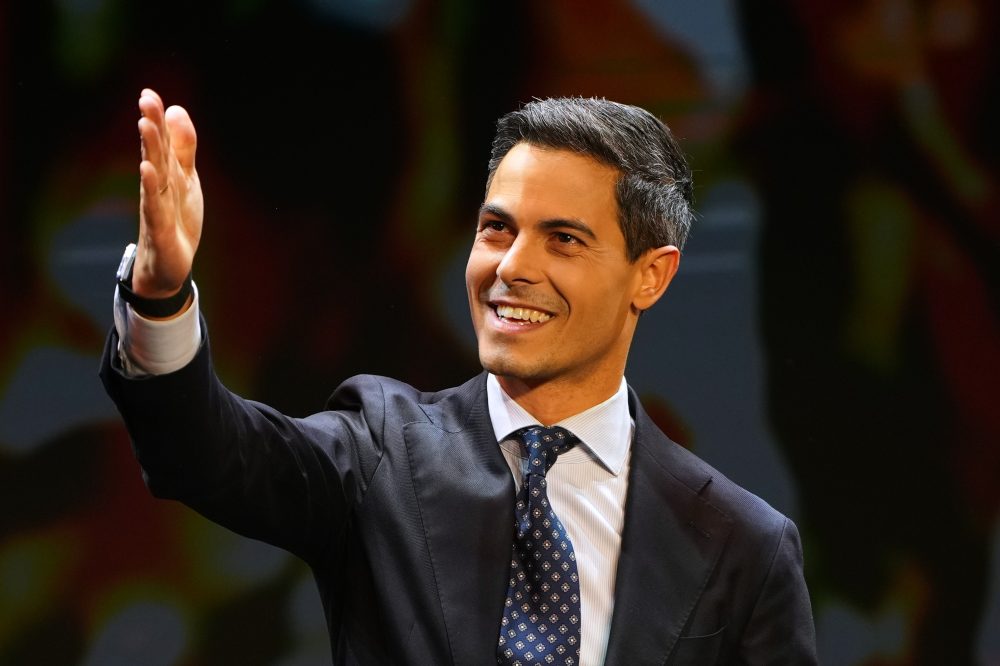

THE HAGUE, Netherlands — The Netherlands welcomed its youngest prime minister in history Monday as Dutch King Willem-Alexander administered the oath of office to 38-year-old Rob Jetten and his new minority coalition government.
Jetten leads a three-party alliance consisting of his centrist D66 party, the center-right Christian Democrats, and the center-right People’s Party for Freedom and Democracy. The coalition controls just 66 seats in the 150-member lower parliamentary chamber, creating significant governing challenges that will require Jetten to secure opposition backing for every legislative proposal.
The new administration faces immediate resistance from the largest opposition group, the recently combined Green Left and Labor Party, which has voiced strong disapproval of Jetten’s proposed reductions to healthcare and social welfare spending.
Opposition leader Jesse Klaver criticized the government’s fiscal approach in a Friday post on X, stating that under the new administration’s proposals, “ordinary people will have to pay hundreds of euros more, while the wealthiest are not asked to contribute anything extra.” Klaver continued: “We are taking responsibility to adjust these plans. This must change.”
The swearing-in ceremony took place at the royal palace located in a wooded area outside The Hague, where Jetten and his ministerial team formally accepted their positions. Following the traditional Cabinet photograph on the palace steps, the new government held its inaugural meeting.
Jetten secured victory in the October 29th election by the narrowest of margins, earning the same seat count as anti-Islam politician Geert Wilders’ Party for Freedom but receiving slightly more total votes. The final outcome was determined through postal ballot tallying.
The unexpected election occurred after Wilders, who had won the previous contest, pulled his ministers from the four-party right-wing coalition his party controlled in June of last year. Departing Prime Minister Dick Schoof, whose administration lasted only 11 months and ranks among the briefest in Dutch history, has served in a caretaker capacity since then.
The new prime minister aims to establish a fresh period of parliamentary cooperation following years of divisive partisan conflicts across the fragmented political landscape.
Jetten also seeks to restore the Netherlands’ diminished influence within the European Union, which many observers believe weakened under the previous administration.
Speaking to The Associated Press last month, Jetten, who has previously criticized U.S. President Donald Trump, explained that among his initial priorities will be to “talk to my colleagues in Europe to see what role the Dutch can play again in strengthening the European cooperation.”
However, he emphasized the continued significance of Dutch-American relations, noting the United States’ importance as a key economic partner.
Jetten has committed to sustaining robust Dutch assistance for Ukraine in its ongoing conflict against Russia’s four-year military offensive.
Cabinet positions in the new government are distributed among Jetten’s party and his coalition allies.
Christian Democrat Tom Berendsen assumes the foreign ministry role and is anticipated to work toward revitalizing the Netherlands’ European standing, drawing on his experience as his party’s European Parliament delegation leader.
Finance Minister Eelco Heinen continues in his current position from the previous government, where he earned recognition for his prudent fiscal management.
Dilan Yeşilgöz-Zegerius, formerly justice minister and head of the People’s Party for Freedom and Democracy, transitions to defense minister, where she will manage efforts to strengthen the country’s armed forces.
Christian Democrat Bart van den Brink takes charge of asylum and immigration policy, with expectations that he will advance the former government’s initiatives to limit migration and expedite asylum application processing.