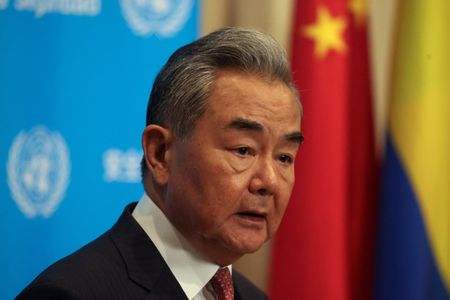

BEIJING — Nepal’s Foreign Minister Shisir Khanal sat down with China’s leading diplomat Wang Yi on Monday in Beijing, marking his first official visit to the neighboring superpower since his party claimed victory in March elections — and coming just days after he wrapped up a trip to China’s regional rival, India.
For Chinese diplomats, the change in government on their doorstep creates a tricky situation. Analysts say Beijing has been working hard to maintain strong ties with neighboring countries while also pressing its territorial claims in the East and South China Seas — and the removal of a Communist Party-led coalition government in Nepal complicates that effort.
According to a statement released by China’s foreign ministry late Monday, Wang told Khanal that “China has always placed Nepal at the forefront of its ‘neighbourhood diplomacy’” and pledged that China “will support Nepal in safeguarding its national sovereignty and territorial integrity.”
Analysts note that Nepal’s close relationship with the South Asian powerhouse India gives the country of roughly 30 million people some leverage when dealing with China — putting Beijing in the unusual position of having to demonstrate its value as a partner.
Nepal and India have had a long-running dispute over their shared 1,751-kilometer (1,088-mile) border that has stretched on for about 80 years. Still, when Khanal met with officials in Delhi earlier this month, he indicated that the new Nepalese government was “free from the political baggage from the past” and eager to strengthen ties with India.
Relations between Nepal and China have stalled in recent years, largely due to delays in delivering infrastructure projects tied to Chinese leader Xi Jinping’s signature “Belt and Road” initiative. Nepal joined that program in 2017, but disagreements over financing have slowed progress significantly.
During Monday’s meeting, Wang reaffirmed China’s intention to help build up Nepal’s infrastructure, pointing to planned cooperation in areas including electricity generation, road construction, ports, and aviation.
Eric Olander, co-founder of the China-Global South Project — a media and research organization — suggested China may not have anticipated the shift in Nepal’s political landscape.
“Beijing doesn’t like change that directly impacts them,” Olander said. “Change that is potentially hostile or challenges their interest is what gets their attention.”
“My guess is they didn’t see this coming in Nepal and they don’t like it when popular movements overthrow incumbent governments,” he added.