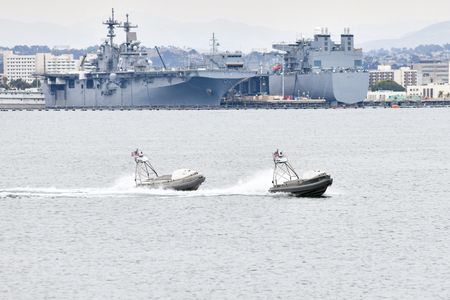

The U.S. Navy made history when an unmanned vessel successfully rescued two Army helicopter crew members whose aircraft was downed in the Middle East, marking the first recorded instance of American forces using a robotic ship for personnel recovery operations at sea.
Military officials identified the rescue vessel as a Saronic Corsair, measuring 24 feet (7.3 meters) in length and capable of operating without human crew aboard. This autonomous craft represents part of the Pentagon’s broader initiative to integrate robotic systems with conventional military equipment.
Several important developments highlight America’s expanding sea drone capabilities:
• Revolutionary naval operations: In 2021, the Navy established Task Force 59, headquartered in Bahrain as the service’s inaugural unit focused exclusively on robotic systems. These Corsair vessels began operational deployment in the Middle East during late March.
• Versatile water-based robotics: American forces operate both surface-level unmanned craft and submerged robotic vehicles, providing military leaders with adaptable options based on mission requirements. The most sophisticated underwater systems remain classified. These robotic platforms offer distinct operational advantages while minimizing danger to American personnel.
• Diverse mission capabilities: Naval drones perform surveillance operations, locate underwater explosives, and monitor hostile forces. Military planners are also developing these vessels for direct combat applications. They prove valuable for both standard patrol duties and dangerous operations.
• Economic and tactical benefits: Pentagon leadership views autonomous vessels as an affordable method to extend operational range and accelerate threat response. Naval officials plan widespread deployment involving hundreds, possibly thousands of Corsair units. However, maritime drone technology continues developing and encounters both technical and operational obstacles.
• International combat effectiveness: Although not American-built, Ukraine’s deployment of sea drones against Russia has proven their military value, including destroying naval vessels and reportedly shooting down a helicopter — an extraordinary achievement for unmanned maritime craft.