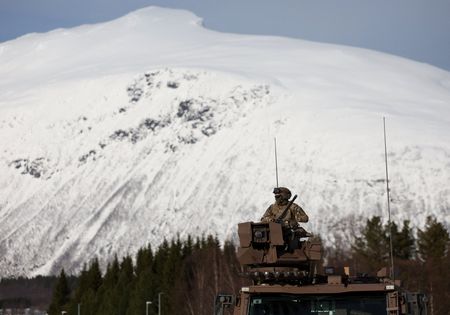

On a frigid morning in Arctic Norway, British and Norwegian soldiers moved quietly through a snow-covered birch forest, taking part in a simulated NATO reconnaissance mission. They were among roughly 30,000 troops rehearsing a counter-attack against a fictional “enemy to the east” — widely understood to mean Russia — during large-scale military exercises held in March.
Over the past decade, Russia has surged ahead in Arctic military capability, modernizing the world’s largest icebreaking fleet as melting ice opens new shipping routes, and reopening dozens of Soviet-era military bases in a region that offers the shortest path for its nuclear missiles to reach the United States.
Those March exercises were part of a broader initiative called Arctic Sentry, designed to demonstrate to Washington that Europe and Canada are capable of protecting NATO’s northern flank. NATO Secretary General Mark Rutte launched Arctic Sentry in February as part of his effort to convince U.S. President Donald Trump to abandon his push to acquire Greenland.
Rutte succeeded on that front, but meaningfully strengthening NATO’s Arctic position is a far more difficult task, according to interviews with dozens of current and former NATO officials and Arctic security experts.
Doing so requires sustained, large-scale investment across many areas — including icebreakers, submarines, drones, and satellites — placing heavy demands on allies’ budgets and militaries at a time when Trump has threatened to pull the United States out of NATO entirely, while Washington simultaneously pulls back troops, aircraft, ships, and weapons from Europe.
For most of NATO’s eight decades, the harsh and remote High North was treated as a low priority. But melting sea ice, Russia’s expanding footprint in a mineral-rich region larger than the entire United States, and growing Chinese interest in the area have forced a strategic rethink.
“No major power in the 21st century will be able to maintain its position on the global scene without, in one way or another, having a strong presence in the Arctic,” said Olafur Ragnar Grimsson, a former Icelandic president who now chairs the Arctic Circle forum, sometimes called the ‘Davos of the Arctic.’
Reuters was unable to determine whether the United States is contributing more or less to collective Arctic defense under the Arctic Sentry program, which is led by Joint Force Command Norfolk, Virginia — a command established in 2019 specifically to address Russia’s growing capabilities in the north. A NATO official responded to questions by stating that the U.S. remains a key contributor to Arctic defense and that this commitment was reaffirmed in a joint statement among Arctic allies in June.
The Pentagon and White House did not respond to questions about whether U.S. forces involved in Arctic defense could be affected by an ongoing American review of troop deployments in Europe. That review, along with continuing concerns about Trump’s ambitions regarding Greenland, is expected to loom over an upcoming NATO summit in Ankara in July.
The White House has previously stated that Trump has pushed allies “to recognize the need to meaningfully contribute to their own defense,” and has described the Arctic as critical to U.S. national security and economic interests.
Russia’s Ministry of Defence did not respond to a request for comment. The Kremlin has previously accused the United States of inflaming tensions in the Arctic.
THE KOLA PENINSULA THREAT
One of the most pressing challenges for European NATO members is keeping tabs on military activity on Russia’s Kola Peninsula, which borders both Finland and Norway. The peninsula is home to roughly two-thirds of Russia’s second-strike nuclear capabilities, including the Northern Fleet, which operates six of Russia’s 12 nuclear-armed submarines.
From the Kola Peninsula, Russia could launch hypersonic missiles toward the United States, making early warning systems essential. It could also deploy submarines toward the U.S. East Coast via the Bear Gap in the Barents Sea and the GIUK Gap — the strategic waterway between Greenland, Iceland, and Britain.
Norway and other NATO allies currently monitor Russian naval activity in both the GIUK Gap and the Barents Sea, where undersea cables have been damaged in incidents that some officials attribute to Russia. Norway also conducts surveillance of Kola Peninsula installations and shares that intelligence with the Americans.
But NATO needs to significantly improve its intelligence, surveillance, and reconnaissance capabilities, according to Mauro Gilli, a professor of military strategy at the Berlin-based Hertie School.
None of this comes cheaply in the Arctic, where standard military equipment frequently fails. Parts of northern Norway can experience temperatures as low as -45 degrees Celsius (-49 degrees Fahrenheit) in winter, not accounting for wind chill.
Because much of the Arctic is ocean — stretching across Greenland, Iceland, northern Norway, and the Barents Sea — any meaningful security presence must be primarily naval, which is inherently expensive, Grimsson noted. The United States currently operates only two icebreakers. Russia, which controls by far the largest share of Arctic territory, has 42, some of them nuclear-powered.
Satellite systems capable of operating at high latitudes are critical for real-time monitoring, Gilli said, as are long-range drones engineered to function in extreme cold, expanded underwater surveillance networks, and various types of ground-based radar systems. He estimated the total investment needed could reach hundreds of billions of dollars.
Climate change is also complicating submarine detection, as warming oceans alter salinity levels and currents in ways that affect how sound travels underwater — shrinking the range at which submarines can be tracked. Research from the NATO Defence College published in 2025 highlighted the North Atlantic as warming particularly rapidly.
“At the moment we can listen to and track submarines in the Barents Sea and follow them. If we are not doing that and we lose control of the submarines, then we have a problem,” Norwegian Defence Minister Tore Sandvik told reporters in January.
In June, the Icelandic government reported that a Russian intelligence vessel had been spotted monitoring NATO exercises in the North Atlantic and was tracked moving between Iceland and Greenland — a reminder that Moscow is actively watching the region’s strategic waterways.
IS NATO PREPARED?
There are indications that NATO is taking the challenge seriously. Nordic nations rank among the alliance’s top defense spenders and are on pace to reach NATO’s target of spending 5% of GDP on defense by 2035. The U.S. and Finland are jointly working to build up to six new icebreakers, with the first expected next year. Norway is purchasing frigates and submarines. The Nordic countries have also combined their air forces into a fleet comparable in size to Britain’s.
Canada, rattled by Trump’s suggestions that it could become a U.S. state and eager to reduce its long reliance on American defense support, announced a major C$35 billion ($25.7 billion) Arctic defense plan in March. The plan covers military infrastructure including airfields in the region. Canada is also working more closely with Nordic countries and, alongside Denmark, investing in ice-capable vessels. Prime Minister Mark Carney told Reuters during a March visit to Oslo that NATO’s renewed focus on Arctic security was long overdue but welcome.
British officer Vice-Admiral James Morley, deputy commander of JFC Norfolk, said Arctic Sentry will help more NATO personnel gain experience operating in harsh polar environments. “It provides a much more realistic environment,” Morley told Reuters at the Bardufoss air base in northern Norway, where British Royal Marines train on snowmobiles, skis, and helicopters.
The United Kingdom is doubling its permanent Royal Marines deployment in Norway to 2,000 troops. In June, NATO activated a new military grouping of 600 soldiers based in the Lapland regions of Sweden and Finland.
Still, former U.S. deputy assistant secretary of defense for Arctic and global resilience Iris Ferguson, who held that role from 2022 to 2025, cautioned that keeping the Arctic a priority is difficult. “When you have a hot war burning in the East, it’s hard to direct investment into a region that doesn’t feel as hot,” Ferguson told Reuters, referring to Russia’s ongoing war in Ukraine.
KEEPING THE U.S. ENGAGED
American military leaders participating in the Arctic Sentry exercise, known as Cold Response, sought to reassure their European counterparts. “Our commitment is to defend every last inch of NATO territory,” said Major General Daniel Shipley, commander of U.S. Marine Corps Forces for Europe and Africa, speaking in Bardufoss, Arctic Norway.
But anxiety among European leaders remains elevated following Trump’s Greenland threats and his talk of withdrawing from NATO. Last month, the U.S. announced reductions to its contributions to NATO’s crisis response force, including cuts to fighter jets, drones, and ships.
Norway, which has historically maintained close ties with Washington, joined France’s nuclear deterrence initiative in June. Norwegian officials now find themselves making the case that it is in America’s own interest to remain engaged in the Arctic — an argument they never previously felt compelled to make.
“100 kilometres from my border is the world’s largest nuclear arsenal. And it is not directed against me, Mr. President, but against you,” Norwegian Prime Minister Jonas Gahr Stoere said in a speech in February, recounting a conversation he had with Trump at the White House.