
SANTA FE, N.M. — As the United States reaches its 250th anniversary, Native Americans are grappling with a milestone that carries a unique mix of grief, pride, and complicated patriotism — one rooted in centuries of struggle and survival.
The westward push of the 1800s brought devastating consequences for Indigenous peoples across the continent. Forced relocations, broken treaties, and aggressive policies aimed at erasing Native cultures left communities fractured and populations in steep decline. Survival itself was uncertain.
Yet amid that pressure, Lakota women — celebrated for their extraordinary beadwork — found a way to push back. By weaving American patriotic symbols into their creations, they were doing far more than adopting the imagery of the nation that was dismantling their way of life. It was a quiet form of defiance, a method of preserving their values when federal policies were tearing their communities apart.
Now, as the nation celebrates its semiquincentennial, museum exhibitions featuring that intricate beadwork are opening a window into that painful past. Alongside them, works by contemporary Native artists offer sharp commentary on political struggles that continue to this day.
Curators and tribal scholars argue that the Native American experience must be front and center in any honest accounting of U.S. history.
“The United States could not exist without Native history having been here first,” said Aaron Carapella, who is of Cherokee descent and creates maps of Indigenous territories. “There’s so many influences that Native people embedded into the fabric of what we call America.”
Carapella, a student of history, believes the Founding Fathers likely never anticipated that tribal nations would endure as sovereign entities. The expectation was that Indigenous peoples would be absorbed into the broader American population.
Instead, laws like the 1830 Indian Removal Act, signed by President Andrew Jackson, and the 1887 Dawes Act, enacted by President Grover Cleveland, drove forced relocations through brutal passages like the Trail of Tears. Millions of acres of tribal land were broken up and seized. Bounties were placed on Native people in Minnesota and the Southwest, while militias in California further stripped away tribal territories. Then came the boarding schools, where Native children were taken and stripped of their languages, cultures, and religious traditions.
Tribal leaders are clear: this is not distant history. Their communities are still living with the consequences of those policies today.
Currently, 575 tribes hold inherent sovereignty recognized by the U.S. government, with the Lumbee Tribe of North Carolina added to that list in December. The government-to-government relationships between tribes and the United States are unlike arrangements most other nations have with their Indigenous populations.
N. Bruce Duthu, chair of Native American and Indigenous Studies at Dartmouth College and a member of the United Houma Nation, has spoken with Indigenous leaders around the world. He said leaders in places like Bolivia are often stunned to learn how much political power tribes in the U.S. have managed to build over the past half-century — influencing environmental policy and pushing through landmark legislation to hold non-tribal citizens accountable for crimes committed in Indian Country.
“The U.S. is routinely at the top of the heap in terms of a country that, despite all the flaws, at least now in the last 50 years or so, seems to have gotten it right,” Duthu said.
Native contributions to American identity run deep — from concepts of democracy shared with the Founding Fathers to the fierce warrior tradition that drove tribal nations to defend their lands against other tribes, foreign powers, and the federal government alike. That spirit of service endures: Native Americans serve in the U.S. military at one of the highest per-capita rates in the country.
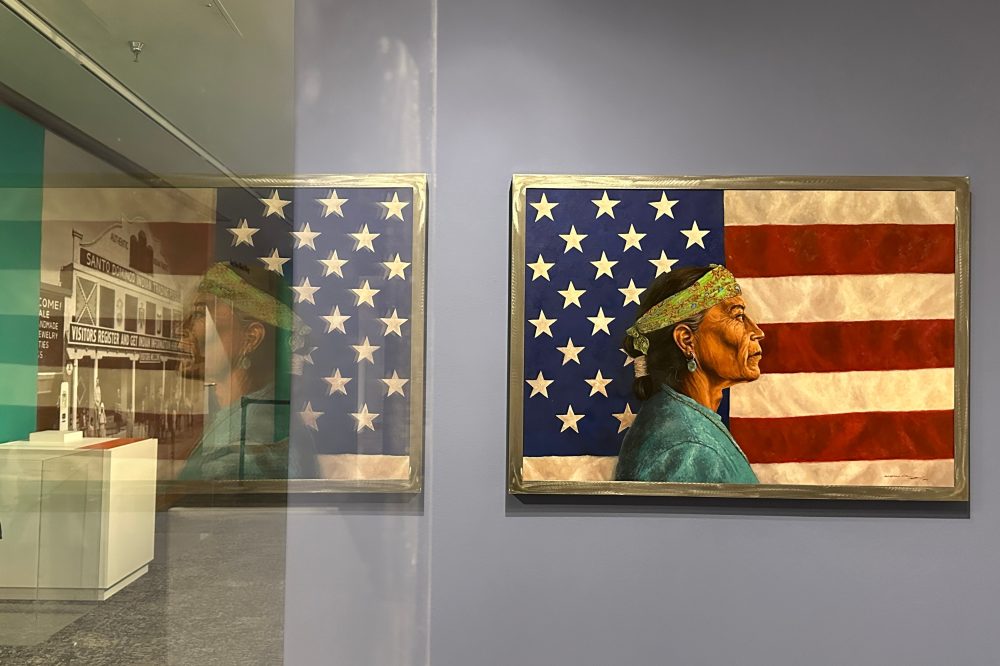
At the heart of the “Stars, Stripes and First Americans” exhibit at New Mexico’s Museum of Indian Arts and Culture hangs a painting by Kee Yazzie called Diné Code Talker, honoring the Navajo Code Talkers whose language-based code proved unbreakable and helped turn the tide in critical World War II battles.
Danyelle Means, the museum’s executive director and a member of the Oglala Lakota Nation, noted that other tribes also contributed code talkers, including the Choctaw Nation and Comanche, Kiowa, Hopi, Muscogee, Sioux, and Seminole recruits.
“Veterans are a huge part of celebration and ceremony within Native communities and are often revered and have their own societies within these communities,” Means said. “So it is something — that aspect of the U.S. and being a warrior for this country — that is very deep-seated in so many Native communities.”
In Washington, D.C., the Smithsonian’s National Museum of the American Indian is marking the 250th anniversary with an installation featuring two dresses that speak to Native heritage and the service of Native American women in the military. One is a Lakota beaded dress, likely made for a Fourth of July celebration roughly a century ago. The other is a modern jingle dress worn by members of the Native American Women Warriors, bearing a patch honoring Lori Piestewa — believed to be the first Native woman killed in combat on foreign soil. The Hopi soldier died from injuries after an ambush in Iraq in 2003.
Those military operations followed the September 11, 2001, attacks — a moment that Navajo artist Pauline Thomas described as frightening, knowing that more Native soldiers would soon be heading into harm’s way. The 73-year-old created a weaving after 9/11 that is now part of the New Mexico exhibition. For Thomas, her weavings capture moments in time while keeping Navajo traditions alive. Her 12-year-old granddaughter is already earning blue ribbons for her own weavings.
“I think it’s very, very important,” Thomas said from her hometown of Naschitti on the Navajo Nation. “I don’t want my people to lose their culture. I want them to learn more about their ancestors, where they came from.”
Jami Powell, curator of Indigenous art at Dartmouth College’s Hood Museum of Art and a citizen of the Osage Nation, uses the phrase “colonial entanglements” to describe the layered complexity of the relationship between the U.S. and tribal nations. She tells her students that the history rarely fits into neat categories of right and wrong.
“And it is OK to have feelings of ambivalence around these issues and the difficult histories that led to this current moment,” Powell said.
The Hood Museum is featuring Native artists’ work as part of its own 250th commemoration. Powell said the pieces are intentionally provocative, designed to push visitors to think not just about the past but about what the next two centuries might hold.
Making sure Native youth have a voice in shaping that future is the mission driving Tracy Canard Goodluck, executive director of the Center for Native American Youth. A member of the Oneida Nation of Wisconsin and of Mvskoke Creek heritage, Goodluck said the depth of young Native voices was on full display in essays submitted for a recent competition centered on the 250th anniversary — essays touching on sovereignty, self-determination, and the bonds between people, land, and culture.
“They know who they are, where they come from, their identity, their culture, their history,” Goodluck said. “And we need to create pathways for them to be able to share that with everyone.”