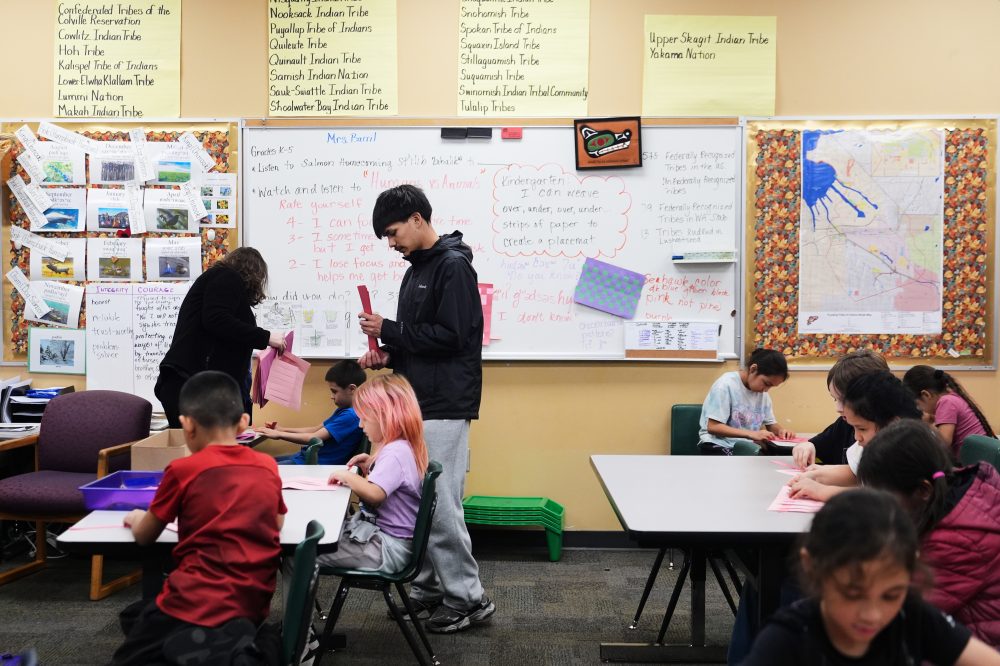

During his final year of high school on the Puyallup Reservation, Gerald Dillon swapped much of his traditional coursework for hands-on career training. Every morning he stepped into a second-grade classroom as a teaching assistant, the young students would leap from their seats to greet him with hugs and fist bumps.
For Dillon, who was 18 at the time and had previously found school dull enough to coast through with minimal effort, those moments gave him a reason to show up.
“It motivates me. I like making connections with the kids, I like helping them,” Dillon said.
The shift began in his junior year when he signed up for career-focused courses. His grades climbed, and he ultimately graduated in June from Chief Leschi Schools in Washington state. He is now weighing the possibility of pursuing a college degree in education.
School administrators say the push toward technical and career-readiness training is showing real results, with more students finishing school on time rather than dropping out.
That kind of progress mirrors a broader trend across the U.S. Bureau of Indian Education, which oversees 183 elementary and secondary schools educating more than 40,000 students. In 2015, just over half of high school students at BIE-affiliated schools graduated within four years. By 2025, that figure had climbed to a record 79%.
Some educators within the BIE credit local program innovations for the improvement. Assistant Secretary of Indian Affairs Billy Kirkland has pointed to the gains as evidence of the Trump administration’s dedication to Native American students, including investments in teacher development. The agency also overhauled how it reports graduation data, correcting longstanding flaws that had caused the numbers to appear worse than they actually were.
Still, significant concerns remain. Moves to dismantle the U.S. Department of Education and ongoing disruptions tied to cuts made by DOGE have raised fears that the progress could be reversed before struggling schools have a chance to catch up.
Agency officials acknowledge that part of the jump in graduation figures reflects more accurate record-keeping rather than a sudden improvement in student outcomes. For years, school administrators throughout the system used faulty tracking methods — often counting students who transferred elsewhere as dropouts.
“We had to come to a consensus and set an accountability framework for our schools,” said Carmelia Becenti, the agency’s chief academic officer.
Starting in 2018, the BIE began standardizing how schools collect and report graduation data. According to Becenti, the result has been a clearer and more encouraging picture of student outcomes.
An Associated Press analysis of BIE data found that graduation rates across the system have risen 55% since the new reporting standards began rolling out, with nine secondary schools reporting growth of 100% or more.
Fewer than one-third of BIE schools are directly run by the federal agency. The remainder are operated by tribal governments using federal funding. At some of those schools, educators say the data improvements only tell part of the story.
Don Brummett, superintendent of Chief Leschi Schools, said his team recognized a “disconnect” between the school’s previous emphasis on college preparation and the reality that many students simply wanted to enter the workforce after graduation.
“We devalued the trades. That was a mistake,” Brummett said.
The school introduced its career and technical education program in 2020, backed by funding from the Puyallup Tribal Council. Since then, Brummett said students who might have otherwise walked away from school entirely have found new motivation through programs in health sciences, education, and fisheries management.
Dillon said the practical, job-focused training suited the way he learns best. “It was kind of the first time I felt excited to go to school,” he said, recalling the days he helped second-graders practice reading and study the life cycle of a frog. Between 2019 and 2025, Chief Leschi Schools saw its four-year graduation rate jump from 53% to 87%.
Career training is just one approach tribal-run BIE schools have taken to keep students on track. At Choctaw Central High School, operated by the Mississippi Band of Choctaw, administrators say a virtual learning experiment launched during the COVID-19 pandemic helped push graduation rates from roughly 70% to 93%.
“For certain kids that have more responsibilities at home, kids that need to work, we saw that (virtual learning) gave them a flexible schedule and an opportunity to earn their diploma,” said principal Alaric Keams.
After pandemic restrictions ended, the district kept the virtual option available to all high school students.
Not every tribal government, however, has the financial resources to fund these types of programs or take over management of BIE schools.
Peter Lengkeek, chairman of the Crow Creek Sioux Tribe in South Dakota, says the BIE-operated high school serving his community is chronically short-staffed and burdened by years of deferred maintenance — including a gymnasium with sinking walls and a rodent problem. The school has reported graduating fewer than 60% of its students on time in recent years.
“If we were able to, we would step in and try to remedy a lot of these things,” Lengkeek said. “We have to rely on the government to fulfill its treaty promise.”
Tribal leaders say they fear the combination of a dismantled federal education department, DOGE-driven staff reductions, and threats of deep funding cuts could erode the gains that have been made.
In November 2025, the Department of Education began transferring oversight of dozens of programs serving Native students over to the BIE. At a tribal consultation meeting held in February in Washington, D.C., dozens of tribal leaders voiced strong opposition, arguing the transition would pile additional responsibilities onto an agency already stretched too thin. Several accused the department of bypassing its legal obligation to consult tribes before moving forward.
“We are here too late,” said Herschel Gorham, lieutenant governor of the Cheyenne and Arapaho Tribes. “The ink was dry on the agreements before the tribes were ever notified. That should never, ever happen.”
Jason Dropik, executive director of the National Indian Education Association, said instability at the agency’s Washington headquarters ripples down to individual schools. He pointed to a Trump administration executive order that sought to transform the BIE into a school choice system — an effort that was scaled back following pushback from tribal nations.
“That caused some delays and disruptions to services,” Dropik said. “When drastic changes go into motion without tribal consultation, there can be unintended consequences for our students.”
Lengkeek said he worries the BIE will be consumed by political turmoil while schools like the one in his community continue to fall short.
“This system holds the future of our nations in its hands,” Lengkeek said. “We need stability. We need increased funding. We need infrastructure.”