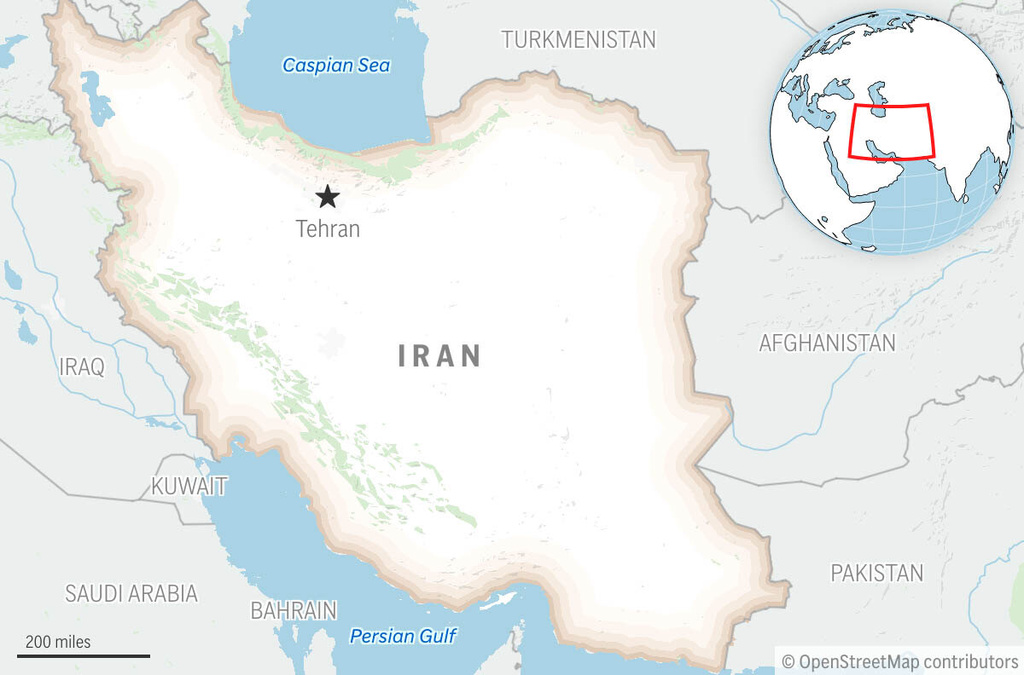

DUBAI, United Arab Emirates — A string of airstrikes with no nation stepping forward to claim responsibility has landed on Iran in the hours following the United States’ announcement that it had finished its own military campaign, leaving the international community wondering who else may be behind the attacks on the Islamic Republic.
The strikes occurred on Thursday, at a moment when Iran was preparing funeral arrangements for its late Supreme Leader, Ayatollah Ali Khamenei. The explosions struck multiple locations across southern Iran. Iran’s government has stopped short of directly blaming any specific country for the attacks, though one member of the country’s parliament issued a pointed warning to the United Arab Emirates, accusing it of quietly supporting the American military effort against Iran.
Gulf Arab nations, which have repeatedly been on the receiving end of Iranian attacks since the conflict began February 28, did not respond to media requests for comment on Friday regarding the strikes. Both those countries and the United States have been vocal in insisting that the Strait of Hormuz — a critical passage for global energy supplies — must remain open to international shipping.
Iran, however, has staked out the opposite position, demanding sole authority over the strait and insisting that ships passing through must pay fees to Tehran. The international community has long regarded the waterway as open to all nations. Before the war began, roughly one-fifth of the world’s oil and natural gas flowed through that passage.
The U.S. military’s Central Command announced Thursday at approximately 6:30 a.m. local Iran time that it had completed a round of strikes hitting around 90 targets. Shortly after that announcement, Iranian news outlets and state media began reporting explosions and airstrikes in the country’s Bushehr and Sistan and Baluchestan provinces, as well as the cities of Ahvaz and Chabahar, among other locations.
A U.S. defense official, who spoke without being identified in order to discuss details of the ongoing military operation, confirmed that no new American strikes had taken place since the last round concluded Thursday morning.
Iran responded to the strikes by launching a broader wave of attacks across the Middle East, targeting Bahrain, Jordan, Kuwait, and Qatar. Missile warning sirens blared in all four countries, prompting residents to seek shelter. At least one person was reportedly injured in Kuwait as air defense systems worked to intercept the incoming fire.
The leader of the UAE, Sheikh Mohammed bin Zayed Al Nahyan, traveled to Kuwait shortly after the Iranian attack to meet with that country’s ruling emir. Gulf Arab nations also held calls with Qatar’s foreign minister, who has been playing a significant role alongside Pakistan in brokering negotiations between Iran and the U.S. aimed at maintaining a temporary halt to open warfare.
This is not the first time unclaimed airstrikes have occurred during the conflict. Officials later confirmed that both Saudi Arabia and the UAE had previously launched strikes on Iran after Tehran targeted energy infrastructure in those countries. A Gulf nation striking Iran again could be seen as an attempt to discourage further Iranian attacks on the region.
Israel, which has been conducting an aggressive campaign against Iran under Prime Minister Benjamin Netanyahu, has not struck the Islamic Republic since June. In most instances, Israel has openly acknowledged its strikes on Iran.
Israel’s government confirmed that Netanyahu spoke with U.S. President Donald Trump on Thursday evening, with Trump briefing Netanyahu on what was described as “American moves in the Gulf.”
Israel’s defense minister, Israel Katz, also issued fresh warnings that his country stood prepared to act against Iran if circumstances required it. “The Israeli military is on alert and ready to renew the campaign, to reestablish aerial superiority, and to carry out a blue-white (Israeli) strike in Iran to remove threats, even for a third time,” Katz told attendees at a military ceremony. “If we will have to return, we will return with even greater force.”
On Friday, Iranian state media reported that Esmail Kousari — a member of Iran’s parliament national security committee and a former commander in the paramilitary Revolutionary Guard — warned that the UAE would “pay the price for its cooperation with the United States.” He accused the Emirates of playing a “behind-the-scenes” role in the recent U.S. attacks on Iran.
Iran has repeatedly accused Gulf Arab states of actively aiding the American military effort, allegations those countries have denied. The United States has maintained a large military presence across the Gulf region since the 1991 Gulf War, including a base in Bahrain that serves as headquarters for the U.S. Navy’s 5th Fleet.
The Joint Maritime Information Center, a multinational organization operating under U.S. Navy oversight, issued a new advisory on Friday encouraging vessels to use the Strait of Hormuz route. A similar advisory issued earlier on Tuesday prompted an Iranian attack that struck three ships.