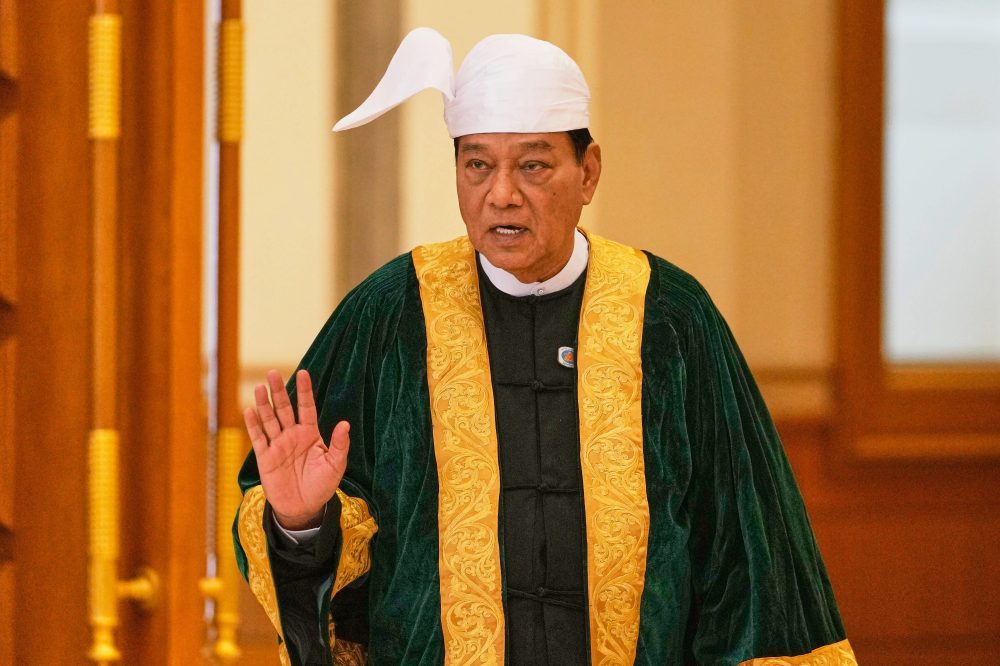

Myanmar’s Parliament launched the presidential selection process on Monday, signaling what many see as a superficial shift back to civilian leadership following five years of army control.
The legislative proceedings coincided with Senior Gen. Min Aung Hlaing’s announcement that he was stepping down from his role as the military’s top commander. This resignation clears a constitutional requirement that prevents anyone from simultaneously serving as both president and commander-in-chief.
Min Aung Hlaing stands among three contenders vying for the presidency and appears virtually guaranteed to secure the position, given that military-supported legislators and appointed military representatives control a decisive parliamentary majority.
The selection process involves three groups each putting forward candidates: the Lower House has nominated two individuals including Min Aung Hlaing, the Upper House presented two lesser-known contenders, and the military bloc has yet to reveal their pick. Each faction must ultimately settle on one nominee before the 586-member legislature casts votes, with the winner becoming president and the runners-up serving as vice presidents.
The parliamentary vote could occur as soon as Thursday, though officials haven’t confirmed the exact schedule.
These lawmakers gained their positions through elections conducted in December and January, though military opponents denounced the voting as rigged to provide legitimacy to army rule following the February 2021 overthrow of Aung San Suu Kyi’s democratically elected administration.
Myanmar experienced military governance from 1962 through 2016, when Suu Kyi’s National League for Democracy assumed control after winning decisively in 2015. The party secured an even stronger victory in 2020, but the army intervened before the new legislature could begin work.
Military forces violently suppressed peaceful demonstrations against the coup, prompting democracy supporters to take up arms alongside ethnic minority groups that have long sought greater self-rule.
The nation now finds itself engulfed in devastating civil conflict, with security issues preventing voting in 67 of Myanmar’s 330 townships during recent elections.
Min Aung Hlaing has commanded Myanmar’s armed forces since 2011, wielding significant political influence under the military-authored 2008 constitution. He gained international notoriety following a 2017 crackdown on Rohingya Muslims that forced hundreds of thousands to flee to Bangladesh amid reports of widespread abuses.
State television MRTV reported that the 69-year-old Min Aung Hlaing formally handed military leadership to his trusted deputy, Gen. Ye Win Oo, during a Monday ceremony in the capital city of Naypyitaw.
Ye Win Oo, age 60, previously held leadership roles in the ruling State Administration Council and the State Security and Peace Commission, both established following the military takeover.
Leading opposition groups, including Suu Kyi’s former National League for Democracy, either faced exclusion from recent elections or chose not to participate under conditions they considered illegitimate.
Suu Kyi, the 80-year-old former leader, is currently imprisoned serving a 27-year sentence on charges widely regarded as fabricated and politically driven. Authorities forced her party to disband in 2023 after it refused to comply with new military registration requirements.