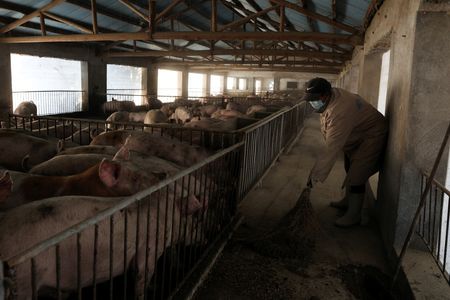

Chinese pig farmers are facing a devastating double blow as the conflict in Iran drives up feed costs while pork prices remain at their lowest point in 16 years.
The war that began February 28 has pushed futures prices for soymeal and corn—critical components of animal feed—to multi-month peaks on China’s Dalian exchange. Industry experts point to rising oil prices, increased shipping costs, and higher fertilizer expenses as key factors driving the surge.
During March alone, Chinese spot prices for soymeal jumped more than 200 yuan per ton, while corn increased around 100 yuan per ton—representing increases of 7% and 4% respectively. Other essential feed components have seen even steeper price hikes, with some ingredients rising as much as 77% this month.
“Prices for most raw materials used in animal feed have experienced a significant increase in March, partly driven by the ongoing conflict in the Middle East,” explained Lin Guofa, a senior analyst with Bric Agriculture Group.
Rosa Wang from Shanghai JC Intelligence Co. noted that critical feed additives including lysine, methionine, fishmeal, and vitamins A and E have all increased between 6% and 77% due to the war’s impact.
The timing couldn’t be worse for Chinese hog producers, who raise half the world’s pig population but are already struggling with excess capacity and sluggish consumer demand. On Monday, China’s primary hog futures contract dropped to a record low of 9,980 yuan ($1,448.16) per ton, while cash prices fell to 9.69 yuan per kilogram—the weakest level in 16 years according to JCI data.
The financial squeeze is severe. Lin calculated that producing a pig weighing 60-62.5 kilograms currently costs farmers 12.2-12.5 yuan per kilogram, meaning they lose 280-350 yuan on every animal sold.
Smaller operations face the greatest risk of closure, as they’re particularly vulnerable to price volatility despite accounting for less than 30% of China’s pig production, industry analysts warn.
“For small farmers now, either you sell your pigs cheap or you grit your teeth and bear it, get through this price drop, and then wait for the pig price to rebound,” said Fu Zhenzhen, a feed analyst with Beijing Orient Agribusiness Consultants.
Li, who operates a 600-head pig farm in northern Hebei province, described his predicament: “We are being roasted by fire now. Pork prices are so low, but feed costs have jumped sharply in March.” He said his operation has been losing money since last year.
Chinese government officials have stepped up efforts to address the oversupply crisis, encouraging breeders to reduce sow numbers and manage slaughter timing more strategically. Authorities have also begun purchasing frozen pork for national reserves to help stabilize market prices.
Despite these interventions, China’s sow population remained at 39.61 million head at the end of December, still above the recommended normal level of 39 million.
“Going forward, pork prices will mainly depend on how aggressively companies trim their herds,” said Pan Chenjun, senior animal protein analyst at Rabobank in Hong Kong.