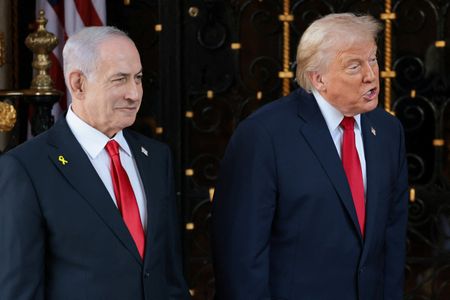

DUBAI, March 19 – Should the current U.S.-Israeli military campaign against Iran conclude in the near future, political analysts believe one outcome has become evident: Israeli Prime Minister Benjamin Netanyahu emerges in a stronger position, while President Donald Trump faces the challenge of addressing market volatility and strain on Gulf partnerships that have shouldered significant burdens.
Political experts suggest the conflict has reshaped Israel’s domestic political landscape to Netanyahu’s advantage, shifting focus from Gaza operations toward Iran, where Israeli public unity remains strongest and Netanyahu’s defense and economic track record carries the most weight.
The situation presents Trump with opposite results: he finds himself engaged in a conflict without a clear conclusion, his Gulf Arab partners face escalating dangers, and the economic narrative that helped secure his return to the presidency has been undermined.
“There is a clear winner and a clear loser,” said Aaron David Miller, a former U.S. Middle East negotiator. “Netanyahu is by far the key winner. He has demonstrated Israel’s military competence. The Gulf states are by far the biggest losers.”
Miller noted that Trump lacks an exit strategy that would enable him to claim success and withdraw from the situation.
Iran expert Karim Sadjadpour explained that Trump, who called for Iran’s complete capitulation, anticipated discovering an Iranian equivalent to Venezuela’s compliant power broker Delcy Rodríguez, but instead “found an Iranian Kim Jong-un,” referencing North Korea’s resistant authoritarian approach.
Unlike perspectives in Washington, the Iranian conflict is viewed broadly in Israel as essential rather than optional, according to Natan Sacks, a senior fellow at the Middle East Institute. “Even if regime change doesn’t happen,” Sacks said, “weakening Iran and the (militia) axis it leads is a huge goal for Netanyahu.”
FOR TRUMP, ONLY TOUGH CHOICES
Israeli sources indicate the aerial campaign has been strategically divided, with Israel targeting western and northern Iranian regions, striking ballistic missile and nuclear facilities, while U.S. forces focus on eastern and southern areas, including the Strait of Hormuz, to diminish Iran’s maritime capabilities.
Israel has spearheaded the elimination of Iran’s top leadership, officials report, including security chief Ali Larijani on Tuesday and Intelligence Minister Esmail Khatib on Wednesday. Defence Minister Israel Katz announced that he and Netanyahu had given military commanders authority to target any senior Iranian official they can find, without needing additional authorization.
Despite these achievements, the conflict has not moved closer to resolution. Trump confronts three unfavorable options: continue the airstrikes, claim victory while hoping Tehran backs down, or significantly intensify operations — none providing a clear exit strategy, analysts observed.
The White House, U.S. State Department and Netanyahu’s office did not respond to requests for comment for this story.
U.S. intelligence chief Tulsi Gabbard informed Congress on Wednesday that although Iran’s government has been damaged since hostilities began, it continues to function, with Tehran and its allied groups still able to threaten U.S. and partner interests throughout the Middle East.
Trump’s apparent strategic error is creating significant repercussions across the Gulf region. As Iran launches missiles and drones toward commercial centers and restricts Hormuz, the pathway for one-fifth of global oil transport, analysts warn that Gulf nations risk becoming the conflict’s primary victims.
“The common threat they (Gulf Arab states) now perceive is nothing short of the future security and stability of the Gulf,” said Miller, also a senior fellow at the Carnegie Endowment for International Peace. “The notion that the Gulf represents the future of the region is now at stake — and with it, the Gulf’s vision for itself.”
US, ISRAEL OPERATE WITH DIFFERENT RISK PERCEPTIONS
Experts suggest Israel may accept Iranian instability more readily than the United States, believing it would experience less regional consequences, particularly following the weakening of allied groups Hamas and Hezbollah during recent years.
Meanwhile, Washington and Gulf partners face greater exposure to energy infrastructure attacks that increase oil costs and interrupt maritime commerce.
Assaf Orion, former strategy chief for the Israeli military, noted that regional nations question whether Israel seeks disorder in Iran, observing that Israel would experience less impact from such instability compared to neighboring countries or Washington.
Fundamentally, analysts explain, the two allies maintain different threat assessments: Israel considers Iran a potential existential danger, while Washington prioritizes preventing an extended conflict that could create substantial economic damage and harm partnerships.
Demonstrating this tension, an Israeli strike on Iran’s massive South Pars gasfield, the world’s largest offshore natural gas reserve shared with Qatar, prompted an angry Trump response. He posted on social media that the U.S. “knew nothing about this particular attack”, noting that Qatar, a U.S. partner that has experienced Iranian strikes on its own gas infrastructure, was uninvolved.
Trump’s Wednesday statement revealed his careful balance between the strong U.S. military partnership with Israel and crucial U.S. relationships with wealthy Gulf Arab nations.
Israeli officials report that Trump and Netanyahu have maintained daily phone conversations since the conflict began. However, Trump’s denial of advance knowledge regarding the Israeli attack contradicted earlier statements from both leaders claiming their armed forces operate in coordination.
Israel has not publicly accepted responsibility for the South Pars strike, which prompted Iranian retaliation against Gulf Arab energy installations. Israeli media extensively reported that the Israeli operation proceeded with U.S. approval.
Iranian sources indicate Tehran is carefully managing its response to inflict significant costs, restore deterrence and secure sanctions relief — offering Washington an exit only at a substantial price.
ISRAEL MARKETS BUOYED BY ATTACKS ON IRAN
Although the Iranian conflict receives public approval in Israel and could provide Netanyahu with political advantages, it has not yet resulted in improved polling numbers before elections scheduled for later this year.
Opinion polls indicate his conservative coalition lacks a majority, holding approximately 50 of the Knesset’s 120 seats, declining from 68.
This gap between public support and political benefit remains hidden, temporarily, by strong Israeli financial markets. Rising Israeli stock prices and shekel strength may suggest confidence, but they hide a more unstable situation.
Aviv Bushinsky, a former Netanyahu advisor, explained the war will ultimately receive judgment in absolute terms: either Iran’s “regime” collapses, or it survives. Anything less risks converting initial military successes into political problems for Netanyahu, who has characterized the operation as pursuing “total victory.”
Should Ali Khamenei’s system survive, even in a diminished capacity, the story would transform from success to excessive ambition, reviving unresolved dangers from Hamas in Gaza and Hezbollah in Lebanon. Israeli markets may reflect resilience, but they seem unaware of the price of an incomplete war.