
TULA, Mexico (AP) — Explosive devices dropped from above and gunfire echoing through her concrete home forced 74-year-old María Cabrera and her relatives to escape into the dark mountainous terrain of central Mexico carrying nothing but what they wore.
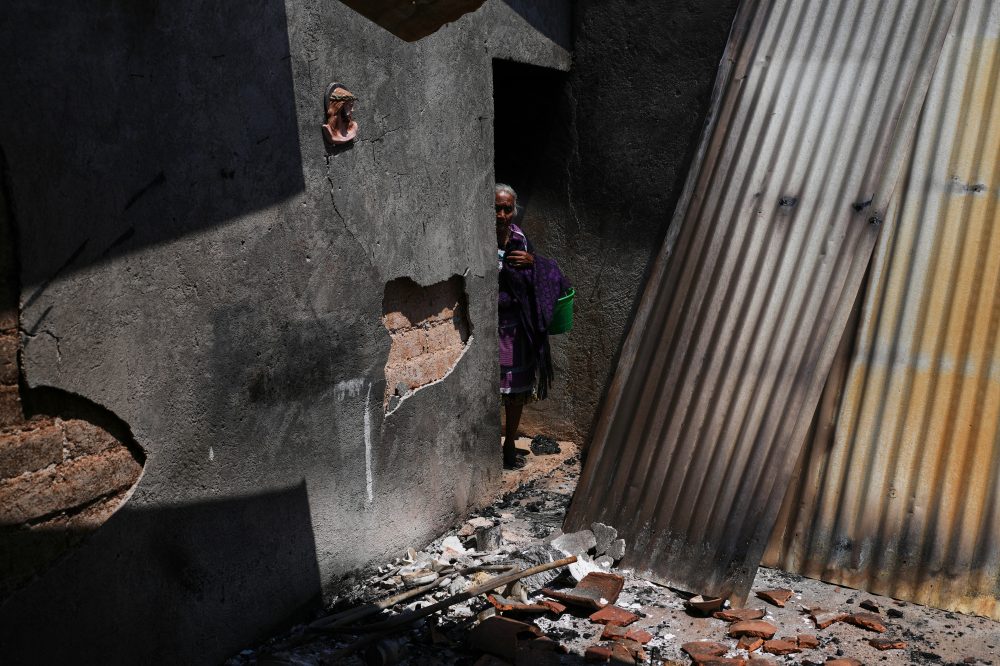
Seven days after fleeing, Cabrera sifts through the burnt remains of her belongings, recovering cookware, fabric pieces and a small wooden cross. She understands this marks her final visit to the residence where she lived for six decades.
“Oh God, why have you abandoned me,” she expressed while crying inconsolably, walking among the burned remnants of her former mattress in a tiny room with a caved-in ceiling and a damaged refrigerator nearby. “How are we going to rebuild? We don’t have money, we don’t have anything.”
She became part of an expanding population of displaced individuals in violence-plagued areas of Mexico who must abandon their residences. Researchers characterize this situation as a hidden crisis with lasting humanitarian impacts — official statistics on displaced populations remain limited, and these individuals have minimal support systems available after violence drives them away.
Cabrera escaped her small community on Friday following years of escalating criminal organization violence in Tula. This settlement of approximately 200 indigenous Náhuatl residents represents one of numerous communities in the central state of Guerrero devastated by decades of splintering competing criminal organizations fighting for territorial dominance.
During the previous week, an organization called Los Ardillos launched an assault on her community and several neighboring ones using explosive devices fired from drones, engaged in combat with local community police units, slaughtered farm animals and incinerated residences like Cabrera’s beyond recognition.
Cabrera cautiously passed bags of personal items to military personnel accompanying a small number of families returning to collect their possessions. She offered prayers while armed uniformed men loaded her belongings into a vehicle’s cargo area. During her final walk through her garden, she asked for forgiveness from the dogs and chickens she had to abandon.
“We don’t want to abandon them,” she expressed. “But we suffered through everything. We can’t live here anymore.”
A regional human rights organization, Indigenous and People’s Council of Guerrero-Emiliano Zapata, or CIPOG-EZ, calculated that no fewer than 800 individuals, including minors and elderly residents, were forcibly relocated alongside Cabrera, and three community police members — units frequently established for self-protection due to government absence — who resisted the criminal organization were killed.
The government statistics show much smaller numbers: Mexico’s administration announced on Tuesday that just 120 individuals were compelled to relocate and verified zero fatalities. One community representative staying at the basketball facility on Friday informed a local government representative that in their settlement alone they calculated approximately 280 residents had been compelled to flee.
Some households escaped into the hills without looking behind them. Hundreds found refuge beneath a neighborhood basketball facility, hoping conditions might become safe enough to eventually return to their homes. Additional families — some injured by bullets — entered automobiles, buses and trucks, dispersing to various areas of Mexico.
Footage shared on social platforms this week display groups of weeping women and children asking for assistance.
These scenes prompted the administration to send 1,200 military and police personnel to the area. Authorities report they have mostly controlled the violence, created a “safe corridor” for humanitarian assistance to arrive, and established the foundation to resolve the area’s complex conflict.
“What we do not want is a confrontation that would affect the civilian population. Above all, we must preserve people’s lives,” Mexican President Claudia Sheinbaum stated during a press briefing last week.
Opponents argue this represented another instance of government inaction and attempts to minimize the severity of the displacement crisis in Mexico. Unlike Colombia, Mexico lacks a comprehensive database of displaced individuals. Government statistics are frequently described as inadequate by organizations like the U.N. refugee agency, human rights organizations and researchers studying the crisis.
A 2025 government National Survey of Victimization and Public Security Perception calculated that almost 250,000 households were compelled to abandon their residences in 2024 alone to protect themselves from criminal activity.
From 2024 to 2025, the Ibero-American University recorded no fewer than 44,695 individuals who had escaped their homes to different regions of Mexico. Many additional people migrate to the U.S.
In a May analysis, the university observed that forced relocations are increasing in Mexico during a period when the administration has attempted to emphasize security improvements — such as significant decreases in murders — to counter threats by the administration to conduct military operations against Mexican cartels.
“There’s no more life in these communities,” stated Prisco Rodríguez, a local representative for CIPOG-EZ. “The government says people have already returned to their houses, but there’s no one here. People don’t say where they’re going out of fear … and the majority never appear.”
Cabrera and her spouse, 75-year-old Alejandro Venancio Bruno, were struggling to determine their destination. Cabrera mentioned that her children urge her to relocate with them in Mexico City, roughly 350 kilometers (220 miles) from their residence, or the state of Queretaro, and restart their lives in a different location.
However, Venancio explained that he has dedicated his life to cultivating his property, and without funds, a residence or his most precious assets — his goats — any alternative existence beyond Tula appears impossible.
“It’s like starting from zero,” he stated.