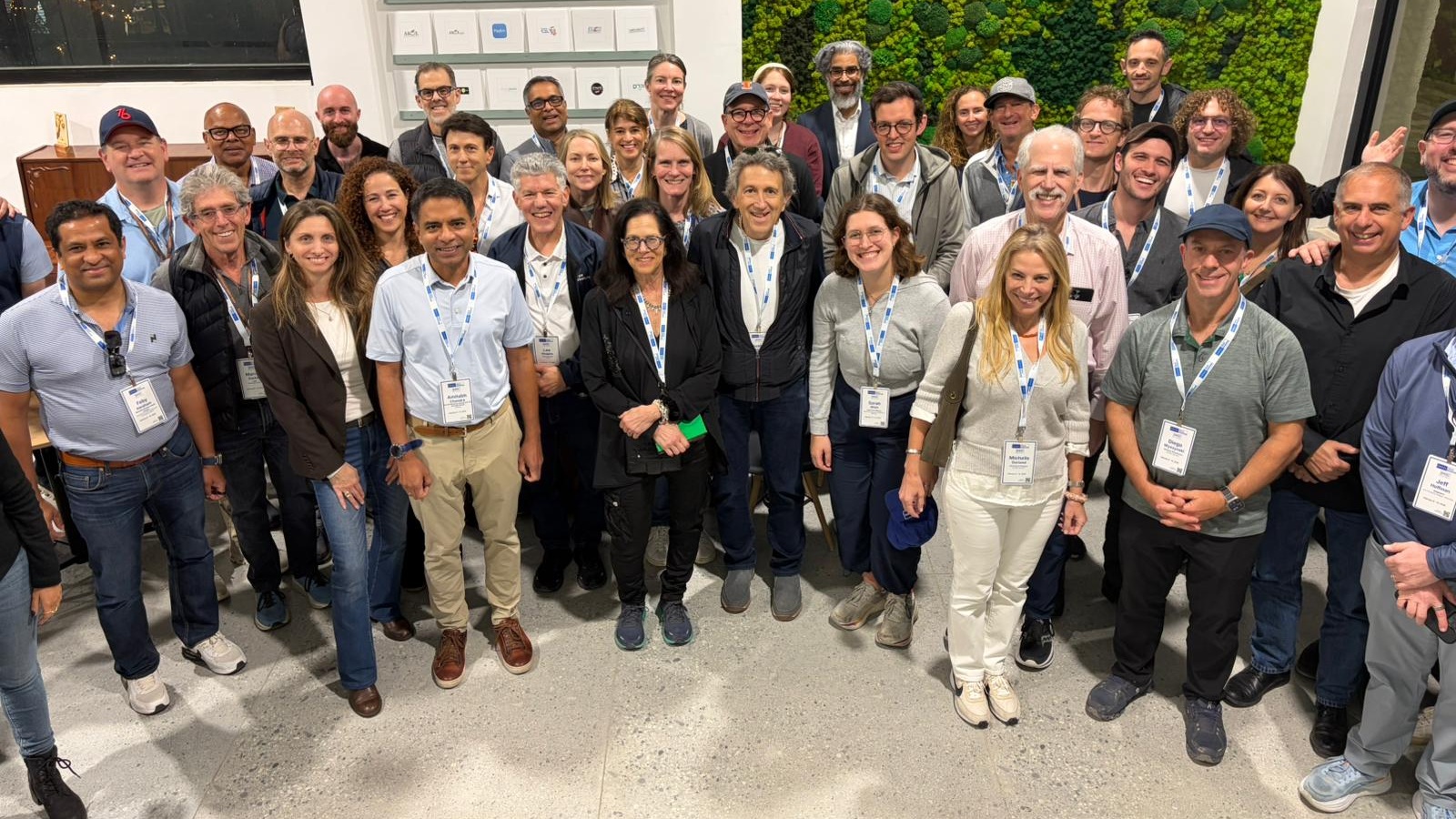

A group of nearly 40 healthcare executives from around the world recently completed an intensive tour of Israel’s medical innovation centers, exploring how groundbreaking research transforms into life-saving technologies used globally.
The delegation arrived at the Weizmann Institute of Science in Rehovot on a clear February day, though visible damage from an earlier Iranian missile strike served as a stark reminder of ongoing regional tensions. The attack had destroyed dozens of laboratories conducting critical cancer and disease research.
Dr. Daniel Kraft, founder of Exponential Medicine and a physician-scientist working at the crossroads of technology and healthcare, shared his perspective with The Media Line. “The future of health and medicine is coming faster than you think,” Kraft said. “It’s not the technology; it’s often the convergence of a new operating system for the future of health and medicine.”
According to Kraft, Israel’s unique advantage lies in its concentrated environment where artificial intelligence, digital health tools, diagnostic systems, and clinical facilities operate within close proximity. This density speeds up the development process significantly. “Health and medicine are a universal need and collecting point,” he explained, noting that medical collaboration often continues even when political relationships face challenges.
The visiting healthcare leaders participated in a program jointly organized by Israel Tech Mission and 8400 The Health Network, Israel’s primary HealthTech ecosystem accelerator. The network serves as a bridge connecting the country’s medical innovation ecosystem with global health sector leaders.
As the primary organization supporting Israel’s HealthTech and Life Sciences sector, 8400 The Health Network played a crucial role in designing the program’s agenda and facilitating connections between international visitors and key Israeli stakeholders.
The initiative aimed to showcase both current obstacles and emerging opportunities within the ecosystem, while identifying areas of mutual strategic benefit and establishing pathways for long-term investment, collaboration, and partnerships. The organization continues supporting ongoing relationships, helping transform initial meetings into enduring partnerships and sustained strategic involvement.
The participants included investors, company founders, advisors, and operators from the United States and international markets, all sharing a common goal: understanding how laboratory discoveries in Israel successfully transition into global healthcare applications.
David Siegel, chairman and founder of Israel Tech Mission, helped structure the week-long program. He characterized the initiative as an opportunity to expose participants to both promising companies and the fundamental operating principles of Israel’s innovation ecosystem.
“We don’t bring people here just to see companies. We bring them here to understand how the system works,” Siegel explained to The Media Line. For him, this distinction is crucial, as the goal involves creating lasting relationships that continue developing well beyond the formal meetings.
David Nakar, the mission’s executive director, coordinated the week’s complex logistics and arranged meetings across research institutions, hospitals, and startup facilities. “Israel’s advantage isn’t just density of talent—it’s velocity,” Nakar told The Media Line. “But velocity needs channels. Delegations like this create structured pathways between founders, researchers, operators, and capital allocators. When those pathways are intentional, the distance between lab discovery and global patient impact shortens dramatically.”
Mission participant Al Kinel expressed his enthusiasm about the experience to The Media Line. “I feel so proud and happy about what is occurring here and what’s coming out,” Kinel said. “I’m excited to be able to help take those innovations and get them out to the world and help let people learn about them.”
Kinel operates a health technology consulting firm called Strategic Interests and leads the New York Israel Chamber of Commerce, which fosters commercial and research connections between Israel and the United States. His work focuses primarily on helping medical innovations move beyond early-stage promise into actual implementation within American healthcare systems. “There are people that are going to be supportive and helpful, and we will figure out how to work with them to help us be successful, and then there’s the undecided,” he said. “I want them to understand the value of the innovation of Israel and how it’s changing the world in tikkun olam [‘healing the world’].”
He acknowledged the challenging global environment surrounding these efforts. “Unfortunately, we’re in a spot in a world where there are people who are going to hate us and will never want to listen,” he said. “That’s not our audience.” His focus remains on those willing to consider evidence and engage in collaboration. From his perspective, exporting medical technology represents more than just economic activity—it becomes a form of engagement based on measurable results. “If we can align, we will probably be way more impactful than we each could in our own individual way,” he added.
While Kinel emphasized alignment, Sam Moed discussed organizational structure.
As a global board member of 8400 The Health Network, Israel’s national HealthTech ecosystem accelerator, Moed described the organization’s dual mission. “We are very focused on supporting and strengthening the health care system in Israel,” he told The Media Line, “but at the same time, we are building bridges globally.”
For Moed, these international connections serve practical purposes. Israel produces substantial early-stage medical innovation, but scaling these technologies requires access to global capital and markets. “The United States is the largest source of life sciences capital in the world,” he said. Without connecting to that ecosystem, promising technologies may fail to reach patients.
“I am very optimistic about the magnitude of disruptive innovation that is coming out of Israel,” Moed stated. The goal, he suggested, involves not just incremental improvements but establishing healthcare alongside cybersecurity and defense as one of Israel’s defining pillars. “We want health care to be one of those pillars.”
He noted that local challenges often generate globally applicable solutions. Referencing trauma care and mental health innovation, Moed observed that real-world experience has shaped technologies now attracting international attention. “Some of the innovation agenda is driven by the problems we face here,” he said. In this way, the country’s constraints have produced exportable expertise.
During the week, the delegation met with participants operating at every level of Israel’s health system, from capital formation to clinical application. The program included sessions with venture capital leaders and life sciences investors, hospital-based innovation teams integrating digital tools into patient care, early-stage founders developing diagnostics and therapeutic platforms, and professionals working in trauma and mental health in southern Israel following the October 7 events. Rather than focusing on individual companies, the schedule exposed participants to the structural elements of the ecosystem: academic research, clinical integration, capital formation, and resilience-driven innovation, and how these components interact.
At the Weizmann Institute of Science, conversations focused on translational pathways. Researchers explained their approach of designing studies backward from proof of concept and regulatory milestones, rather than forward from curiosity alone.
During one smaller breakout session, a group met with Professor Ravid Straussman, a physician-scientist in the Department of Molecular Cell Biology at the Weizmann Institute of Science. From his office, Straussman presented the progression of his research and how it has developed into three startups focused on cancer treatment. His work centers on identifying specific bacteria and fungi living within tumors, discoveries that are changing how certain cancers are understood and treated therapeutically. By analyzing the tumor microbiome, his team has opened new strategies for targeting cancer and potentially strengthening patients’ immune responses.
The discussion reflected a broader theme of the visit: the transition from discovery to practical application. Straussman described not only the scientific breakthrough, but the process of translating that breakthrough into structured ventures designed to carry the research beyond academic settings. For participants evaluating Israel’s health ecosystem, the session provided a concrete example of how basic science can develop into companies with international clinical significance.
Jonathan Sheffi, vice president of strategy and product excellence for the Life Sciences & Healthcare division at Clarivate, said the visit has already prompted him to pursue a structured initiative. Speaking with The Media Line, he stated, “I will create a business plan to develop a translational research platform based on Israel’s patient-level data.” The intention, he explained, involves not incremental collaboration but systematic leverage. “Through this platform, I hope to spur financial and human capital investment in Israel by large pharmaceutical companies,” he noted. By building on what he described as Israel’s strengths in “software, data science, and AI,” Sheffi added that he hopes to help “create a new generation of Israeli drug discovery companies.”
“It was announced that I will be joining the board of directors of Compugen,” Michele Holcomb told The Media Line, referring to the Israeli biotechnology company. Holcomb, a board director at PureTech Health and a veteran biotech and pharmaceutical executive, noted that the dialogue and interviews related to the appointment preceded the visit. Still, the timing highlighted the depth of integration between Israeli life sciences and global industry leadership. The flow of expertise, she suggested, moves in both directions.
Lee Shapiro’s relationship with Israeli health technology spans more than two decades. As co-founder of Chicago-based 7wire Ventures, he has observed the ecosystem evolve from early digital health experiments to mature global companies. “Israel had a very organized longitudinal record for every citizen in Israel, kind of cradle to grave health information that existed,” he said, recalling the early infrastructure that allowed companies to innovate around data long before it became common elsewhere.
Today, he sees few comparisons. “There really is very little comparison,” he said. “Israeli companies and their technology base are far advanced from where European companies have been and what we see coming out of Asia.” At the same time, he believes awareness lags behind reality. “We need more stories told about the life-saving technologies,” Shapiro said. “I don’t think people realize that some of the great medications that they’re using every day have come from Israel.”
Those medications, devices, and digital platforms are integrated into health systems across North America, Europe, and Asia. Their impact is measured in survival rates, early diagnoses, and more efficient care pathways. Shapiro framed that reach culturally. “The spirit of tikkun olam in terms of healing the world is something that is part of the ecosystem here and is something that’s used in a way that can not only create great markets but also do good for the rest of the world,” he said.
The conversation at Startup Nation Central expanded the perspective further. There, attention turned to infrastructure: mapping innovation, matching investors with startups, and supporting regulatory and market entry abroad.
Innovation, in Rob Cronin’s view, carries another dimension. As founder and CEO of 120/80 GROUP, a New York-based communications firm specializing in health technology, he sees economic impact and diplomacy intersect. “What I see as the opportunity and the ultimate form of diplomacy and the mechanism by which we can fight antisemitism is an economic, innovation-based form of tikkun olam,” he told The Media Line. “It’s about improving people’s lives.”
Michelle Garland, founder and CEO of Soul Search Partners, has spent more than two decades placing executive teams in venture-backed health technology companies. What impressed her most was not only product or capital, but people. “The talent here is exceptional, and the ideas are brilliant,” she told The Media Line. Sustained collaboration, she suggested, depends as much on relationships as financing. “We have to build more bridges,” she asserted.
By the end of the conversation, her reflection became personal. “I have a bigger tribe than I knew of,” she said, visibly moved. The remark pointed to something that ran beneath the week’s formal meetings: a sense that professional ambition, identity, and global health purpose were not entirely separate.
Participants repeatedly described an ecosystem that is compact yet internationally focused, technically rigorous yet commercially disciplined. Israeli medical innovation is developed with international application in mind. Therapies enter multinational trials. Digital platforms integrate into foreign health systems. Devices travel through supply chains that extend well beyond national borders.
For Moed, that orientation remains central. “We want Israel to be seen as a global health care innovation powerhouse,” he said. The measure is not visibility, but penetration into global health systems.
Israel’s growing role in global healthcare reflects more than scientific output. It reflects structure. As Kraft told The Media Line, “It’s often about connecting dots and getting people out of their old silos, their cognitive silos, their political silos, their belief silos, and better work together.” In a compact ecosystem where research, capital, and clinical infrastructure converge at close range, that ability to connect may be what places Israel at the center of how new medicine is built.