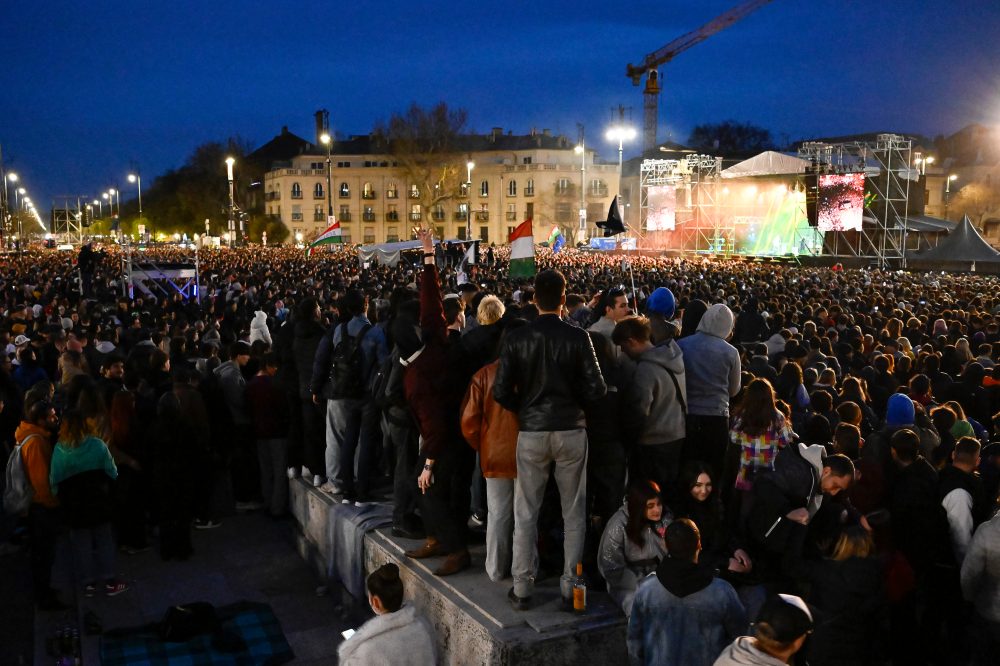

BUDAPEST, Hungary — A massive musical demonstration drew more than 100,000 people to Budapest’s Heroes’ Square on Friday, as citizens gathered for a marathon concert demanding political change just 48 hours before Hungary’s pivotal election.
The seven-hour musical marathon featured more than 50 of Hungary’s top artists, each performing a single song in what organizers called a “system-breaking” event aimed at mobilizing voters to reject Prime Minister Viktor Orbán’s administration on Sunday.
The predominantly young crowd repeatedly chanted anti-government slogans, including “Ruszkik haza!” meaning “Russians go home!” — a phrase echoing Hungary’s 1956 uprising against Soviet control that has gained fresh relevance as Orbán strengthens ties with Moscow.
Heléna Sugár, a 19-year-old attendee, explained her motivation for joining the demonstration. “I listen to these performers every day. But now the most important thing here is the political goal,” she said. “I think it is important to show how many of us think this way, how many of us think that the time for this system is over and it is time for us to change.”
The Civic Resistance Movement, which coordinated the event, stated that every performance was “critical of the corrupt regime” and designed to “demonstrate to the masses of voters and make them realize that the era of impunity is over.”
The enormous turnout at the capital’s iconic square, combined with more than 100,000 additional viewers watching online, highlighted widespread discontent with Orbán’s administration, especially among Hungary’s younger generation.
Hungary faces a growing divide between generations, with young citizens overwhelmingly seeking an end to what they view as Orbán’s authoritarian leadership, while older voters continue supporting the longtime prime minister.
Orbán and his Fidesz party face mounting challenges including economic difficulties, corruption allegations, and the emergence of a formidable opposition force that represents the strongest challenge to his authority in nearly two decades.
The center-right Tisza party, led by Péter Magyar, has energized voters nationwide who view him as the most viable alternative to Orbán’s 16-year tenure in power.
Recent polling data from 21 Research Center reveals that 65% of voters under 30 back Tisza, while just 14% support Orbán.
Noel Iván, 22, who relocated from Hungary to Austria in search of better opportunities, shared his hopes for change. He said he “would like to move back and plan the future at home, which is currently hopeless and deeply sad.”
Despite not identifying as conservative, Iván expressed his intention to “contribute to regime change by voting for the Tisza party.”
The concert lineup included Hungary’s biggest musical stars: vocalist Azahriah, hip-hop artists Beton.Hofi and Krúbi, and rock groups Quimby and Ivan and the Parasol.
Benedek Szabó, who leads the popular band Galaxisok, told The Associated Press that Hungary’s growing alignment with Moscow represents “selling out the EU allies to Russia.”
“Everyone’s fed up, and everyone’s ready to finally change this system, to finally send a message,” he said. “Not only today, but the day after tomorrow, that we’ve had enough, and we want to belong to Europe.”
Galaxisok delivered a performance reflecting on what they perceive as lost potential and squandered time during Orbán’s leadership.
The song concluded with a rebellious message: “Whispered on trams, written on factory walls, on rain-drenched autumn streets, secretly everyone knows,” the lyrics declared. “We’ve had enough, once and for all. In the end, all regimes fall.”