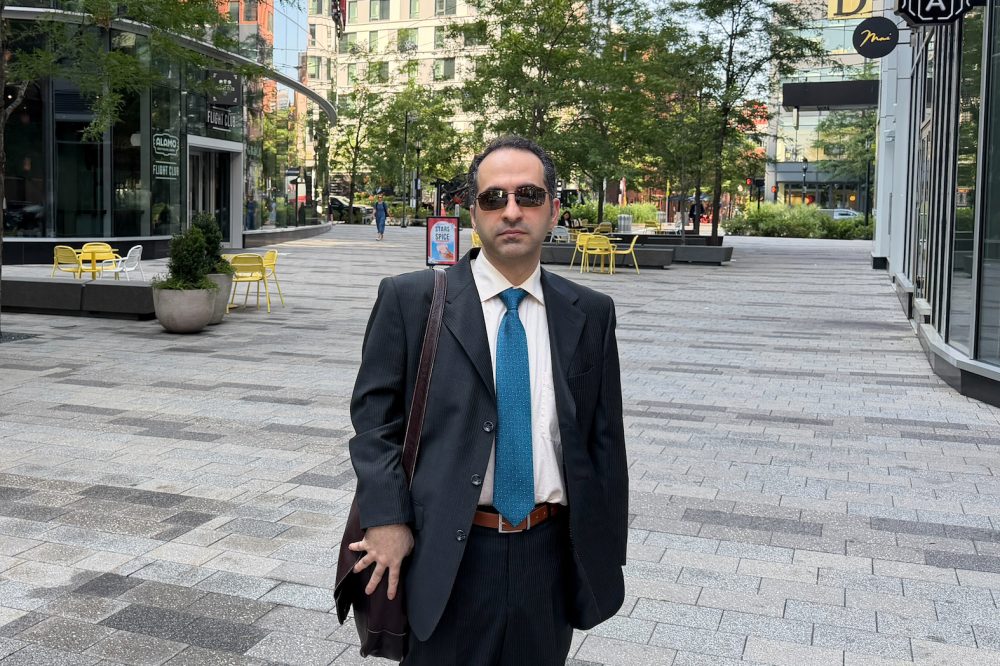

BOSTON — A Massachusetts man has been convicted of conspiring to illegally ship electronic components to Iran, breaking U.S. sanctions laws, a federal jury decided Monday.
Mahdi Mohammad Sadeghi, an employee at global electronics firm Analog Devices, was accused of helping an Iranian business associate circumvent American export control regulations. Federal prosecutors allege that the business associate runs a Tehran-based company that produces navigation systems for military drones operated by Iran’s Revolutionary Guard. The alleged scheme reportedly involved setting up a shell company in Switzerland.
A second person named in the case, Mohammad Abedininajafabadi — referred to in court documents as Abedini — was not tried alongside Sadeghi. Authorities believe Abedini is currently in Iran following what appeared to be a prisoner exchange involving an Italian journalist.
Sadeghi was convicted on three of the five counts he faced. He showed no outward reaction when the verdict was read, which came early in the fourth day of jury deliberations. He and his legal team declined to speak with reporters as they exited the courthouse. He will remain out of custody until his sentencing on October 13.
Sadeghi is a 43-year-old naturalized U.S. citizen who chose not to take the stand in his own defense. A father of two, he lost his position at Analog Devices after the charges were filed. He was originally arrested in December 2024 — well before the current conflict with Iran — though his trial took place during that ongoing hostilities.
During closing arguments, Assistant U.S. Attorney Alathea Porter laid out the government’s position plainly. “At its core, this case is straightforward. You cannot send goods, especially the goods at issue in this case, to Iran. Period. Full stop,” she told the jury. “The defendant knew that, and conspired with Mr. Abedini to do that.”
Fellow prosecutor Assistant U.S. Attorney Jared Dolan argued that documents, text messages, and photographs demonstrated the illegal activity was the direct result of the relationship between Sadeghi and Abedini. “The evidence established that he knew what Abedini was doing because he told him in writing,” Dolan said. “He helped him anyway.”
Sadeghi’s defense attorney, William Fick, pushed back strongly, telling jurors the prosecution’s narrative “makes no sense” and contained significant gaps. Fick argued his client was simply giving a longtime friend guidance on how to pursue business with the semiconductor company and was not involved in actually obtaining the parts for Abedini.
Fick also argued there was no proof the components ever reached Iran, and he challenged the prosecution’s characterization of the Swiss company as a front operation. “If you look at the world through dirty glasses, everything looks dirty,” Fick told jurors. “That is fundamentally what the prosecution is asking you to do here.”
The defense attorney further noted that prosecutors had not demonstrated Sadeghi had anything to gain from the alleged scheme — though prosecutors countered that proving a motive was not required. “He had nothing to gain and everything to lose,” Fick said. “He has lived in the country for decades. He was a well-regarded, respected employee on his way up in the company.”
Prosecutors had originally sought to introduce evidence connected to an Iranian drone used in a 2024 attack that killed three U.S. service members at a remote base in Jordan. Defense attorneys moved before trial to block any such evidence relating to Abedini’s alleged involvement in drone manufacturing or attacks on American troops.
The judge sided with the defense on that issue, ruling that prosecutors could only present general information about Abedini’s Iranian company and the potential military uses of its technology, including drones. During a February hearing, prosecutors acknowledged they lacked evidence that Sadeghi had any knowledge that the technology he allegedly helped export was connected to the drone involved in the Jordan attack.
Both defendants face export control violation charges. Abedini faces an additional charge of conspiring to provide material support to a foreign terrorist organization, a charge tied to the deaths of the three service members.
Abedini was taken into custody at an Italian airport on a U.S. warrant in December 2024, but was released about a month later and returned to Iran. Just three days after his arrest, Italian journalist Cecilia Sala was detained while working in Iran. Sala, widely believed to have been held as leverage for Abedini’s freedom, was able to return home in January 2025.