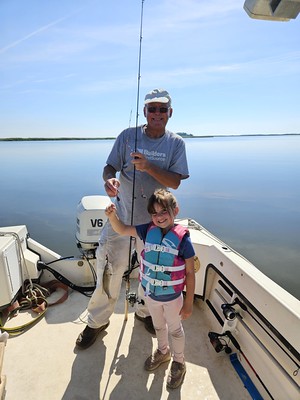

Summer is in full gear, and fishing conditions across Maryland’s waters are offering plenty of opportunities for anglers of all ages. Wildlife managers are encouraging families to bring young fishers along and get them started with action-packed outings.
A key reminder: the Chesapeake Bay recreational striped bass fishery is open for harvest only through July 31. The fishery will then be completely closed for the entire month of August, reopening September 1. The closure is designed to protect the species from the added stress of being targeted when water temperatures are at their highest and oxygen levels are lowest.
Before heading out during the remaining open season, anglers are encouraged to check the forecast and the Click Before You Cast tool. The forecast for July 22 through July 28 shows all days currently in the green for striped bass fishing.
Forecast Summary: July 22 – July 28
Most Maryland rivers and streams can expect below-average water flows this week. Water clarity throughout most of the Bay and its rivers should be near average. Tidal currents will be above average as the July 29 full moon approaches. Anglers can refine their target areas by focusing on underwater points, hard bottom, drop-offs, and concentrations of baitfish.
Upper Chesapeake Bay
At the Conowingo Dam, the typical summer evening power generation pattern is in effect. Striped bass are biting well during morning and evening hours, while catfish are the main catch during daylight. Paddletails, soft plastic jigs, and cut bait are popular choices for striped bass, while fishing cut bait deeper puts anglers into catfish territory. Chesapeake Channa are also consistently active in the dam pool, as it marks the end of the line for them heading upriver.
Along the edges of the Susquehanna Flats, early morning and late evening are producing some striped bass action. Once the sun rises, anglers are shifting to jigging along deeper channel edges, live-lining spot, or drifting cut bait. Dissolved oxygen levels drop off quickly below 10 feet as you move farther down the upper Bay. Reports indicate striped bass action near the Love Point rocks when live-lining spot or casting jigs.
Blue catfish have pushed up into the tidal rivers in search of better water quality near the bottom, appearing farther upstream than many might expect. The mouth of the Susquehanna offers solid dissolved oxygen levels, making it a natural gathering spot. Current breaks and water depths around 25 feet are good starting points. With the August striped bass closure approaching, blue catfish offer a great alternative to keep the lines wet.
White perch fishing in the tidal rivers is also solid, particularly during morning and evening hours. Grass shrimp, peeler crab, or bloodworms on a bottom rig in deeper water are popular choices. Early morning and late evening are also good times to cast spin-jigs, spinnerbaits, and jigs near shoreline structure.
Chesapeake Channa are active in and around the grass beds of the Susquehanna Flats and the shallower stretches of the upper tidal rivers. Soft frogs, chatterbaits, and buzzbaits cast over the grass are effective, as are paddletails worked along the edges of grass beds.
Middle Bay
Anglers fishing near the Bay Bridge may encounter low dissolved oxygen conditions below around 20 feet, depending on the tide. Live-lining spot back toward the bridge pier bases along the 30-foot channel edge on the eastern side is a popular tactic. Casting soft plastic jigs at pier bases in shallower water also works well. Both approaches are most productive during early morning or evening on a moving tide. The shallower water on the west side of the bridge has been a reliable spot for spot, croaker, and white perch.
The shallower areas of the middle Bay with moving currents and structure are good for casting a variety of lures during early morning and late evening. Anglers are reporting occasional speckled trout and bluefish in the mix. Kent Narrows is a productive location for striped bass via live-lining spot, jigging, or casting paddletails depending on the time of day, and is also a good white perch spot.
Water temperatures in the middle Bay are hovering around 83 degrees this week. If hot weather returns — which is likely — temperatures could climb to critical levels. This is the primary reason for the August 1 through August 31 striped bass closure, as released fish face high mortality rates in these conditions. Anglers are urged to release fish without removing them from the water, minimize catch-and-release of striped bass, and use heavy enough tackle to bring fish to the boat quickly. The DNR offers best practices for catch-and-release fishing on its website.
Live-lining spot is the most popular technique for striped bass this week. Productive areas include the east side of the shipping channel from Buoy 83 south past Sharps Island, the False Channel down to the CP Buoy, and Thomas Point. Bluefish are heavily mixed in, especially around Sharps Island. Saving cut pieces of spot to drift is an effective way to target them.
Trolling is another solid option, with a mixed spread of Drone spoons, umbrella rigs, bucktails, and surge tube lures working for both striped bass and bluefish. Spoons, umbrella rigs, and surge tube lures should be pulled behind inline weights.
Blue catfish in the Choptank River and Tuckahoe Creek have moved upriver near Denton and above the Route 328 bridge on the creek, offering some of the best fishing of the week. Cut menhaden, gizzard shad, or white perch work well, as do a variety of scented baits.
White perch are scattered throughout the region’s tidal rivers and creeks. Grass shrimp, peeler crab, or bloodworms on a simple bottom rig is a go-to method from docks and boats. Early morning and late evening casting of small spinnerbaits and spin-jigs along promising shorelines is a fun way to land quality white perch.
Lower Bay
The lower Bay is offering a wide variety of fishing options this week for both boat and shore anglers. Striped bass, bluefish, cobia, red drum, speckled trout, spot, croaker, and blue catfish are all in play. Spanish mackerel may also make an appearance soon.
Striped bass, speckled trout, and bluefish are keeping anglers busy along the shorelines of the tidal rivers, the Bay, and Tangier Sound during early morning and late evening hours. Poppers, paddletails, and soft plastic jigs are all drawing strikes. Good locations to explore include the mouth of the St. Marys River, Point Lookout, Cedar Point, Hoopers Island, and the shores and creek mouths of Tangier Sound.
Striped bass are also being taken along channel edges by live-lining or drifting cut spot. Using a depth finder to locate fish suspended along channel edges is key. The steep channel edge running from St. George Island to Piney Point, Cedar Point, Cove Point, the HS Buoy, and the Target Ship are all worth checking out.
Bluefish are spread throughout the region from shallow water to the edges of deep channels, ranging in size from 3 pounds up to an impressive 10 pounds. They will crash live-lining or chumming setups and can be caught by drifting cut bait along channel edges. Trolling with spoons or surge tube lures — popular in red, green, white, pink, and orange — has been very effective. Anglers trolling surge tube lures may also pick up a cobia.
Cobia fishing is productive near Smith Point, the Target Ship area, and Point Lookout. Anglers are chumming and drifting live eels back through their chum slicks, and sight-casting to fish swimming near the surface on calm days is also an option. A significant portion of cobia being caught are falling just short of the required 43-inch total length.
Large red drum are moving through the lower Bay and are frequently found near Point Lookout, the Target Ship area, and the Middle Grounds. Slicks, disturbed water, and depth finder readings can help locate schools. Soft plastic jigs are popular, but soft crab baits are especially enticing to large red drum. Trolling with large chrome spoons is another effective approach at times.
For speckled trout, drifting soft crab baits at the mouths of creeks flowing out of the marshes of Tangier and Pocomoke sounds during the outgoing tide is a favored method. Casting Zara Spooks and paddletails over grass beds and stump fields during morning and evening hours also produces results.
Spot are available throughout the lower Bay region this month — larger ones in deeper water and smaller ones in the shallows, with croaker mixed in among the bigger fish. The lower Patuxent River, the mouth of the Nanticoke, Hoopers Island, and Tangier are all holding spot and croaker. Anglers report that action shuts down quickly when bottlenose dolphins arrive. White perch may also be mixed in and can be found in the tidal creeks.
Blue Crabs
Recreational crabbers are reporting improving catches as July winds down. The best-sized crabs are coming from water depths of 12 to 20 feet, though some may still be light and should be returned to fatten up. Razor clams remain the top bait choice, though cownose rays are also drawn to them. Crabs are being caught throughout the Bay, with the strongest results coming from the middle and lower regions.
Freshwater Fishing
Deep Creek Lake is in full summer mode, with tourists, vacationers, and heavy boat traffic making it more challenging for anglers seeking quiet spots. Largemouth and smallmouth bass fishing is best in the early morning and just before dark. Points are productive but often congested, so many anglers are seeking out coves instead. Working the edges of deeper grass with spinnerbaits and small crankbaits is a good approach. Bass can still be found under docks and catwalks during the day. With fish moving slowly in the heat, wacky-rigged worms or lizards placed right in front of them is sometimes the only way to trigger a strike.
The upper Potomac River is in its typical summer phase of low water and warmer temperatures. Shore anglers are wading carefully and making long casts to smallmouth bass holding near current breaks, boulders, and underwater ledges. Root beer-colored tubes, swimbaits, and small crankbaits are among the most popular lures. Early morning and evening offer the best opportunities whether fishing from a boat or from shore.
Largemouth bass are in their typical summer routine of feeding at night and resting in cool, shaded areas during the day. Early morning and late evening are the prime windows for fishing near shallow grass beds, feeder creeks, and shoreline structure. Frogs, buzzbaits, and chatterbaits work well in the grass, while spinnerbaits, soft plastics, and paddletails are effective along grass edges. Later in the morning, flipping wacky-rigged soft plastics near fallen treetops, shoreline brush, or under docks can pay off. Dropping weighted wacky-rigged stick worms through floating grass mats is another solid tactic. Anglers should be aware that Chesapeake Channa may be encountered when fishing near or over grass in tidal waters.
Atlantic Ocean and Coastal Bays
Surf anglers using small baits such as bloodworms, artificial bloodworm baits, shrimp, or squid are landing kingfish, spot, northern puffers, and flounder. Those fishing larger baits of cut mullet or menhaden are connecting with large bluefish, sandbar sharks, and large red drum.
Dredging operations at the Ocean City Inlet are underway and are expected to continue through the end of the month, wrapping up just in time for the White Marlin Open. Information on how the dredging affects inlet mariners is available online.
At the inlet and Route 50 Bridge area, striped bass and bluefish are being caught during early morning, late evening, and nighttime hours. Casting soft plastic jigs or drifting cut bait near jetty rocks, piers, and bridge piers are popular approaches. Sheepshead are being caught on sand fleas, and flounder are consistently present.
Flounder fishing in the channels leading from the inlet and back bay areas is very good this month. Drifting with various baits, skirted baits, and Gulp baits continues to produce results as long as bay waters remain clear.
In the nearshore waters outside the inlet, trolling a combination of Drone spoons, surge tube lures, and Clark spoons is a productive way to target bluefish and occasional schools of Spanish mackerel. The inshore lumps and reef sites are holding some large flounder, sea bass, and triggerfish.
Farther offshore, wreck and reef sites are producing black sea bass along with a mix of triggerfish, flounder, and hake. Areas with lobster buoys are holding schools of small dolphin, which offer fun action on light spinning tackle.
Even farther out, additional concentrations of small dolphin are being found near commercial fishing and lobstering buoys. Trolling boats are catching a mix of yellowfin tuna and white marlin at the canyons. Deep-drop fishing is producing blueline and golden tilefish, and a few large snowy grouper have also been brought to the docks. Anglers and boat captains are reminded that tilefish catches must be reported electronically — details are available on the NOAA website.
This report was written and compiled by Keith Lockwood, a fisheries biologist with the Maryland Department of Natural Resources. The Forecast Summary was written by Tidewater Ecosystem Assessment Director Tom Parham. Maryland anglers are encouraged to participate in DNR’s Volunteer Angler Surveys to contribute valuable data to fisheries monitoring and management.