
Financial markets across Asia continued a worldwide surge on Friday as investors grew optimistic about the possibility of a Middle East peace agreement, leading to declining oil costs and reduced concerns about inflation.
Market attention is focused on the highly anticipated public trading debut of Elon Musk’s SpaceX, which has achieved a historic milestone with the largest initial public offering on record. The offering generated an unprecedented $75 billion, giving the rocket and spacecraft company a valuation of $1.77 trillion and establishing Musk as the globe’s first trillionaire.
On Thursday, President Donald Trump indicated that a peace agreement might be finalized as early as this weekend, making this statement just hours after issuing additional threats against Iran. He revealed that diplomatic discussions with Tehran had reached Iran’s top leadership levels and received backing from a wide alliance of regional nations.
These comments from Trump come after multiple instances where the president expressed optimism that ultimately did not result in an agreement, causing uncertainty in financial markets.
However, “This does look perhaps a bit more tangible than we have had,” said Ray Attrill, head of FX strategy at the National Australia Bank.
“If we hear something from Iran that sounds positive, the odds (of a peace deal) are clearly going to flip quite dramatically.”
Should this agreement be verified, it would represent the most important diplomatic progress so far in resolving the three-month conflict, which has caused global energy costs to spike significantly. The European Central Bank was forced to implement its first interest rate increase in almost three years to combat war-related inflation.
Energy prices dropped to two-month minimums following reports of the potential agreement. U.S. West Texas Intermediate crude futures declined 1.9% to $86.08 per barrel, adding to a 2.6% decrease from the previous session. Brent crude fell 1.5% to $89.08 per barrel after dropping nearly 3% overnight.
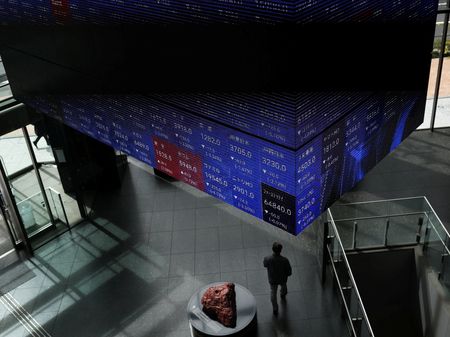
Asian markets showed strong performance with Japan’s Nikkei gaining 4.3%, while Australia’s resource-focused stocks advanced 1.8%. South Korea’s KOSPI experienced a dramatic 8.3% increase.
During the previous trading session, Wall Street experienced significant gains with the three primary indices recording their largest single-day increases since April 8, when the U.S. and Iran reached a temporary ceasefire agreement. The Nasdaq climbed 2.5%, boosted by anticipation surrounding SpaceX’s strong market entrance.
Economic data revealed that U.S. producer prices rose beyond forecasts in May, resulting in the most substantial yearly increase in 3-1/2 years as the Middle East situation pushed energy costs higher. Regarding employment, the number of Americans applying for unemployment assistance rose slightly last week, indicating ongoing strength in the job market during early June.
Treasury bonds gained value as peace deal optimism caused markets to reduce expectations for Federal Reserve rate increases this year. The probability of an October rate hike decreased from 51% to 36%.
Two-year Treasury yields remained stable at 4.066% on Friday after dropping 6 basis points in the previous session. The benchmark 10-year Treasury yields stayed at 4.4631% following an almost 8 basis point decline overnight.
The dollar experienced weakness due to lower yields. The dollar index, which tracks the currency against major trading partners, remained at 99.78 after losing 0.4% in the prior session.
The dollar gained slightly by 0.1% against the yen to 160.19, following a 0.4% retreat in the previous session. Market participants remain vigilant for potential intervention by Japanese officials as the yen continues below the important 160 threshold.
Precious metals benefited from the weaker dollar. Gold prices increased 0.2% to $4,222 per ounce after a substantial 3.5% overnight surge, while silver rose 0.3% to $67.52 per ounce following a 5.8% gain.