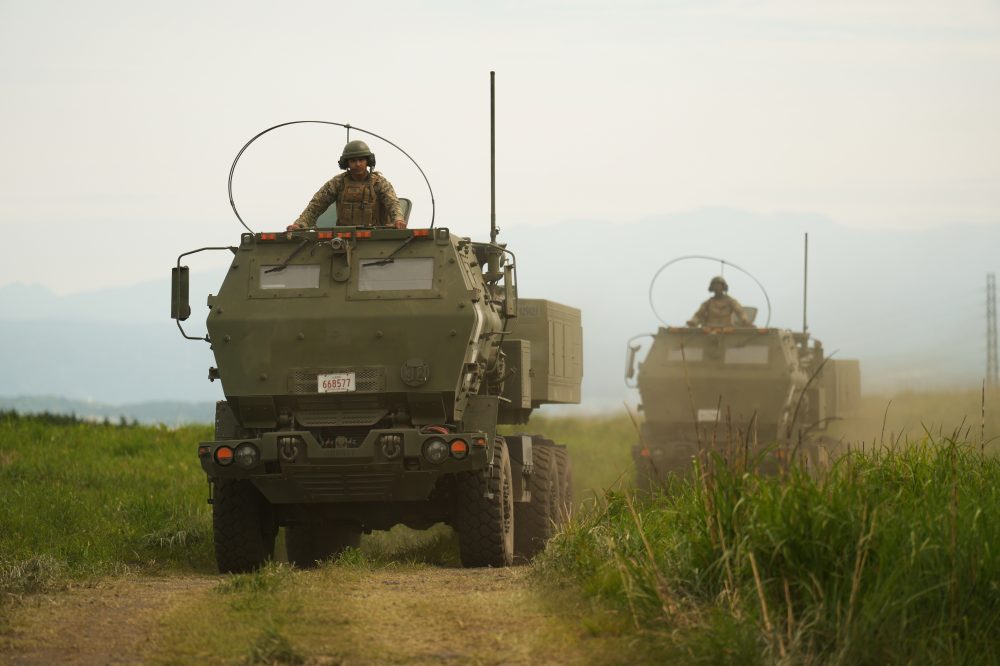

GOTEMBA, Japan — Fire erupted from a mobile launcher positioned in the peaceful foothills near Mount Fuji this week as U.S. Marines demonstrated a weapons system that’s becoming central to America’s evolving Pacific defense strategy.
The first missile launched from the truck-mounted system cut through the clear sky, its orange trail visible against the blue backdrop. Five additional rockets launched quickly after, followed by a second HIMARS vehicle that emerged from its hidden spot among the evergreen trees, fired six missiles of its own, then disappeared back into cover.
The brief training exercise at Camp Fuji’s east maneuver area represented more than routine military practice — it showcased American military capabilities to Pacific partners as the U.S. works to prevent potential Chinese military action against Taiwan, the independent democracy that Beijing considers its territory and has threatened to seize by force if necessary.
The demonstration also highlighted Washington’s tactical evolution in the Pacific region, changes driven by China’s rapid military advancement and modernization over recent years.
“The U.S. does not want China to invade Taiwan, but it would not be relying on the traditional aircraft carrier-based attack wings of the past,” said Euan Graham, a senior defense analyst with the Australian Strategic Policy Institute.
“In Iran, with the U.S. conflict there, there were over 40 U.S. aircraft, manned and unmanned, either destroyed or damaged against a much less capable adversary, so in the case of conflict with China that vulnerability would be much greater,” he said. “That’s why we’re seeing the U.S. emphasizing … these smaller units.”
The Pentagon’s most recent annual congressional report states the objective is to “deny the ability of any country in the Indo-Pacific to dominate us or our allies.” The document emphasized strengthening deterrence “through strength, not confrontation.”
The HIMARS system’s purpose is clear from its complete designation: “High Mobility Artillery Rocket System.” This truck-based rocket launcher can remain concealed from aerial surveillance, move into position to launch its GPS-guided projectiles, then rapidly relocate using military tactics known as “shoot-and-scoot.”
“It depends on the crew, but it can get as fast as four minutes, (even) two minutes sometimes,” said Sgt. Kevin Alvarez, section chief of one of the two Fox Battery, 3rd Battalion, 12th Marines, 3rd Marine Division HIMARS involved in the Camp Fuji exercise.
While the HIMARS entered service approximately two decades ago and saw action in Iraq and Afghanistan, it remained relatively obscure to civilians until Ukraine successfully employed it against Russian forces.
Recent conflicts, particularly the widespread use of battlefield drones that can rapidly locate stationary artillery, have highlighted the importance of mobility, according to Lt. Col. Ryan Anness, commander of the 3rd Battalion.
“They’re much quicker, much faster, and much easier to hide than, say, traditional cannon artillery, and obviously having the precision fire weapons and having the ability to hide easier is why so many countries, and why it’s important for us, to have the HIMARS,” he said.
The system can launch various missile types. Ukraine initially received only shorter-range ammunition before the U.S. approved the ATACMS, or Army Tactical Missile System, which can strike targets approximately 300 kilometers (180 miles) away.
During the early stages of the war against Iran following the U.S. and Israeli attacks on Feb. 28, HIMARS fired both ATACMS and the longer-range Precision Strike Missiles in their first combat use, destroying “multiple” Iranian naval vessels and a submarine in port, according to Air Force Gen. Dan Caine, chairman of the Joint Chiefs of Staff.
The PrSM can engage targets beyond 500 kilometers (310 miles), manufacturer Lockheed Martin reports.
Combined with the Army’s Typhon — another truck-mounted launcher that fires longer-range Tomahawk missiles but offers less mobility than HIMARS — these systems could effectively cover both the Taiwan Strait separating Taiwan and China, and the strategically vital Luzon Strait between the Philippines and Taiwan, if positioned on Taiwan and surrounding Philippine and Japanese islands, Graham explained.
Both waterways would play crucial roles in any Chinese invasion or blockade scenario.
“In advance of a conflict around Taiwan, there would likely be a large-scale outflux of U.S. assets within the envelope of China’s missile capabilities,” Graham said. “All that would be left is submarines, which are more survivable, and small units based on rugged survivability — mobile systems like the HIMARS.”
Wednesday’s Camp Fuji training employed practice rockets — concrete-filled tubes without explosives — and followed rigorous safety protocols while Japanese military officials observed. Local authorities closed a nearby road during the exercise as a precautionary measure in case any projectiles fell short of their targets.
Despite the safety measures that required conducting the live-fire drill more slowly than combat conditions would allow, Lt. Col. Anness emphasized its importance for both Marine training and allied relationships.
“Being able to have long-range precision-fire weapons provides deterrence here in the Pacific, and we train with our Japanese partners as much as we can to make sure we’re ready,” he said.