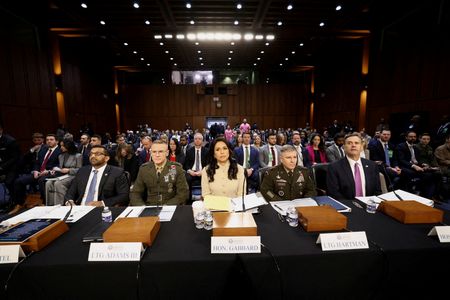

By Erin Banco and Jonathan Landay
WASHINGTON, June 2 (Reuters) – America’s premier intelligence agency has withdrawn from participating in key national security assessments, including reports on the Iran conflict, as tensions with the nation’s top intelligence office reach a breaking point, according to sources with knowledge of the situation.
The conflict between the CIA and the Office of the Director of National Intelligence (ODNI) has been escalating for over twelve months, undermining the cooperative intelligence analysis that presidents have historically depended on for navigating international crises, according to a government official and three individuals with direct insight into the matter.
The sources requested anonymity when discussing confidential internal issues.
Central to these disputes is disagreement over a special team established in April 2025 by Tulsi Gabbard, the director of national intelligence, according to the sources.
The CIA, under Director John Ratcliffe’s leadership, argues that Gabbard’s Director’s Initiatives Group has operated irresponsibly by bypassing established intelligence-sharing and declassification procedures, according to two sources. ODNI representatives counter that the CIA has repeatedly prevented the team from accessing intelligence materials.
This breakdown in intelligence agency cooperation occurs during a critical period for the Trump administration, as the United States remains engaged in the Iran conflict while confronting security threats from Chinese military buildup to Russia’s ongoing war in Ukraine.
The situation also indicates that reforms implemented after September 11, 2001, which established a director of national intelligence to coordinate America’s 18 intelligence organizations, have failed to eliminate institutional dysfunction.
“ODNI is supposed to be the oil in the system that keeps the arteries of the intelligence community flowing, that removes blockages,” said Beth Sanner, a former deputy director of national intelligence during President Donald Trump’s first term.
“When you’re not doing that, then you set up the potential that agencies are just going to kind of pull back into their stove pipes and you set yourself up for intelligence failures.”
Gabbard announced last week her intention to resign as Trump’s top intelligence official on June 30, citing her husband’s health issues. Trump announced Tuesday his selection of Federal Housing Finance Agency chief Bill Pulte as acting director of national intelligence.
“The president and policymakers continue to receive the best intelligence and analysis” from the intelligence agencies, said Olivia Coleman, an ODNI spokeswoman, adding that ODNI and the agencies it oversees “communicate and collaborate daily with CIA counterparts across the full spectrum of intelligence products and operations.”
The Director’s Initiatives Group “operated within ODNI’s oversight authorities and in support of the president’s executive orders,” Coleman said.
Reuters reported in February that Gabbard had disbanded the team and moved its staff to other positions within her agency following congressional examination of its operations.
“Under Director Ratcliffe, CIA quickly moved out on President Trump’s priorities with a more aggressive agency taking smart risks to outmaneuver our adversaries and give the United States a decisive advantage,” CIA Director of Public Affairs Liz Lyons said.
White House spokesman Davis Ingle said Trump’s “peace through strength foreign policy is a tried-and-true approach that keeps America safe and deters global threats,” and media efforts to sow internal division would fail.
“President Trump has full confidence in his entire exceptional national security team,” Ingle said.
REDUCED PARTICIPATION IN INTELLIGENCE REPORTS
The CIA’s decision to substantially reduce its involvement in reports produced by Gabbard’s office represents one of the most significant outcomes of the agencies’ mutual mistrust.
The CIA has traditionally been a primary contributor to analyses produced by the National Intelligence Council (NIC), America’s leading intelligence analytical organization. These reports hold considerable influence, particularly during wartime.
Two sources with direct knowledge indicated that reports concerning Iran — where U.S. military forces have been engaged since February — are among those the agency no longer routinely contributes to.
The CIA and ODNI now function essentially as separate analytical entities, the sources indicated.
At one time last year, the CIA, responding to tensions between the agencies, temporarily stopped publishing NIC reports on the internal intelligence community distribution platform it manages, briefly restricting access to the analytical products, sources said.
A government official described the reports being withheld for “a few hours” due to a “processing issue.”
The inter-agency tensions began shortly after Gabbard took office in February 2025, the four sources indicated.
One of her initial actions was to establish stronger oversight of the Presidential Daily Brief production, sources said. The CIA had historically played a leading role in assembling the brief, a top-secret daily collection of intelligence reports prepared for the president.
Relations deteriorated further with the establishment of the Director’s Initiatives Group to “root out” alleged politicization of the intelligence community, sources said.
The team also worked to declassify materials concerning the assassination of former President John F. Kennedy, while investigating election voting machine security and COVID-19 origins.
Critics, including former intelligence professionals, allege the team was created as a mechanism for retaliation against Trump’s perceived political opponents.
Team members repeatedly requested the CIA provide intelligence and materials necessary for ODNI-directed investigations, but felt insufficient information was supplied, according to two knowledgeable sources.
REMOVAL OF CIA PERSONNEL
In May 2025, Gabbard removed two senior CIA officials who headed the NIC.
An intelligence official speaking anonymously about internal government affairs said ODNI dismissed the two “because they created a toxic work environment, as documented in a workforce survey, and because they had a history of politicizing intelligence.”
The official provided no evidence supporting these allegations.
In August, Gabbard revoked security clearances from 37 current and former officials, inadvertently exposing the identity of an undercover CIA operative working abroad.
Gabbard accused the 37 of politicizing and leaking intelligence, but provided no supporting evidence.
Former officials and others alleged the action was partially retaliatory for a 2017 intelligence assessment concluding Russia had conducted an extensive influence campaign to favor Trump in the 2016 presidential election.
The CIA-ODNI disputes became public last month when a CIA officer assigned to the Director’s Initiatives Group testified to a Senate committee that the agency prevented the group from accessing intelligence regarding COVID-19 origins.
This disagreement has prompted an investigation by the intelligence community inspector general’s office, an independent oversight body located at ODNI, according to two sources familiar with the inquiry.
Reuters was unable to establish the investigation’s parameters.