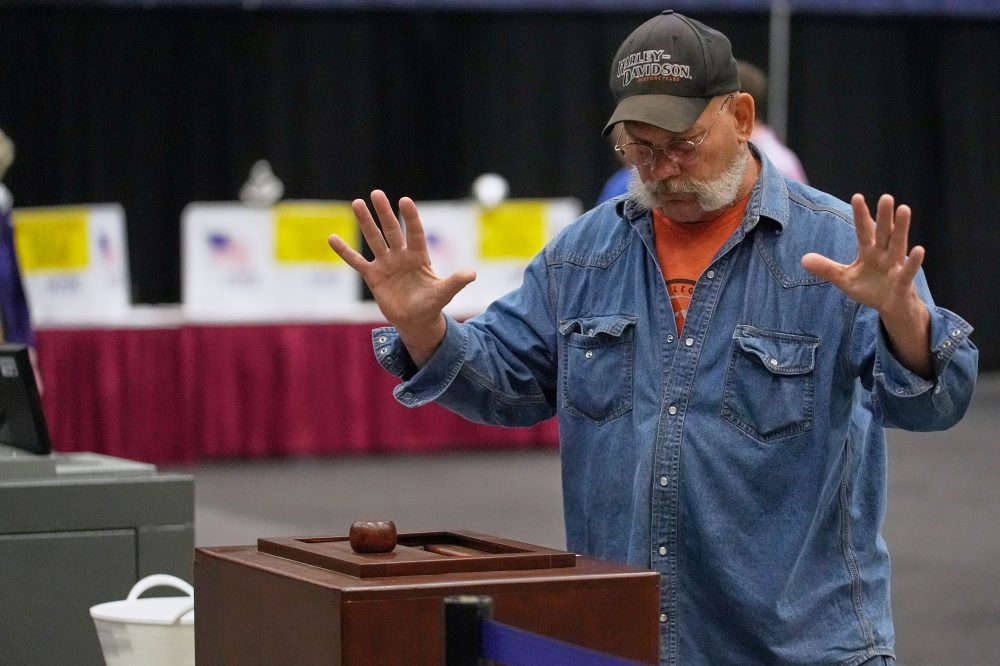

PORTLAND, Maine (AP) — Election officials in Maine started processing ranked choice voting ballots Friday following primary elections where no candidates achieved majority victories in key races for governor and a U.S. House position.
The secretary of state’s office announced that final outcomes should be available sometime during the upcoming week.
Both Maine and Alaska employ ranked choice voting systems for certain statewide contests. This method allows voters to list candidates according to their preferences rather than selecting just one.
When this system is used, any candidate failing to reach 50% of votes cast triggers an elimination process where the last-place finisher is removed and those voters’ secondary picks are redistributed. This process repeats until one candidate secures more than half of all votes.
Tuesday’s primary elections saw no candidate surpass the 50% threshold in either party’s gubernatorial contest or the Democratic race for the 2nd Congressional District. Officials from the Maine Secretary of State Department announced Friday that ballot processing would commence that afternoon, with public viewing available both in person and through the secretary of state’s YouTube channel.
Democratic Gov. Janet Mills, who has been in office since 2018, faces term limits that prevent her from seeking reelection, resulting in competitive fields for both political parties. Five Democrats actively sought their party’s nomination in the June 9 primary, while seven Republicans competed for theirs. The Democratic contest proved particularly tight, with the leading four contenders separated by only small margins.
Democratic voters selected from among Maine Secretary of State Shenna Bellows; former Maine Senate President Troy Jackson; former state House Speaker Hannah Pingree; energy executive Angus King III; and former director of the Maine Center for Disease Control and Prevention Nirav Shah.
Since Bellows’ office oversees the ranked choice counting process, she “has stepped aside from this part of the process and has delegated to her staff,” explained Jana Spaulding, the deputy secretary of the office.
Republican voters chose from former U.S. Assistant Secretary of State Bobby Charles; healthcare executive Jonathan Bush; former Senate Majority Leader Garrett Mason; former Paris, Maine, selectman Robert Wessels; and businessmen Owen McCarthy, David Jones and Ben Midgley.
Mills entered the U.S. Senate primary race this year but ended her campaign in April. Oyster farmer Graham Platner ultimately won that primary and will challenge longtime Republican Sen. Susan Collins in the general election.
For the 2nd Congressional District Democratic primary, the ballot featured former Secretary of State Matt Dunlap, state Sen. Joe Baldacci, former U.S. Senate candidate Jordan Wood and social worker Paige Loud.
The Democratic winner will face Republican former Gov. Paul LePage, an ally of President Donald Trump who ran unopposed in his party’s primary. LePage held the governor’s office from 2010 to 2018, establishing himself as an outspoken opponent of liberal policies and strong supporter of Trump during that period.
November’s 2nd District election will not feature an incumbent since Democratic Rep. Jared Golden, who has represented the area since 2018, decided not to seek reelection.
This district has a history of supporting Trump in presidential elections while also choosing Golden for four consecutive terms.