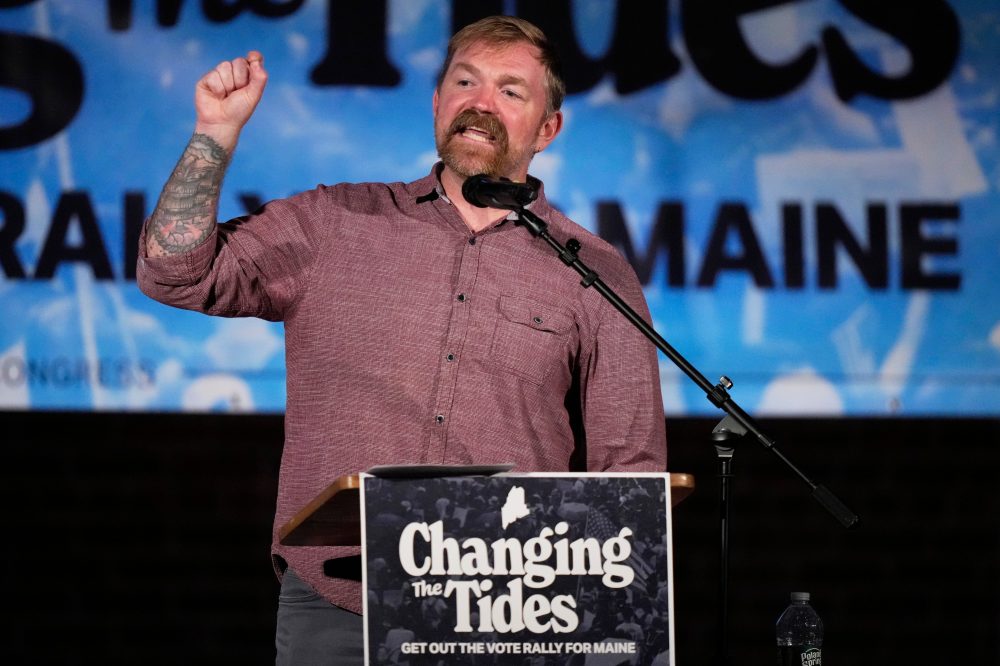

PORTLAND, Maine (AP) — Marine veteran and oyster farmer Graham Platner has built a devoted base of supporters while weathering numerous scandals during his rise from political newcomer to frontrunner for the Democratic Senate nomination in Maine’s pivotal election.
The 41-year-old candidate competes in Tuesday’s primary for the opportunity to challenge veteran Republican Sen. Susan Collins in a race Democrats consider essential for gaining Senate control this November.
Platner’s nomination prospects improved significantly when Democratic Gov. Janet Mills withdrew from the race in late April due to fundraising challenges, although her name remains on the ballot since she ended her campaign after the deadline. His only remaining Democratic opponent is David Costello, a former Maryland government worker who has run a limited campaign.
Multiple scandals have shadowed Platner’s candidacy, including reports of inappropriate text messages sent to women during his marriage and accusations from former partners that he treated women poorly. These issues have left some Democrats worried about their chances of capturing this crucial seat.
Speaking at a campaign event before Tuesday’s primary, Platner declared his intention to “take this seat back for working Mainers” by defeating Collins.
“We can build a government by working people, for working people,” he stated during a Friday rally in Bar Harbor. “We need to build a world in which everyone in this country has the time to live up to their full potential.”
Maine voters will also select Republican and Democratic gubernatorial nominees Tuesday in competitive races to succeed Mills. In the 2nd Congressional District, Democrats will pick a candidate to face former Gov. Paul LePage, who runs unopposed in the Republican primary. With Democratic U.S. Rep. Jared Golden retiring, Republicans see an opportunity to reclaim a district that President Donald Trump won decisively in 2024.
The elections will utilize ranked choice voting, allowing voters to rank candidates by preference. Without a 50% majority winner, the last-place candidate gets eliminated and second choices are counted. This process continues until someone achieves a majority, potentially delaying results for several days.
Platner, who previously served as planning board chair in Sullivan, has attracted hundreds to campaign events across Maine, packing venues with enthusiastic supporters. His campaign emphasizes combating high costs affecting middle-class families, with income inequality as a central focus.
Progressive leader Sen. Bernie Sanders, a Vermont independent, provided early endorsement support that helped elevate Platner’s profile. Senate Democratic leader Sen. Chuck Schumer had backed the 78-year-old Mills.
Running as an anti-establishment outsider, Platner has promised to confront billionaires and Washington insiders, including Collins.
However, his background has drawn criticism from multiple political perspectives.
Past online statements by Platner surfaced last year appearing to support political violence, minimize military sexual assault, and criticize law enforcement and rural communities. Platner issued apologies for these remarks, explaining he was battling post-traumatic stress disorder and depression when he wrote them.
Questions also arose about a skull-and-crossbones tattoo linked to Nazi imagery. Platner explained he received the chest tattoo while drinking during military leave in Croatia. He maintains he only recently learned of its Nazi connections and has covered it with different artwork. While Platner claims ignorance of the symbol’s origins, a former girlfriend told the New York Times he was aware of its meaning.
Recently, he defended himself against reports of sexually explicit text exchanges with multiple women while married. Rather than directly addressing the messages’ existence, Platner criticized the aide who spoke to reporters and accused media outlets of spreading rumors.
Last week’s New York Times reporting detailed relationships with former girlfriends, some speaking positively while others described volatile and demeaning behavior. One woman alleged Platner physically restrained her arm during a dispute and confined her to a room. Platner’s campaign has rejected this claim.
A Platner-Collins matchup would contrast a progressive newcomer against one of the Senate’s most influential lawmakers and remaining moderate Republicans.
Collins, first elected in 1996, represents the sole remaining Republican senator from New England and is widely considered among her party’s most vulnerable incumbents this cycle, despite surviving previous electoral challenges.
Collins has emphasized her experience and leadership role as appropriations committee chair as reasons for reelection.
“It has been 92 years since a Maine senator was chair of the Senate Appropriations Committee, the most powerful committee in the Senate,” Collins stated in May. “When I took over last year I realized I had a once in a century opportunity to help the state of Maine and pursue national priorities as well.”
For governor, Democrats choose among Maine Secretary of State Shenna Bellows; former Maine Senate President Troy Jackson; former Speaker of the Maine House of Representatives Hannah Pingree; energy executive Angus King III; and former director of the Maine Center for Disease Control and Prevention Nirav Shah.
Republicans face an even larger gubernatorial field, selecting from former U.S. Assistant Secretary of State Bobby Charles; healthcare executive Jonathan Bush; former Maine Senate Majority Leader Garrett Mason; University of Maine System trustee Owen McCarthy; former Paris, Maine, selectman Robert Wessels; and business owners David Jones and Ben Midgley.
In the 2nd Congressional District Democratic primary, former Maine Secretary of State Matt Dunlap, state Sen. Joe Baldacci, former U.S. Senate candidate Jordan Wood and social worker Paige Loud compete for the nomination. The victor will face LePage, a Trump supporter.