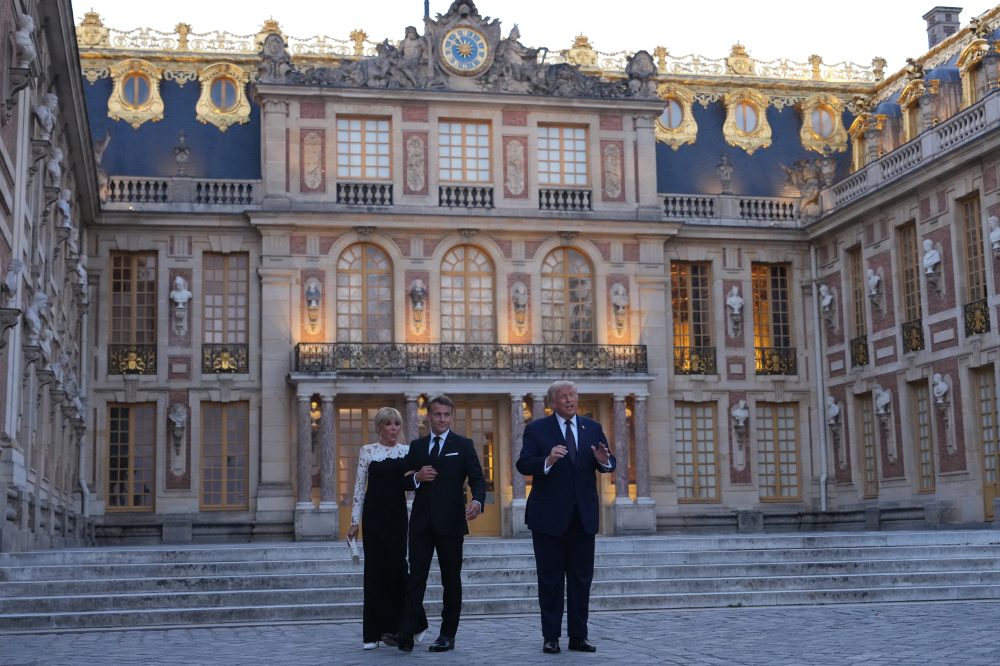

PARIS (AP) — It could stand as one of Emmanuel Macron’s final major foreign policy achievements as France’s leader: drawing U.S. President Donald Trump to a historic evening at the Palace of Versailles, where Trump signed an initial agreement to bring the Iran war to an end.
But that dramatic moment was just one highlight from a G7 summit where Macron’s nearly decade-long experience on the world stage and the relationships he has cultivated paid off in significant ways.
Among the most notable accomplishments was persuading Trump to take a stronger stance in support of Ukraine’s fight against Russia — a significant victory for European leaders and Ukrainian President Volodymyr Zelenskyy, coming after a diplomatic stumble at the White House back in March 2025.
“Bravo,” Macron said following Trump’s signing of the Iran agreement. The signing caught most of the officials and guests at the Versailles Palace dinner off guard, and the room responded with applause.
Macron had framed the dinner as a celebration of the friendship between France and the United States. The unplanned signing ceremony turned it into a symbolic capstone to Macron’s week-long effort to bring Trump into greater alignment with European positions — potentially among his last significant achievements before his term concludes next spring.
Macron had described Versailles as an “instrument of influence” and suggested the exclusive invitation could help keep Trump engaged through the close of the G7 summit held in Evian. Trump had departed last year’s summit in Canada before it wrapped up.
The Palace of Versailles — which Trump praised as “not gold leaf” — has served as a venue for French leaders to welcome distinguished guests for more than three centuries.
Following the signing, Macron praised the Iran agreement as one that “allows for putting an end to the conflict, that allows peace, that allows the reopening of the Strait of Hormuz” and said it would likely lead to lower oil prices.
Macron was not part of the Iran war negotiations and cannot take credit for Trump’s decision to sign the deal. However, he secured the historic setting, helping to place Europe back into the spotlight of a conflict that the U.S. and Israel launched together without consulting their Western allies.
French Economy Minister Roland Lescure, who was present at the dinner, said the signing was largely unplanned and improvised.
Lescure said Trump announced during his remarks that he intended to sign the agreement. When asked whether Macron had prior knowledge, Lescure said he believed Trump had told the French president shortly before the moment arrived.
“But for us, ministers in the French government, it was a surprise,” Lescure told French radio RTL.
Trump arrived in France under domestic pressure over Iran, including criticism from some of his own allies about how he had handled the conflict and the deal taking shape. Sen. Lindsey Graham, one of Trump’s closest supporters and a longtime hardliner on Iran, had voiced skepticism about the agreement.
As negotiations with Iran moved forward, Trump sought support from G7 leaders, according to a European diplomat familiar with the discussions who spoke anonymously because they were not authorized to comment publicly. The G7 includes the United States, France, the United Kingdom, Italy, Germany, Canada, and Japan.
“We certainly gave him some reassurance on the Middle East,” the European diplomat said. “And President Trump, for his part, delivered for us on Ukraine.”
The G7’s statement on geopolitical matters described a “breakthrough” in the Middle East and mentioned Trump by name three times, praising what it called his “strong leadership.”
Trump has had tensions with Macron, British Prime Minister Keir Starmer, German Chancellor Friedrich Merz, and Italian Prime Minister Giorgia Meloni over his failure to consult them before deciding to go to war. He has also pushed back on those four NATO members for not supporting the U.S. in the conflict.
Macron, whose relationship with Trump has been bumpy since an unusually prolonged handshake nearly a decade ago, spent months preparing for the G7 summit through regular phone calls centered on both Iran and Ukraine.
On the sidelines of the summit, Trump met with Zelenskyy, who showed him photographs documenting the destruction caused by Russian bombing of the Dormition Cathedral in Kyiv.
Macron has at times expressed wariness about Trump’s shifting stances, particularly when it comes to Russia and President Vladimir Putin. But European officials argued that the written commitments made this week carry more lasting weight because Trump himself approved the language.
“America is with us on Ukraine. That is very important,” Macron said after Trump joined a three-way phone call with Zelenskyy from Versailles.
G7 leaders agreed in a joint statement to step up deliveries of air-defense systems and long-range weapons to Ukraine. They also committed to ramping up pressure on Russia through tougher sanctions, including measures aimed at the country’s oil and gas industries.
Macron also used the summit as an opportunity to raise the issue of Lebanon’s future with Trump. France has deep historical ties to Lebanon and has worked to keep international attention focused on Lebanese sovereignty. During discussions in Evian, Trump repeatedly expressed sympathy toward Lebanon while criticizing Israel and describing friction with Prime Minister Benjamin Netanyahu.