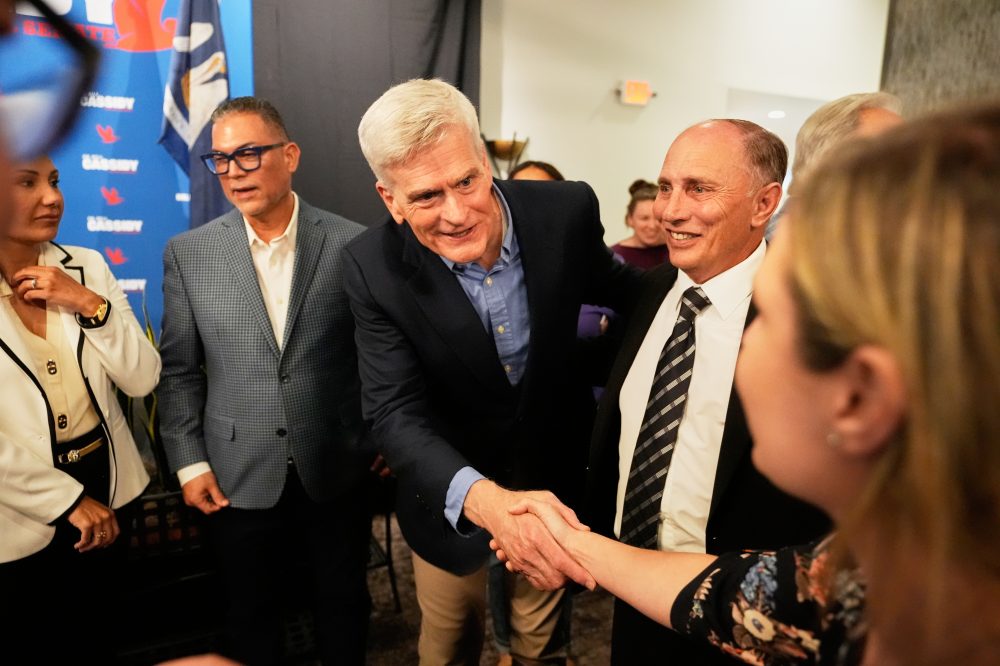

NEW ORLEANS (AP) — Louisiana’s Republican primary on Saturday has become a crucial test for U.S. Sen. Bill Cassidy, who faces a formidable challenge from a candidate endorsed by President Donald Trump in what represents Trump’s latest effort to remove lawmakers he considers disloyal from the party.
Trump has thrown his support behind U.S. Rep. Julia Letlow in her bid to unseat Cassidy, marking an uncommon move by the president to target a sitting senator. Cassidy’s decision to vote for Trump’s conviction during his second impeachment proceeding, which arose from the January 6, 2021 Capitol attack, has put him at odds with the former president. The senator, who has a medical background, has also disagreed with Health Secretary Robert F. Kennedy Jr. regarding vaccination policies, despite providing key backing for Kennedy’s confirmation.
State Treasurer John Fleming rounds out the field as the third contender. Should no candidate secure at least 50% of the vote, a runoff election will take place on June 27.
Given Louisiana’s strong Republican tendencies, the primary winner is virtually guaranteed to prevail in November’s general election.
Recent complications arose from a U.S. Supreme Court ruling that weakened portions of the Voting Rights Act affecting congressional redistricting. While the Senate primary proceeds as scheduled, state officials chose to postpone House primaries to allow time for redrawing district boundaries, potentially creating voter confusion on Saturday.
Cassidy has mounted an intensive effort to persuade voters not to dismiss his candidacy.
“Four months ago I would have told you it’s impossible for Cassidy to win this,” said Mary-Patricia Wray, who has consulted for Republican and Democratic candidates in Louisiana. “I still think it’s statistically unlikely, but no longer impossible.”
Paul Begue, a 41-year-old New Orleans resident working in agriculture, indicated his intention to support Cassidy. He expressed concern about a video showing Trump describing Letlow as “as loyal as can be,” which Begue called “the final nail in the coffin.”
“I don’t care about her loyalty to President Trump,” he said, adding, “I like elected officials that seem to make their own decisions.”
Campaign spending figures show Cassidy’s team investing approximately $9.6 million in advertising through May 16, according to AdImpact, an advertising tracking company. Louisiana Freedom Fund, a super PAC supporting his candidacy, is projected to spend $12.3 million.
In contrast, Letlow’s campaign, which began January 20, has invested roughly $3.9 million, while the Accountability Project, a super PAC backing her candidacy, has spent about $6 million during the same period.
Fleming’s campaign has allocated approximately $1.5 million for advertising.
Shortly after Letlow announced her candidacy, Cassidy and Louisiana Freedom Fund launched advertisements criticizing her past support for diversity, equity and inclusion programs, which Trump has sought to eliminate from federal operations.
Before her House election, Letlow worked as a college administrator and expressed support for DEI during her 2020 interview for the University of Louisiana-Monroe presidency.
These advertisements represent Cassidy’s strategy to portray Letlow as a liberal disguised as a conservative, attempting to change the narrative in a race where Trump opposes him.
Cassidy’s impeachment vote regarding the January 6 Capitol incident has remained a significant issue throughout his second Senate term.
John Martin, a 68-year-old retired engineer from south Louisiana, plans to vote for Letlow due to lingering anger over Cassidy’s impeachment decision. He displayed a campaign flyer showing Letlow with the president.
“I know a lot more about Cassidy than I do about her,” Martin said. “But if she’s endorsed by Trump, I’m going to believe that.”
Last year, Cassidy avoided Trump’s criticism by supporting Kennedy’s nomination to lead the Department of Health and Human Services, despite publicly questioning the nominee’s anti-vaccination positions.
Mark Workman, a 75-year-old retired infectious disease physician from the New Orleans area, supports Fleming. He stated that if Cassidy had “stood up and blocked RFK,” he would have backed the senator for taking a principled position.
“He had the ability to stop him,” Workman said, “and he was too weak to do that.”
In his role as Senate health committee chairman, Cassidy has been more openly critical of Kennedy, particularly regarding proposed reductions in vaccine development funding.
Trump held Cassidy responsible for derailing his second surgeon general nominee, Casey Means, who questioned the practice of vaccinating newborns against hepatitis B, a procedure Cassidy endorses.
After withdrawing the Means nomination, Trump criticized Cassidy harshly.
“Hopefully all of the Great Republican People of Louisiana, which I won, BIG, three times, will be voting Bill Cassidy OUT OF OFFICE in the upcoming Republican Primary!” Trump posted on social media.
Republican Gov. Jeff Landry’s decision to delay congressional primaries may hurt Cassidy’s chances. Wray suggested this could reduce turnout among voters who are less enthusiastically pro-Trump, particularly if scheduling confusion occurs.
“Suspending the congressional primaries hurts Cassidy,” she said. “Some people believe the Senate primary is canceled.”
On Friday, Cassidy criticized the new primary system implemented last year for confusing voters by requiring them to request partisan ballots instead of using the previous all-party primary format. He reported receiving calls from constituents unable to vote for him.
“The process that was set up was destined to be confusing,” Cassidy told reporters.
Letlow contemplated running last year but only entered after Trump announced his January endorsement.
By then, Fleming, a former House member and Trump administration official elected state treasurer in 2023, was already campaigning as a Trump supporter. However, Landry sought a more recognizable challenger and recommended Letlow to the president.
Letlow’s political career began under tragic and unusual circumstances.
In 2020, while working as a college administrator, her husband Luke won election to the U.S. House but died from COVID-19 before taking office. Letlow successfully ran for and won the seat in a March 2021 special election, earning reelection in 2022 and 2024.