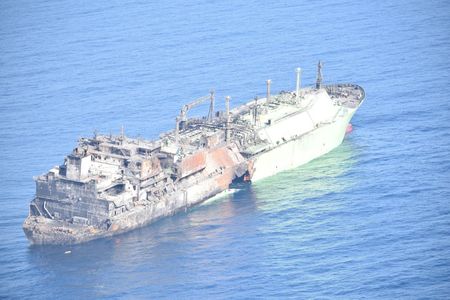

A Qatari tanker carrying liquefied natural gas, known as LNG, faced the possibility of an explosion after sustaining serious damage during an attack on the Omani side of the Strait of Hormuz on Tuesday, according to one source.
Although the LNG industry has seen accidents at land-based facilities over the years, a catastrophic explosion of an LNG cargo tank aboard a commercial vessel at sea has never occurred. Still, growing concerns have emerged as warring parties in both the Ukraine and Iran conflicts have increasingly targeted energy shipping vessels.
Tuesday’s attack on the tanker Al Rekayyat is the second time this year an LNG ship has been drawn into a war-related incident. Back in March, a Russian LNG tanker called the Arctic Metagaz caught fire in the Mediterranean Sea after being struck by Ukrainian naval drones, forcing its crew to abandon ship — an account provided by Russia’s transport ministry.
What exactly is LNG, and how is it transported?
LNG is natural gas that has been chilled to approximately minus 162 degrees Celsius, or minus 260 degrees Fahrenheit. That extreme cooling converts the gas into liquid form and reduces its volume by roughly 600 times, which makes it far more practical and cost-effective to ship across oceans.
The liquid is held in heavily insulated cryogenic tanks that maintain those extremely cold temperatures. At export terminals, the LNG is loaded onto specialized carrier ships built with double hulls and insulated cargo tanks engineered to keep the gas cold for the entire journey.
During transport, a small portion of the LNG naturally evaporates. If not managed, this so-called boil-off gas builds up pressure inside the tanks. Ships typically capture this gas and use it as fuel for their engines.
What dangers does LNG pose?
In its liquid state, LNG does not burn. The danger emerges if LNG leaks, warms up and converts back to gas, blends with air at the right ratio, and then encounters an ignition source.
To guard against these risks, LNG vessels are equipped with double-hull construction, multiple containment barriers, gas detection systems, pressure-relief equipment, emergency shutdown systems, firefighting tools, and strict operational protocols backed by thorough crew training.
Could the Al Rekayyat actually explode?
The Al Rekayyat reported a fire in its engine room, and a source indicated the ship was at risk of exploding — though there was no sign that the LNG cargo tanks had been breached. All crew members were evacuated without injury.
In theory, any LNG carrier could face catastrophic risk if damage causes a large LNG release, forms a flammable gas cloud, and that cloud reaches an ignition source. However, modern LNG vessels are built with multiple layers of protection specifically designed to stop any ignition from reaching the cargo tanks. Industry experts emphasize that an engine room fire does not automatically lead to an explosion.
The danger would grow significantly if the fire were to spread to the cargo systems, damage the containment tanks, or trigger a major LNG leak.
One industry source said Wednesday that as long as the Al Rekayyat does not come under any additional attack, the vessel would likely remain in its current condition and not explode.