
KYIV, Ukraine (AP) — There’s a grim joke that circulates among the people of Kyiv’s historic Lukianivka neighborhood: Russian attacks come so often that residents joke they should be handed military service papers, as if they were stationed on the front lines of the war.
When real estate agent Dmytro Zhekov tries to attract renters to one of the Ukrainian capital’s most frequently struck areas, he doesn’t sugarcoat the situation. His social media listings tout the neighborhood’s genuine advantages — lower rents, proximity to the city center, a convenient metro line and historic sites — but he leads with a warning.
“From the beginning I tell them, ‘This is a place in the danger zone. It gets hit regularly. If you are all right with that, then we can see it,’” he said.
At the heart of the danger is a Soviet-era weapons factory whose roof has been blackened by repeated bombardments, making it one of Russia’s most consistent targets in Kyiv. Just across the street, the Lukianivka metro station — which lends the neighborhood its name — has been struck at least eight times. During air raid warnings, that same station becomes a refuge for local residents. Craters have become a fixture of the surrounding streets.
For people living here, the question is no longer whether another strike will come, but when. Life in Lukianivka means reopening a shop next to the scorched remains of a market, cutting hair in buildings scarred by shrapnel, moving theater productions into basements and choosing to rebuild instead of flee.
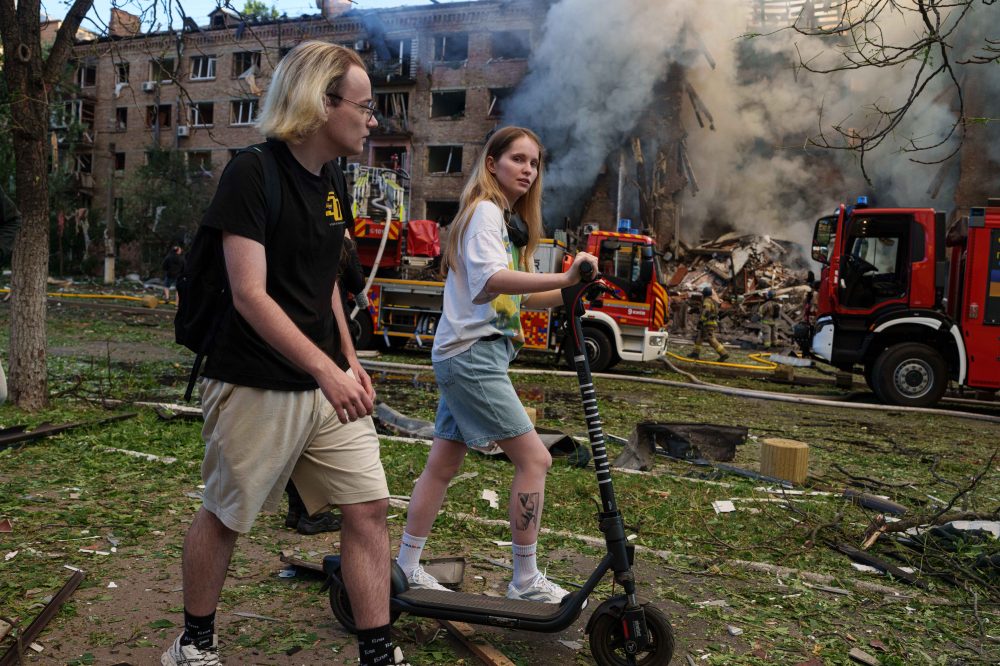
Between attacks, residents sweep broken glass from the pavement, cover shattered windows with boards and press on. After another Russian missile barrage struck on Sunday, that familiar routine started all over again.
“After every attack, I walk down the main street, and it feels like watching a wound widen,” said resident Vladyslav Darmohrai.
Lukianivka’s central road, Dehtiarivska Street, traces a portion of the ancient Via Regia — the medieval trade route that once guided merchants into Kyiv over the course of centuries.
In later years, the neighborhood developed into a working-class area of factories, markets and the Lukianivka prison, whose notable inmates have included former Prime Minister Yulia Tymoshenko. She spent two and a half years behind bars after striking a gas agreement with Russia — a case widely seen as political payback by her rival, then-President Viktor Yanukovych.
The neighborhood has been shaped by successive chapters of history, from Soviet industrialization to Ukrainian independence and now relentless Russian bombardment. Today it also houses many residents who were displaced from other parts of the country by the war.
Ukraine’s first McDonald’s, which opened in Lukianivka in 1997, became an early emblem of the post-independence era. Today, diners eat beneath a plastic sign permanently warped by the heat generated from nearby Russian strikes.
“It’s part of our history now,” said historian Kyrylo Stepanets.
The neighborhood’s position as a historic crossroads gave birth to the Lukianivka market, which had served the community since the late 19th century — until a Russian strike on May 24 reduced it to ruins.
What remains is a charred labyrinth of stalls, frozen in the moment of destruction. Blackened loaves of bread still rest on the shelves of what was once a bakery.
For many locals, the market endures in memories of childhood — of being led by parents and grandparents through its bustling aisles to pick up fruit, flowers and everyday goods.
Alyona Lukianets, 32, spent 11 years growing her produce business there. When she returned after the strike, her stall was ash. Weeks later, she came back to work anyway.
Her new stall — cobbled together from wooden pallets and tarps outside the market’s burned-out shell — looks nothing like what she lost. Each morning, she still arranges her baskets of berries and fresh vegetables with the same attention to detail. The bitter smell of the destroyed market sometimes still drifts through the air behind her.
“I don’t know what it will take for us to leave this place,” Lukianets said. “We are unmovable.”
Julia Sosnovska had dreamed of having a dog ever since she moved into her Lukianivka apartment in 2022. Her landlords had refused for years. But after a devastating Russian strike in May, they finally agreed, and a brown dog named Perry became part of her life.
Displaced after Russia seized control of the southern city of Mariupol, Sosnovska chose Lukianivka for its low rents, even knowing her apartment looked out over the Artem weapons factory.
Rents in the neighborhood begin at under $200 per month for a studio. One-bedroom units start around $270, and two-bedroom apartments can be found for roughly $310.
The Artem plant was originally founded in the late 19th century as an industrial machinery facility. It eventually became one of the Soviet Union’s premier arms manufacturers before transitioning into a key part of Ukraine’s defense industry after independence. Production ramped up after Russian-backed forces began seizing territory in eastern Ukraine in 2014.
Since Russia’s full-scale invasion, the factory has become one of Moscow’s primary targets in the capital. Russia contends the plant is still manufacturing weapons. Ukraine has neither confirmed nor denied that claim, with wartime restrictions preventing officials from commenting on military production.
Residents sometimes wonder whether it would be safer to move production elsewhere — but few believe that would help much, since Russian missiles have struck every district across Kyiv.
Instead, people have adapted to cleaning up after strikes. Some property owners even keep extra windowpanes on hand, according to Zhekov, the real estate agent.
When the latest barrage hit on Sunday, Sosnovska was jolted awake by a blinding flash outside her bedroom window, followed immediately by the sound of shattering glass. Her first thought was to find Perry, who had fled her bed in a panic. She grabbed the trembling dog along with her documents and laptop and joined neighbors sheltering in the building’s underground parking garage as more explosions rang out.
By morning, her apartment windows had been blown out and her car had been damaged. She counted herself lucky. “Glass is the least you can lose in these attacks,” she said.
Still, she is staying in Lukianivka. “Where else would I go? You never know which place will be next,” she said.
Vitalii Zhdaniuk opened a barber school in Lukianivka because he loved the area. The building is riddled with shrapnel marks, and a chunk of brick thrown from a nearby auto repair shop during a Russian strike last year is still lodged in the wall.
“No matter how many missiles fly here,” he said, “I’ll stay.”
Just behind the Lukianivka metro station sits the Mala Opera, a theater that has long been a cornerstone of Kyiv’s cultural scene. The threat of missile strikes has forced performances underground, leaving the main auditorium dark and empty.
It is in that basement space where Director Mykhailo Miskun is staging his newest production.
“When the war began, we set ourselves one task: to perform comedies,” Miskun said. “We want to lift the spirits of the people who come to us.”
His latest play centers on romance, relationships and squabbling neighbors — topics chosen deliberately to give audiences a brief mental escape from the war.
The company has adjusted to the ongoing threat by holding rehearsals online and gathering in smaller venues. After a recent Russian strike, the troupe briefly debated whether to leave. They chose to stay “despite everything,” Miskun said.
Outside, audience members line up to descend into the basement as the evening’s show prepares to begin.
“We live. We create. We give birth,” Miskun said. “Just like any part of Ukraine, Lukianivka is also being restored and continues to live.”