
BOSTON (AP) — Voting rights advocates and representatives from two dozen states presented their case Tuesday before a federal judge, seeking to block President Donald Trump’s executive order that would establish a national voter database and impose restrictions on mail-in voting.
In separate legal challenges, the groups contended that Trump’s directive — designed to ensure only citizens participate in elections — violates the Constitution by giving the president authority that belongs to states and Congress. They warned the court that implementing the order would create expensive burdens for state election administrators and could intimidate officials with threats of prosecution.
“This is going to be a sea change in way that some states administer their ballots,” said Michael Cohen, who was part of a team representing California, adding that “it will be difficult to overstate the disruption that this will cause.”
The American Civil Liberties Union, representing the League of Women Voters in a separate case, has described the order as “a dangerous attempt to disenfranchise eligible voters nationwide.” The organization claims the directive converts “the U.S. Postal Service from a neutral mail carrier to an arbiter of who may cast a ballot by mail.”
“This case challenges an extraordinary and abusive assertion of executive power over the administration of federal elections,” the organization stated in its legal filing.
Tuesday’s proceedings follow another judge’s decision last week to reject a similar request to suspend the order. U.S. District Judge Carl Nichols, appointed by Trump and based in Washington, sided with the Republican administration’s position that blocking the order would be premature since implementation has not yet begun.
The Trump administration’s legal team argued in their dismissal motions that the challengers do not have proper standing to file their complaints. They also contended the requests are too early and that the groups lack proper legal grounds for their Administrative Procedure Act claims, which govern federal agency rule-making processes.
Stephen Pezzi, representing the Trump administration, characterized the alleged harms cited by opponents as speculative, noting that significant changes could occur with the voter database before completion. He assured the court that no prosecutions would result from violations of the executive order.
Missouri Solicitor General Lou Capozzi, speaking on behalf of states that support the database, maintained it was premature to determine how his state might utilize the system but called it “unlikely” that any voters would be removed from registration rolls this year because of it.
“We are not exactly sure how we would use it,” Capozzi stated, adding that “we don’t want this process to be strangled in the crib so to speak.”
U.S. District Judge Indira Talwani said she would consider both the requests to block the order and the motions seeking case dismissals.
During the courtroom proceedings, Talwani voiced worries about whether the federal system could be operational for approaching elections and potential risks for election workers who depend on state lists that differ from the federal version. She also questioned the accuracy of a federal database — pointing out, for instance, that women who changed surnames after marriage or individuals who relocated between states might not be included.
“Isn’t there a reasonable fear and concern on behalf of voters that they will be precluded?” Talwani inquired.
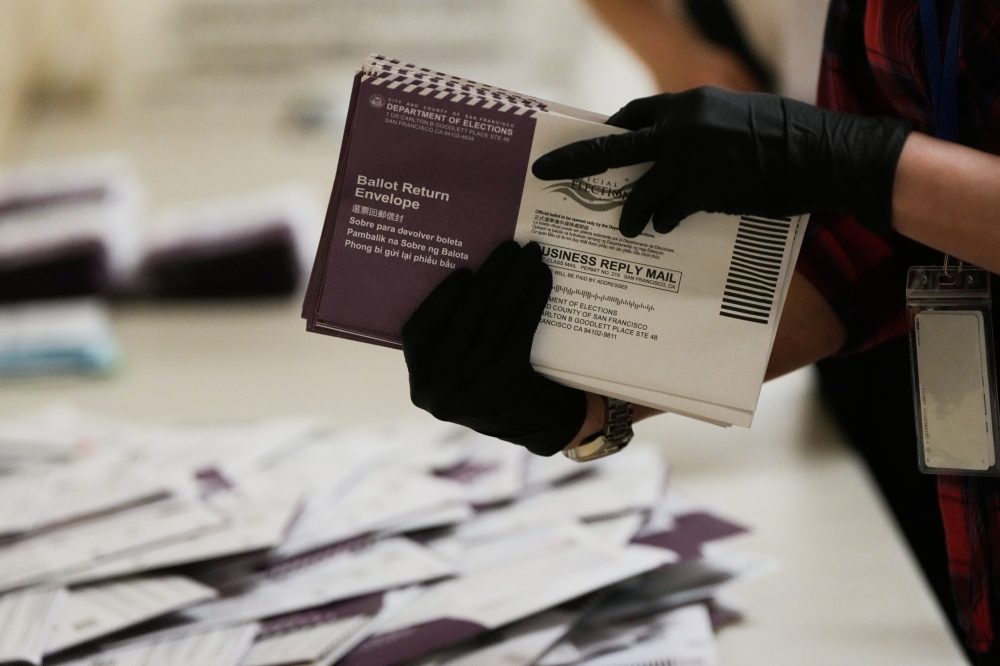
Trump signed the order in March following the stalling of voting reform legislation he had endorsed in Congress. The directive would require the federal government to compile a registry of qualified voters and instruct the Postal Service to deliver mail ballots exclusively to individuals on that registry. Election administrators have warned the plan could lead to misuse and create disorder, while the postal workers’ union has opposed the concept of mail carriers monitoring ballots.
The Postal Service has released a proposed regulation mandated by Trump’s executive order in the Federal Register. The rule would exclude primary elections and overseas ballots from its requirements, among other provisions.
Following his 2020 presidential defeat to Democrat Joe Biden, Trump has repeatedly made unsubstantiated claims that mail-in voting involves widespread fraud and has initiated a federal probe into that election, despite numerous audits and investigations — including Republican-led ones — confirming it was conducted without significant fraud. Trump has also expressed intentions to “take over” election oversight in Democratic regions.