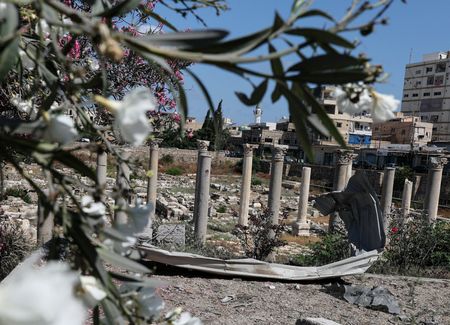

TYRE/BEIRUT, Lebanon — An ancient column at a UNESCO-listed site in Lebanon’s port city of Tyre had its crown blown off. A pilgrimage site sacred to both Muslims and Christians was leveled in another southern town. A historic market from the Mamluk era in the city of Nabatieh was struck by Israeli bombs, and centuries-old villages along Lebanon’s border were bulldozed by Israeli forces.
Lebanese Culture Minister Ghassan Salame told Reuters that Israel’s roughly four-month air and ground campaign — which Israel said was aimed at the Iran-backed armed group Hezbollah — has left a trail of destruction through some of southern Lebanon’s most treasured heritage sites.
Even though a ceasefire went into effect a week ago, authorities still cannot get a complete picture of the damage. Israeli forces remain in control of a zone stretching about 10 kilometers, or roughly 6.2 miles, into Lebanese territory, and Lebanese officials are barred from entering. “We cannot work under the shadow of occupation,” Salame said.
Within that restricted zone lies the medieval Beaufort Castle and numerous ancient villages that were home to Christian, Shi’ite Muslim, and Sunni Muslim communities, along with their houses of worship. “There are villages that have been completely bulldozed,” Salame said.
Historic towns located outside the occupied zone also suffered heavy bombardment. Tyre and Nabatieh both sustained significant damage from airstrikes. The town of Tebnin was heavily bombed, raising fears that its Crusader-era fortress may have been damaged as well, according to Salame.
“Heritage is not only Roman and Phoenician antiquities,” Salame said. “Heritage is also historic buildings, archaeological sites, and buildings with a cultural function.”
When asked by Reuters for comment, the Israeli military said it does not seek to “cause excessive damage to civilian infrastructure and strikes only out of military necessity, with consideration for the safety of its citizens” — referring to residents of northern Israel, which Hezbollah has attacked. The military added that it takes into account the presence of “sensitive sites” and follows “a rigorous approval process as required.” Israel has also accused Hezbollah of storing weapons inside Beaufort Castle, a claim Lebanese authorities reject.
Modern-day Lebanon sits at the crossroads of multiple ancient civilizations — including the Phoenicians, Byzantines, Mamluks, and Crusaders — each of which left behind temples, castles, and mausoleums. Tyre, nearly 5,000 years old, is home to Roman ruins that reflect this rich layered history. The city, originally built as an island fortress, was permanently joined to the mainland by Alexander the Great during his conquest.
Tyre has endured many conflicts throughout the centuries, but the recent war has left much of the city in ruins. Dust-covered cars with shattered windows sit near ancient columns that were once erected in honor of long-forgotten gods. Protective barriers put in place to shield the ruins from strikes or shrapnel were found blown into the middle of the very sites they were meant to guard.
“Look at the damage that happened to it, it’s as if it all exploded from underneath, as if an earthquake hit it,” said Adnan Istanbouli, an official from Lebanon’s antiquities department, while standing near a Roman mosaic.
Alwan Charafeddine, deputy mayor of Tyre, said the city “is supposed to be one of the cities that is internationally protected, or that should never be targeted in any way, in any conflict.”
The United Nations Educational, Scientific and Cultural Organization (UNESCO) issued a statement last month expressing concern over the condition of Tyre, which holds World Heritage Site status and has been granted the organization’s enhanced protection designation. UNESCO also said it was “deeply alarmed” by reports of damage to a citadel in the southern town of Chama and by fighting near Beaufort Castle, condemning what it called “unlawful attacks against cultural property.” The agency had previously raised similar concerns about historical sites in Iran in March.
After Israeli bombing reached the ruins of Tyre, Salame formally requested that UNESCO reclassify the site as a World Heritage Site in Danger — a designation that would place greater responsibilities on UNESCO and the broader international community to act. As of now, that reclassification has not been granted.
Earlier in the conflict, Israel’s Defense Minister stated that Israel would demolish all homes along Lebanon’s border with Israel. Salame expressed fear that Israel’s campaign could permanently wipe out centuries of Lebanese history. “There is something systematic: a systematic destruction of villages, hamlets, and entire towns,” he said.