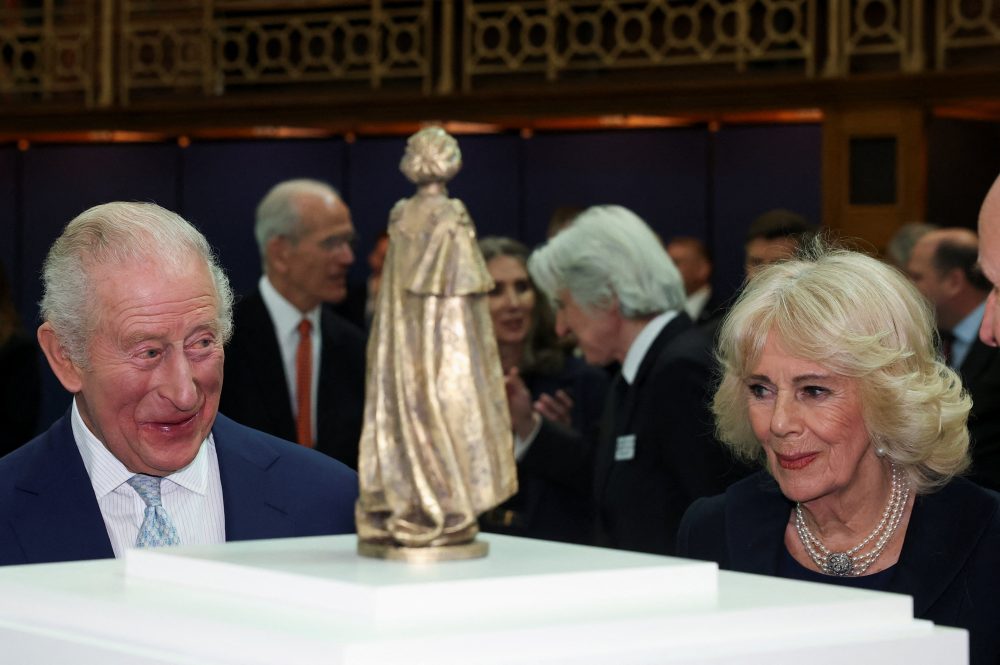

King Charles III faces the ongoing challenge of matching his late mother’s diplomatic legacy as he begins a significant state visit to America this week.
Queen Elizabeth II delivered a memorable address to Congress in 1991 that honored the shared democratic values between Britain and America, referencing Abraham Lincoln, Franklin D. Roosevelt and Ralph Waldo Emerson while emphasizing the strong ties connecting both countries.
Charles will focus on similar themes during his visit as he marks America’s 250th anniversary and works to ease diplomatic friction over Prime Minister Keir Starmer’s decision not to back President Donald Trump’s military campaign against Iran, according to Douglas Brinkley, a presidential historian at Rice University in Texas.
“We’ve got to always make the distinction that there’s a difference between the government of the U.K. and the kings and queens of Great Britain, who are really always coming to try to put (on) a good face,” Brinkley told The Associated Press. “Politics come and go, prime ministers, presidents, come and go, but there’s something deeper about the special relationship between the United States and the U.K.”
Behind the ceremonial aspects of Charles’ four-day journey through Washington, New York and Virginia lies a strategically planned diplomatic mission organized, like all royal visits, upon the British government’s request. Starmer rejected calls to postpone the trip despite Trump’s criticism of British military contributions in Afghanistan and personal attacks on the Prime Minister for not supporting American actions in Iran.
Nevertheless, Trump continues to express positive feelings toward Charles personally.
“History has shown that President Trump really tries to be impressive whenever he’s dealing with British royalty,” Brinkley said. “And I’m sure it’ll be the same this time around.”
Since 1939, when King George VI made history as the first British royal to visit America, these visits have generated unique enthusiasm among Americans.
That inaugural visit occurred as World War II threatened Europe. The royals toured the eastern United States and joined Roosevelt for an informal gathering at his Hyde Park, New York residence. “King tries hot dog and asks for more,” reported the New York Times.
The most significant moment came when the royals visited Mount Vernon to honor George Washington at his tomb, demonstrating respect during America’s isolationist period.
“People could see the handwriting on the wall and know that it was going to be important for the United States and Britain to stay strong for fighting against Hitler,” said Barbara Perry, a presidential scholar at the University of Virginia’s Miller Center.
However, sharing casual meals created broader connections, helping the royals establish relationships with ordinary Americans beyond political leaders. When war began in September 1939, Queen Elizabeth, George VI’s wife and future Elizabeth II’s mother, corresponded with first lady Eleanor Roosevelt about touching letters from Americans who donated money for British forces.
“Sometimes, during the last terrible months, we have felt rather lonely in our fight against evil things, but I can honestly say that our hearts have been lightened by the knowledge that friends in America understand what we are fighting for,” she wrote.
Queen Elizabeth II expanded these relationships through four state visits during her seven-decade reign. She joined President Gerald R. Ford for America’s bicentennial celebration in 1976 and met President George W. Bush in 2007 while British and American troops served in Iraq and Afghanistan.
These visits consistently aimed to calm diplomatic tensions and highlight shared values between the nations.
Charles’ trip will follow this tradition, featuring a September 11th memorial event, a ceremony for fallen soldiers, and Queen Camilla will attend a celebration marking the centennial of A.A. Milne’s Winnie the Pooh stories.
Controversial topics will be deliberately avoided.
The royals will not meet Jeffrey Epstein’s victims, despite requests for the king to address his brother’s connections to the convicted criminal. Charles also has no scheduled meetings with his son Prince Harry, who has criticized the monarchy since relocating to California and abandoning royal responsibilities.
These matters aren’t the focus, explained Robert Hardman, author of “Elizabeth II: In Private. In Public. The Inside Story.”
“He’s going because 250 years ago the Founding Fathers of the USA kicked out his great-times-five grandfather, and he’s going to say, ‘No hard feelings, it’s been a great divorce, we’ve had a lovely 250 years and let’s reflect on the high points,’” Hardman said. “I mean, there are going to be some very, very large elephants in the room during that visit … but, you know, there are plenty of other things for the king to focus on.”
Charles’ congressional address provides an opportunity to emphasize that lasting friendship outweighs temporary disagreements.
He will likely include humor, as his mother did when addressing lawmakers in 1991.
Dressed in soft peach among the gray-suited legislators, the petite queen opened with a joke about the previous day’s White House mishap, when her podium was too high for the audience to see her.
“I do hope you can see me today from where you are,” she said with perfect timing.
The room burst into laughter and applause before she delivered her remarks about democratic principles, legal foundations and the Atlantic partnership.
Charles must present his own interpretation of these concepts, Brinkley noted.
“The theme of the speech is going to be American exceptionalism, American history, the importance of U.S.-British alliance, and some memories from the past,” he said. “But also about the love affair the two countries share with each other, even though it goes over rocky rapids from time to time.”