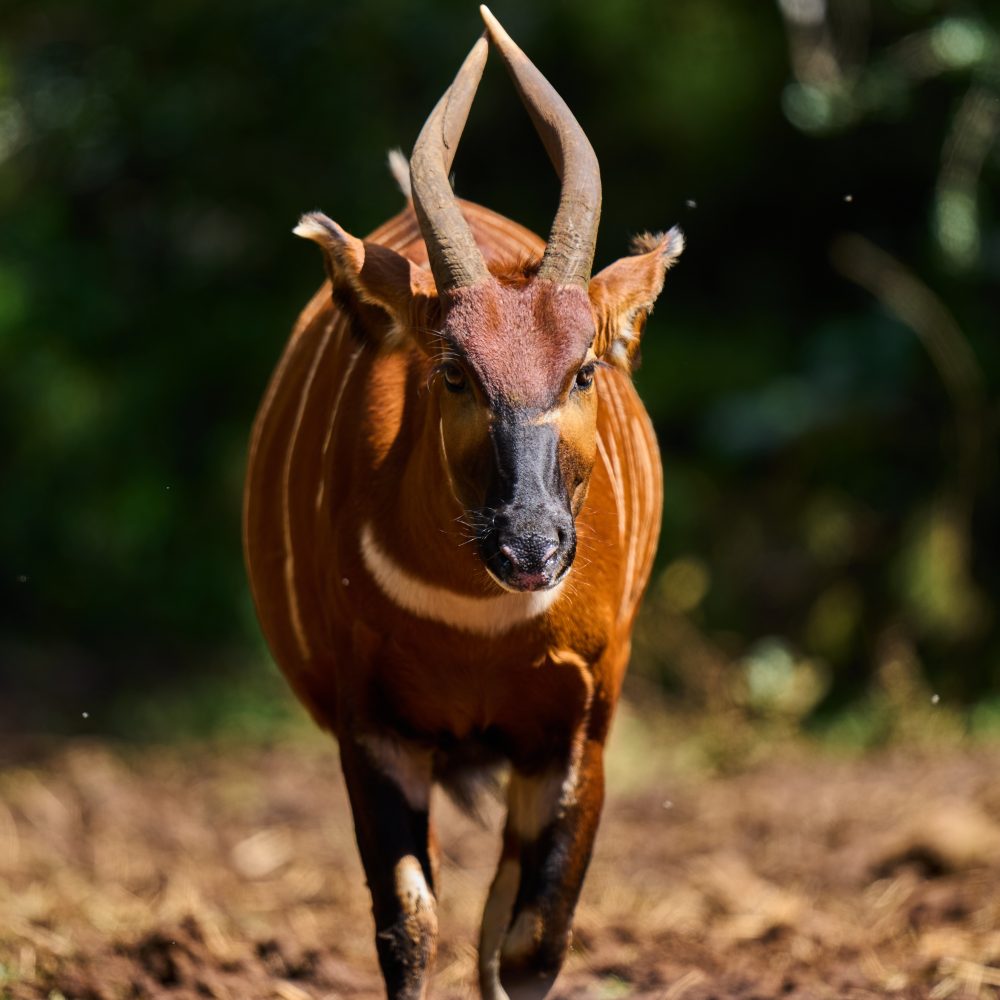

NANYUKI, Kenya (AP) — Known as the phantom of Kenya’s forests, the mountain bongo earns its nickname through remarkable camouflage abilities that help it blend seamlessly into thick vegetation.
This critically endangered antelope species is now the focus of an ambitious conservation effort aimed at boosting the population of these native Kenyan forest dwellers through careful reintroduction programs.
Distinguished by their rich brown coats adorned with striking white stripes, mountain bongos number fewer than 100 in their natural habitat. A Kenyan conservation facility is working to breed these magnificent creatures and gradually release them back into the wilderness, setting an ambitious goal of 750 wild bongos roaming free by 2050.
Nestled on the foggy mountainsides of Mount Kenya and bordering pristine forest land, the Mount Kenya Wildlife Conservancy spans 1,250 acres in the Nanyuki region. Here, staff members work to rebuild the natural survival skills of zoo-raised bongos, teaching them to forage independently, evade predators, and develop resistance to wild diseases.
The facility recently welcomed four male bongos from the European Association of Zoos and Aquaria via the Czech Republic. These newcomers remain in quarantine under careful monitoring before they will breed with offspring from 18 bongos that came from the United States in 2004, creating a healthier genetic mix.
According to conservancy director Dr. Robert Aruho, preventing inbreeding among genetically similar animals is crucial for successfully rebuilding this endangered population.
“We want bongos that are not only strong in body, but strong in the genes they pass to the next generation,” he said.
These antelopes originally inhabited Kenya’s Mount Kenya, Aberdare, Eburu and Mau forest regions, which serve as crucial guardians of woodlands essential to the nation’s water resources.
The final wild bongo sighting in Mount Kenya’s forest occurred in 1994, decades before the conservancy successfully released the first group of 10 bongos back into their natural environment in 2022. These animals now wander freely among orange climbing vines and bushes that make up their preferred vegetation.
Disease epidemics during the 1960s devastated bongo numbers, killing thousands of the animals. Conservationist Don Hunt shipped 36 of these creatures to America in the 1980s as a safety measure, planning to breed them in controlled environments until wild conditions became suitable for their return.
Following the Mount Kenya Wildlife Conservancy’s establishment in 2004, 18 descendants of Hunt’s original bongos arrived and began reproducing, expanding the facility’s current population to 102 animals.
Local resident Caroline Makena, 33, recalls childhood tales from her grandmother about bongos being prized as bush meat in their community. Despite these stories, Makena never encountered one until beginning work as a gardener at the conservancy.
“I never knew the bongos were this beautiful, and I think my community loved them not just for the meat but because of their beauty,” she said.
Their timid nature and camouflage capabilities, despite those distinctive white markings, prove essential for wilderness survival.
Andrew Mulani, who assists with the bongo program, explains that animals undergo months of observation before wild release to identify the most cautious individuals, since tame creatures would become easy prey.
His greatest satisfaction came when a fourth calf was born in the wilderness last year, proving these antelopes are flourishing in their ancestral home and confirming population growth potential.
Nine-month pregnancies slow population recovery efforts, while bongos show greater sensitivity to certain plants and weather patterns compared to other antelope species sharing their ecosystem.
While Mount Kenya’s conservation team works urgently to rescue this endangered species by supplementing their natural shrub diet with specially formulated nutritious pellets, thousands of annual visitors admire their spiral horns and hope this forest phantom will once again become a regular sight throughout Kenya’s woodlands.